



Flame Veneer Drawers
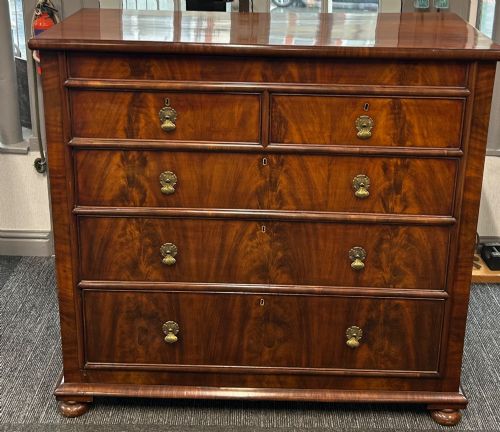
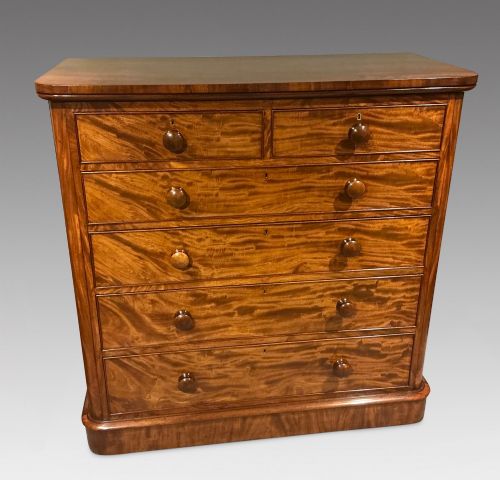
Flame veneer drawers bring striking figure and rich mahogany tones into a room, offering both practical storage and exceptional visual warmth.
Flame Veneer Drawers
When you search for flame veneer drawers, you are looking at case furniture finished in timber selected for its distinctive fire-like grain pattern. These pieces predominantly take the form of chests of drawers, commodes, and tall chests dating from the nineteenth century, including Regency and Victorian periods.
You are most likely to meet mahogany chests of drawers finished with dramatic flame mahogany veneer on this page. Examples span English workshops and continental makers, including Swedish Biedermeier pieces that showcase pale birch or rich mahogany surfaces.
The selection ranges from compact early nineteenth-century commodes to large Victorian tall chests of five drawers. Each piece uses figured wood across the primary drawer fronts to create a bold aesthetic impact.
How they were made
Cabinet makers produced flame veneer drawers by slicing thin sheets of timber from the point where a branch joins the main trunk, revealing the characteristic rippled grain. These delicate veneers were then painstakingly laid over secondary woods such as pine or solid wood foundations.
Construction frequently relied on mahogany as the primary show wood, paired with turned wood details and brass handles. Carpenters matched and balanced the grain patterns across drawer fronts to create symmetrical visual effects.
Flame Veneer Drawers Retail Price Guide 2026
Typical asking prices for flame veneer drawers among the pieces listed under this phrase on Sellingantiques today, from the lower quarter to the upper quarter. They describe what is for sale here now, not the wider market.
The archive includes large Victorian chests with flame mahogany veneers.
What varies in quality
The visual strength and symmetry of the grain figure distinguish the finest flame veneer drawers from more plain examples. Cabinet makers who carefully matched the flame patterns across multiple drawer tiers achieved a far more harmonious facade.
The integrity of the timber preparation and the precision of the underlying carcase construction dictate the longevity of the piece. Superior examples maintain intact, smooth veneer surfaces without lifting, alongside well-fitted drawer structures.
R H & J Simpson
The Flame Veneer Drawers Glossary
- Flame mahogany veneer
- A thin slice of mahogany timber cut from the fork of the tree to produce a flame-like or feather-like grain pattern. This figure is prized for its decorative movement.
- Commode
- A low chest of drawers or cabinet originating from continental traditions, frequently seen in nineteenth-century Biedermeier pieces. These often feature prominent figured wood veneers.
- Compactum
- A large wardrobe or combined storage chest designed to hold various garments efficiently. These pieces often incorporate internal drawers behind panelled doors.
- Regency
- An English design period spanning the early nineteenth century defined by classical restraint and elegant proportions. Furniture from this era often highlights select timber grains.
Flame Veneer Drawers: Frequently Asked Questions
What is flame veneer?
Flame veneer is a decorative wood slicing taken from the junction of a tree branch and trunk. This specific cut creates a dramatic, fiery pattern used to ornament drawer fronts.
Cabinet makers applied these thin sheets over stable secondary timbers to achieve a luxurious finish without using solid figured logs throughout.
How do I date these chests?
Dating relies on stylistic markers, construction methods, and timber characteristics. Pieces on this page span the Regency and Victorian eras, alongside nineteenth-century continental examples.
Examining the drawer linings, handle styles, and secondary woods like pine helps narrow down the period of manufacture.
Where were Biedermeier chests made?
Biedermeier chests originate from central and northern Europe, with Swedish examples appearing frequently. These pieces date across the nineteenth century and lean towards clean architectural lines.
They often utilise rich mahogany or contrasting pale birch veneers to highlight the natural grain without excessive ornamentation.
How do I care for veneer?
Veneered furniture requires stable environmental conditions away from direct sunlight and severe temperature fluctuations. Excessive heat can cause the adhesive underneath to dry and the veneer to lift.
Dusting with a soft, dry cloth and occasionally applying appropriate furniture wax maintains the lustre of the mahogany surface.