

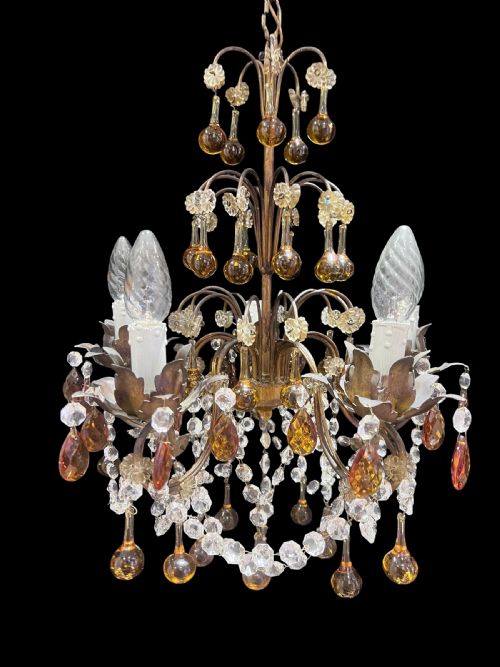
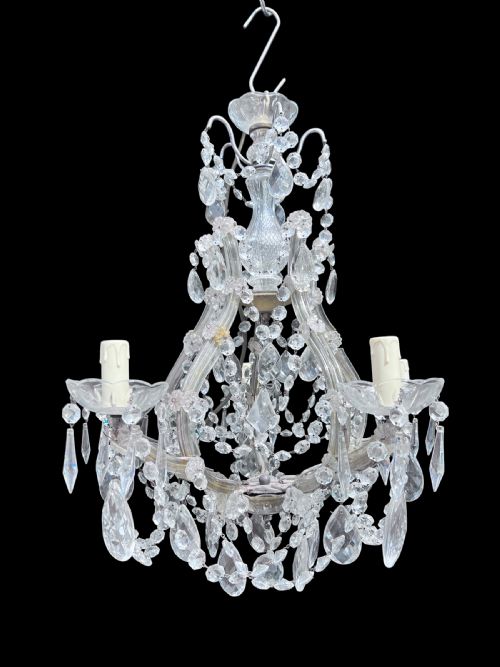


Five Arm Glass Chandelier
These five arm glass chandelier examples offer brilliant illumination and classic proportions, combining cut glass, crystal, and brass across several periods.
Five Arm Glass Chandelier
A five arm glass chandelier provides balanced overhead lighting through five distinct branches radiating from a central stem. These fixtures appear in forms spanning Edwardian, Art Deco, and earlier nineteenth-century eras, reflecting diverse regional aesthetics.
The selections here range from Italian antique designs featuring coloured crystals to French gilded and crystal pieces, alongside brass and glass combinations. Buyers will frequently encounter compact early twentieth-century examples alongside more ornate Italian and French variants.
Originating from periods including the 1920s, 1930s, and the nineteenth century, these chandeliers bring historical character into domestic spaces. Each piece relies on glass components, drops, and swags to refract light effectively across a room.
Materials and construction methods
Makers constructed these luminaires using glass, cut glass, and crystal suspended from frames of brass, gilt bronze, and gilt metal. The combination of metal armatures and reflective glass elements ensured structural stability alongside maximum light dispersion.
Techniques varied from the intricate cutting of crystal components and etched glass to the casting of bronze and brass frames. Frosted glass and coloured crystals further expanded the decorative repertoire available to period artisans.
Five Arm Glass Chandelier Retail Price Guide 2026
Typical asking prices for five arm glass chandelier among the pieces listed under this phrase on Sellingantiques today, from the lower quarter to the upper quarter. They describe what is for sale here now, not the wider market.
Listings feature pieces spanning from the eighteenth century through to the 1930s, utilising brass, gilt bronze, and cut glass.
Distinguishing quality levels
Quality reveals itself in the precision of the glass cutting, the clarity of the crystal, and the weight of the bronze or brass framework. Finer examples display deeply etched motifs, harmonious proportions, and integrated components rather than simpler cast substitutes.
The refinement of the mounting and the integration of swags, drips, and coloured crystals separate standard production from superior craftsmanship. Artisanal attention to the linkage between arms and the central stem governs the overall harmony of the fixture.
The Five Arm Glass Chandelier Glossary
- Cut glass
- Glass decorated by grinding facets or patterns into the surface using a wheel. This technique enhances light refraction.
- Gilt bronze
- Bronze coated with a thin layer of gold or gold-coloured alloy. It provides a durable, lustrous finish often found on fine frames.
- Crystal
- High-clarity glass containing lead oxide. It offers superior brilliance and heavier weight compared to standard glass.
- Swag
- A decorative chain or festoon of glass drops suspended between points on the chandelier. It adds graceful movement to the silhouette.
- Drop
- A pendant piece of glass or crystal hung from the arms or bobeche. Drops catch and scatter the light.
Five Arm Glass Chandelier: Frequently Asked Questions
How do I hang a five arm glass chandelier?
Installation requires securing the fixture to a structural ceiling joist capable of supporting the combined weight of metal and glass components. Professional wiring ensures that historical brass and bronze frames are safely connected to modern electrical supplies.
Adjusting the hanging height depends on the ceiling clearance of the room, typically positioning the lowest point above walkways or dining tables to maintain proper proportions.
What periods do these chandeliers come from?
The available fixtures span multiple eras, including Edwardian, Art Deco, the 1920s, the 1930s, and the nineteenth century. Each period brings distinct stylistic traits, from the linear geometry of Art Deco brass to ornate French gilt finishes.
Recognising these periods involves examining the metalwork techniques, the cut of the glass, and stylistic cues such as Baroque Palladian or French Rococo influences.
How should I clean a glass chandelier?
Maintenance involves gently wiping glass and crystal components with a mild cleaning solution while the fixture is unpowered. Detachable drops can be washed individually and dried thoroughly before reattachment.
Avoiding harsh abrasives protects the gilt bronze, brass, and delicate etched surfaces of the glass arms during the cleaning process.
Where do five arm chandeliers work best?
These chandeliers suit medium-sized rooms such as dining areas, entrance halls, or bedrooms where five branches provide adequate illumination without overwhelming the space. Their varied heights and compact dimensions accommodate different ceiling proportions.
Pairing the chandelier with compatible period furnishings enhances the overall decorative scheme of the interior.