
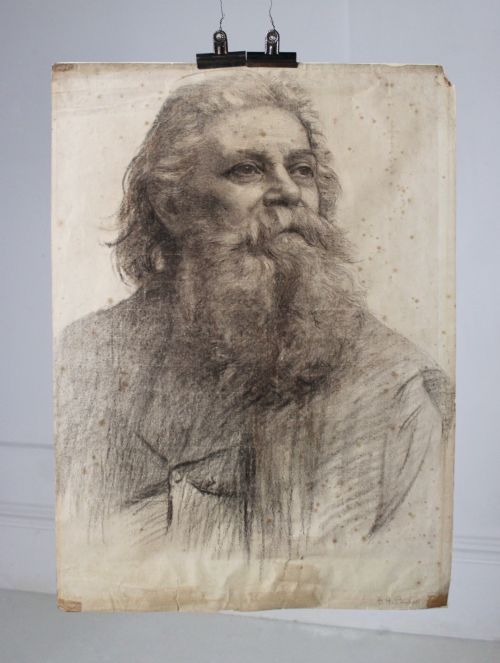
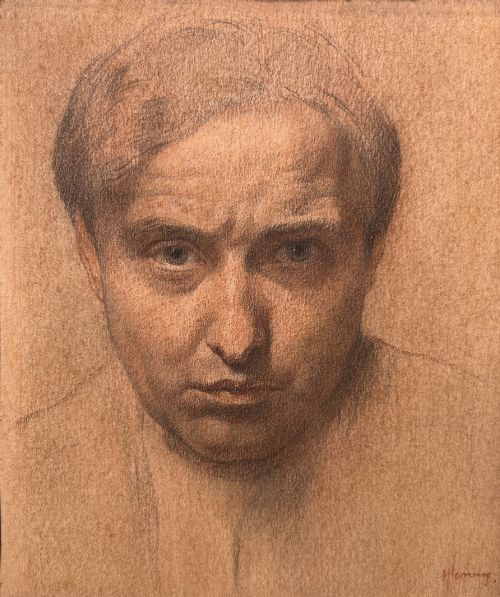


Figurative Charcoal Study
A figurative charcoal study captures the human form through direct draughtsmanship, offering an immediate record of the artist's hand and eye.
Figurative Charcoal Study
A figurative charcoal study on this page spans from the nineteenth century through the Edwardian era and into the mid-twentieth century, recording human subjects through direct draughtsmanship. These works appear primarily as original drawings on paper, often framed for display as wall art.
The subjects range from academic life studies and female nudes to specific portraits, including works by named artists from the early twentieth century. Buyers encounter both intimate studio sketches and larger scale exhibition pieces executed in varied modernist and realist styles.
Compositions frequently incorporate supplementary media alongside the primary medium, resulting in diverse visual textures across the available artwork. Each piece serves as a distinct record of figure drawing practices from specific historical periods.
Materials and technique
Works are executed primarily on paper supports using charcoal, frequently supplemented with graphite, chalk, red chalk, or pastel to build tone and highlight form. Artists employ these dry media to achieve deep blacks alongside delicate tonal gradations.
Framing materials commonly involve wood and glass, protecting the delicate charcoal and chalk surfaces from smudging and environmental degradation over time.
Listings feature works spanning the nineteenth century through the nineteen-sixties, incorporating paper, wood, glass, charcoal, graphite, chalk, and pastel.
Assessing quality
Quality rests upon the sureness of the draughtsmanship and the artist's ability to render anatomical structure and expression with economy of line. Stronger examples display confident handling of shadow and light that brings depth to the figure.
The preservation of the paper support and the stability of the dry medium without excessive loss or smudging influence the overall integrity of the drawing. Superior works maintain their original tonal contrast and graphic impact across the sheet.
Herbert Johnson Harvey·Demetrios Galanis·Frank Dobson·Theobald Chartran·Cecil CP Lawson
The Figurative Charcoal Study Glossary
- Charcoal
- A dry drawing medium made from charred organic material that produces deep black marks easily blended on paper. It allows for broad strokes as well as fine linear detail.
- Deux crayon
- A drawing technique utilising two coloured chalks or drawing media, typically black and red chalk on toned paper. This method creates subtle tonal variation and warmth in figurative works.
- Academic Realism
- An artistic style produced under the influence of European academies of art, emphasising precise anatomical accuracy and traditional techniques. Works in this mode show careful observation of the human model.
- Cubism
- An early twentieth century avant-garde art movement that revolutionised European painting and sculpture. It breaks down subjects into multifaceted geometric shapes and planes.
- Provenance
- The chronology of the ownership of a work of art, establishing its authenticity and history. Documented lineage adds significant historical context to a drawing.
Figurative Charcoal Study: Frequently Asked Questions
What is a life study?
A life study is an artwork created from direct observation of a live model, capturing posture, anatomy, and light. These works formed a core part of academic training and studio practice.
Artists used these sessions to hone their observational skills and record transient gestures. They offer insight into historical drawing instruction and studio methods.
How do I date an antique drawing?
Dating relies on stylistic markers, artist signatures, inscriptions, and the physical characteristics of the paper and framing materials. Signatures and dates written directly on the sheet provide the most direct evidence.
Period framing and collector stamps also help establish the era in which the work was created. Stylistic shifts between Edwardian academic work and later modernist pieces aid chronological placement.
Why are some drawings executed in multiple media?
Artists often combined charcoal with chalk, graphite, or pastel to expand the tonal range and add colour accents to a composition. Red chalk and white highlights bring warmth and dimension to monochrome studies.
This mixed technique allowed draughtsmen to model flesh and fabric with greater nuance. It reflects the experimental approaches found across various twentieth century art movements.