

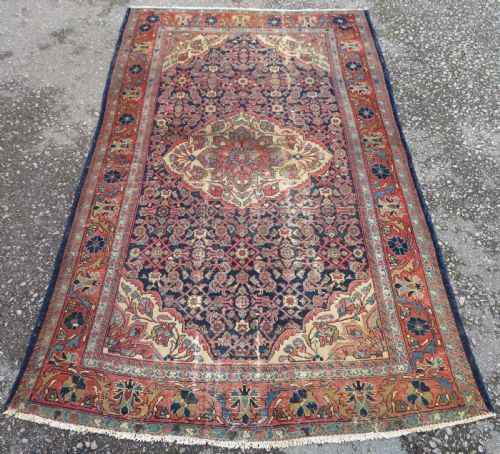
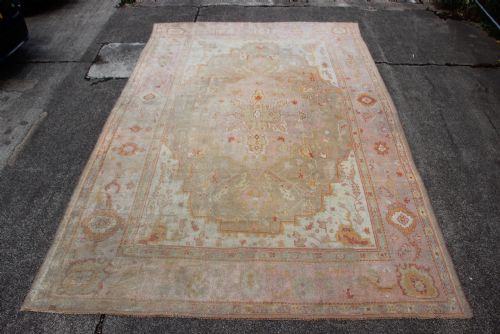
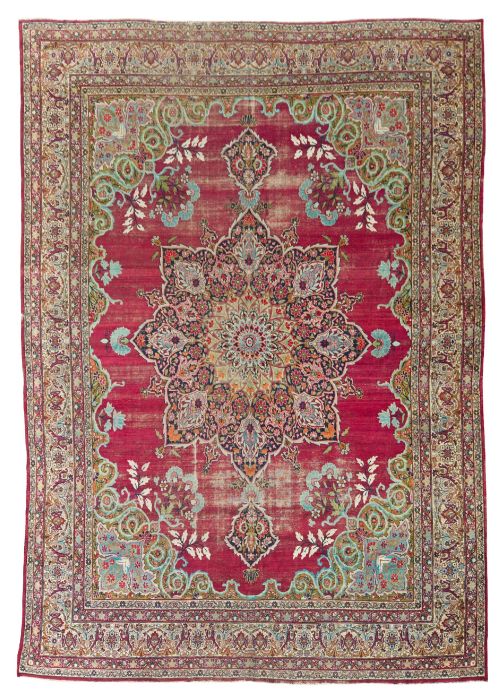



Faded Vintage Carpet
A faded vintage carpet brings subdued colour and historic character to a room through softened tones built up across decades.
Faded Vintage Carpet
A faded vintage carpet spans production from the late nineteenth century into the early twentieth century, originating from weaving centres across Persia, Turkey, and the Caucasus. These floor coverings include large area carpets, long runners, and tribal kilims that have acquired a worn, softened appearance over generations of use.
The selections on this page lean heavily towards large Oushak carpets and Persian pieces like Kirman, Sarouk, and Tabriz. Buyers frequently encounter pale blues, soft pinks, and muted red tones resulting from age and gentle wear upon traditional wool foundations.
How they were made
These textiles were constructed predominantly from wool, cotton, and occasionally angora wool, spun by hand and woven on vertical or horizontal looms. Pile knots were tied tightly onto cotton or wool warp and weft threads, creating a dense structure capable of withstanding heavy daily use.
Dyers utilised natural materials to achieve the initial depth of colour before time and exposure mellowed the pigments. The structural integrity relied on sturdy selvages and securely knotted foundations that survived decades of walking and cleaning.
Faded Vintage Carpet Retail Price Guide 2026
Typical asking prices for faded vintage carpet among the pieces listed under this phrase on Sellingantiques today, from the lower quarter to the upper quarter. They describe what is for sale here now, not the wider market.
Listings span several decades around the turn of the nineteenth and twentieth centuries, incorporating materials like angora wool alongside standard wool and cotton.
What varies in quality
The standard of a piece rests upon the fineness of the knotting and the balance of the composition as the pile recedes. Superior examples retain structural soundness in the foundation despite an even, weathered surface that exposes the underlying design with clarity.
Origin and stylistic harmony distinguish the finer specimens from simpler tribal work. Master workshops in Oushak or Tabriz delivered precise geometry and refined palettes, whereas regional pieces display charming irregularities in symmetry and dye saturation.
The Faded Vintage Carpet Glossary
- Oushak
- A style originating from the Turkish town of Usak, known for large-scale floral designs and soft pastel wools. These carpets were traditionally woven with oversized motifs that suit spacious interiors.
- Warp
- The vertical threads stretched lengthwise on a loom that form the structural foundation of the carpet. The visible fringe at either end of a rug is typically the extension of these threads.
- Weft
- The horizontal threads passed through the warp threads to hold the knots in place. In many traditional rugs, these threads are beaten down tightly after each row of knots.
- Kilim
- A flat-woven carpet produced without a pile by tightly interweaving warp and weft strands. These pieces present a smooth surface on both sides.
- Patina
- The surface sheen and softened coloration acquired by natural materials through age and use. This quality is particularly prized in older textiles for its gentle aesthetic.
Faded Vintage Carpet: Frequently Asked Questions
How do I clean a faded vintage carpet?
Gentle surface vacuuming without a rotating brush roll prevents damage to fragile antique pile. Professional cleaning tailored to delicate wool textiles is essential for deeper maintenance.
Water exposure and harsh chemical detergents should be avoided to protect the muted dyes and aged cotton foundations. Regular rotation ensures even wear across rooms with high foot traffic.
Where do these carpets originate?
The pieces originate primarily from traditional weaving regions in Turkey, Persia, and the Caucasus. Cities like Oushak, Tabriz, and Kirman established distinct design traditions that persist in these older items.
Tribal groups in Anatolia and southwest Persia also produced distinctive smaller rugs and runners. Each geographical area employed specific knotting techniques and local wool varieties.
Are these carpets durable enough for daily use?
The dense wool and cotton construction of these historical rugs makes them robust enough for everyday flooring when placed over a quality underlay. The worn pile indicates past use rather than structural failure.
Placing them in moderate-traffic areas allows the textile to endure while continuing its natural ageing process. Avoiding direct, harsh sunlight preserves the subdued pastel and faded red tones.
What causes the faded look?
Natural fading occurs through decades of sunlight exposure, gentle washing, and general foot traffic acting upon traditional vegetable and early synthetic dyes. This gradual process softens high-contrast palettes into harmonious pastels.
Some pieces achieve a distressed appearance through deliberate washing or clipping of the remaining pile. The resulting soft patina highlights the underlying knot structure and geometric or floral motifs.