

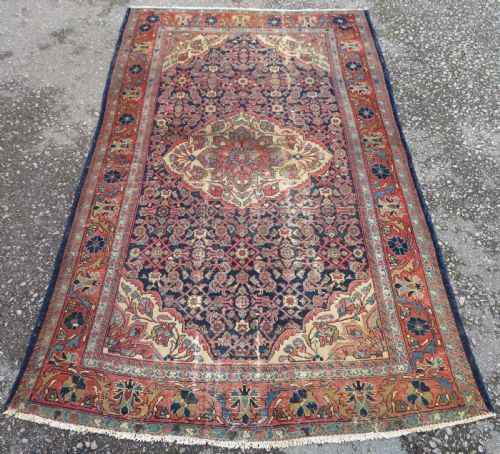
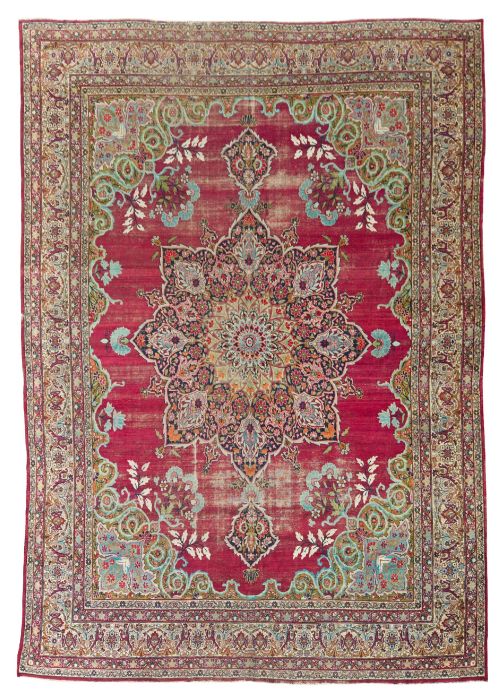
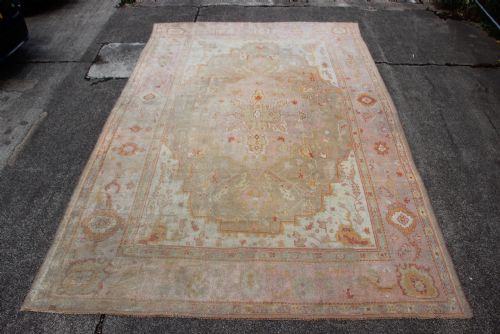



Faded Floor Rug
A faded floor rug brings muted warmth and timeworn pattern into a room through softened wool and cotton.
Faded Floor Rug
A faded floor rug comprises hand-knotted and flatwoven carpets originating from Persian, Ottoman, and Anatolian traditions, spanning the late nineteenth and early twentieth centuries. These pieces appear in formats ranging from small area rugs and runners to very large carpets.
The selection on this page is dominated by Ushak rugs alongside examples from Malayer, Kirman, Sarouk, Tabriz, Ziegler, Khotan, and Shirvan workshops. Buyers meet formats that include square room-size carpets and narrow runners suited to hallways and living spaces.
Materials and construction
These floor coverings are constructed primarily using wool for the pile and foundation, often combined with cotton for warps andwefts. Natural fibres absorb dye unevenly over decades of wear and sunlight, creating the characteristic soft palette seen across the pieces.
Techniques range from traditional pile knotting seen in Persian and Ottoman carpets to flatwoven kilim structures, such as the nine-strip construction found in specific Uzbek Suzani kilims. The physical interaction of wool pile against cotton foundations allows large carpets to drape naturally across floorboards.
Faded Floor Rug Retail Price Guide 2026
Typical asking prices for faded floor rug among the pieces listed under this phrase on Sellingantiques today, from the lower quarter to the upper quarter. They describe what is for sale here now, not the wider market.
Listings span five distinct decades from 1880 to 1920, predominantly featuring wool and cotton constructions from Persian and Ottoman regions.
The spectrum of quality
Quality in a faded floor rug rests upon the integrity of the remaining foundation and the density of the original knotting. Finer regional weaving, such as that found in Tabriz or Kirman pieces, displays greater precision in pattern execution even as the colours soften.
The balance between wear and structural survival determines the character of each carpet. Uniform softening of the pile preserves the integrity of the design motifs, whereas heavy localized loss alters how the rug rests and performs in daily use.
Maples
The Faded Floor Rug Glossary
- Pile
- The upright loops or cut ends of yarn that form the usable surface of a rug. This wool layer takes the weight of footsteps and softens in colour over time.
- Warp
- The vertical threads stretched tightly on the loom before knotting begins. Cotton warps provide structural stability to large room-size carpets.
- Weft
- The horizontal threads passed through the warps to hold the knots in place. These horizontal passes lock the rows together.
- Kilim
- A flatwoven textile produced without a raised pile. These pieces rely on interlocking weft techniques to create geometric patterns.
- Runner
- A long, narrow carpet format designed for corridors and staircases. These pieces balance length with restricted width.
Faded Floor Rug: Frequently Asked Questions
How do I clean an old wool rug?
Gentle surface vacuuming without a beater bar removes embedded dust from the wool pile without pulling at the foundation threads. Professional specialist cleaning remains necessary for deeper washing to protect cotton foundations.
Water exposure should be managed carefully to prevent dye migration in softened wools. Regular rotation distributes foot traffic evenly across the surface of the carpet.
Where should I place a large runner?
Narrow runner formats suit hallways, entryways, and long gallery spaces where floorboards benefit from soft textural contrast. Their linear proportions guide movement through domestic interiors.
Placing a suitable underlay beneath the carpet prevents slipping on smooth wooden or tiled floors. This extra layer also cushions the cotton foundation against hard surfaces.
How do I identify an Ushak carpet?
Ushak carpets typically feature large-scale floral motifs and medallion designs executed in a warm, muted palette of terracotta, saffron, and faded reds. The wool often feels supple and yields a distinctive relaxed drape.
Originating from the Turkish weaving town, these pieces gained popularity in Western interiors during the late nineteenth and early twentieth centuries. Their looser knotting distinguishes them from tighter Persian counterparts.
Can these rugs handle heavy foot traffic?
Wool possesses natural resilience that allows these floor coverings to withstand regular movement in living rooms and dining areas. The density of the pile determines how well the foundation resists compression over decades.
Distressed or worn areas require gentle placement away from abrasive pivoting points like heavy chair legs. Using a quality rug pad absorbs impact and prolongs the structural lifespan of the textile.