




Extending Book Slide
An extending book slide organises a domestic library with a clever concertina action that keeps volumes upright on a desk or table.
Extending Book Slide
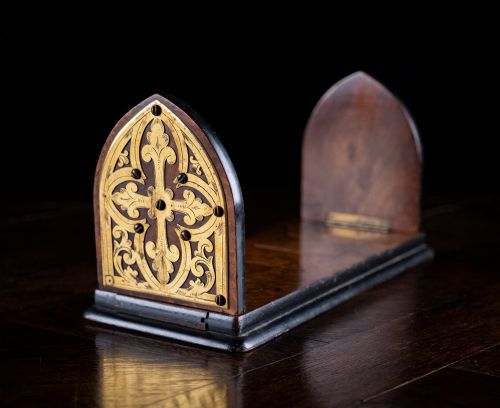
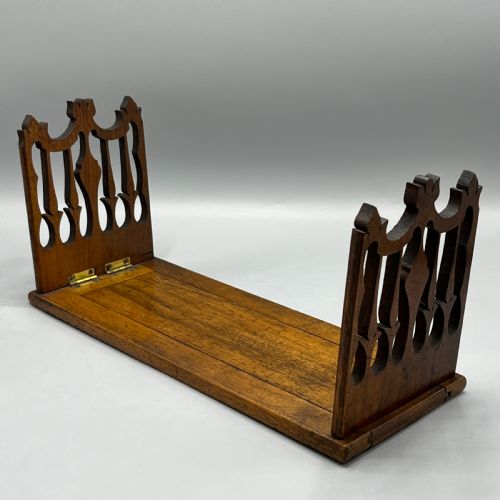
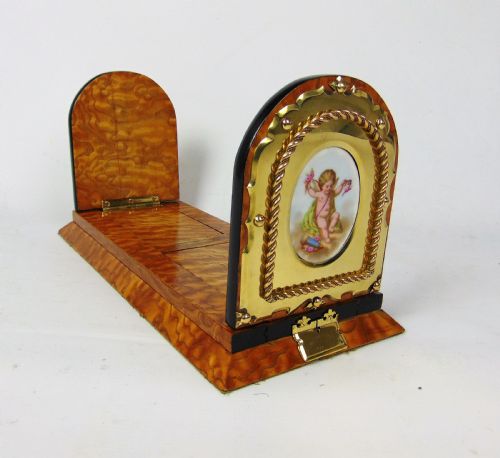
When you search for an extending book slide, you find a desktop accessory designed to hold a growing row of volumes securely between two hinged or sliding ends. These pieces stretch outwards to accommodate more books as a collection expands, returning to a compact footprint when needed.
The most common examples on this page date from the Victorian period, frequently constructed from walnut fitted with brass mounts or hinges. Alongside these standard library pieces, you will encounter more elaborate specimens utilising specialised timbers and decorative inlays.
Forms range from simple folding wooden rests to architectural Gothic revivals and intricate Tunbridge Ware designs. They sit comfortably on a study desk, a library table or a drawing room side cabinet.
How they were made
Cabinet makers utilised dense hardwoods such as walnut, mahogany, oak and rosewood to construct the folding chassis and upright ends. These timbers provided the structural stability required to withstand the lateral pressure exerted by heavy volumes.
Metal components, notably brass hinges, mounts and concertina actions, were screwed or pinned directly into the wood to allow smooth sliding movement. More decorative variations incorporated bone inlays, pietra dura panels or carved teak elements set into the primary wooden frame.
Extending Book Slide Retail Price Guide 2026
Typical asking prices for extending book slide among the pieces listed under this phrase on Sellingantiques today, from the lower quarter to the upper quarter. They describe what is for sale here now, not the wider market.
Design styles span Victorian Gothic Revival, Regency, Edwardian and Anglo-Indian carving traditions.
What varies in quality
The sophistication of the extending mechanism dictates much of the distinction across the range, with superior examples offering smooth, balanced action without binding or tilt. Heavier gauge brass and precise internal linkages ensure the sliding sections remain parallel during adjustment.
Material selection and decorative execution separate standard desk accessories from finer pieces. Finely figured walnut veneers, crisp carving, intact Tunbridge Ware mosaics or specialist stone inlays demonstrate higher levels of workshop craftsmanship.
Tiffany and Co
The Extending Book Slide Glossary
- Tunbridge Ware
- Tunbridge Ware describes small wooden items decorated with mosaic veneers made from many tiny pieces of naturally coloured wood to form a pictorial or geometric mosaic. This technique reached its height in nineteenth-century Kent.
- Pietra dura
- Pietra dura involves inlaying cut and fitted polished coloured stones to create formal designs or pictures. The technique appears on select Victorian desk accessories.
- Gothic Revival
- Gothic Revival is an architectural and decorative style drawing on medieval forms, featuring pointed arches, tracery and heavy structural moulding. Pieces in this style often utilise oak.
- Coromandel
- Coromandel is a dense, heavy cabinet timber from Asia with a dark brown colour and contrasting black streaks. It was favored for luxury nineteenth-century desk items.
- Concertina action
- Concertina action refers to the expanding and contracting linkage that allows the two ends of the book slide to move outwards together while maintaining a rigid base.
Extending Book Slide: Frequently Asked Questions
Where were book slides used?
Victorian households placed these accessories on study desks, writing tables and library surfaces where working volumes needed to stay close at hand. They kept reference books upright without requiring a full bookcase.
They also appeared in drawing rooms and parlours to display smaller collections of poetry or novels. Their portable nature meant they moved easily between rooms as needed.
How do I care for wooden book slides?
Keep these pieces away from direct heat sources and strong sunlight to prevent the timber from drying out or veneers from lifting. An occasional application of appropriate furniture wax maintains the finish.
Check the brass hinges and sliding tracks periodically to ensure dust does not interfere with the movement. Handle the extending mechanism gently to avoid straining the wooden joints.
How do I date a Victorian book slide?
Mid-nineteenth-century examples frequently combine solid walnut with heavy brass mounts and simple architectural forms. Later Victorian pieces often incorporate ebonised wood or more eclectic revival styles.
Turned wooden feet, dovetail construction joints and the style of brass hinges offer further clues to the decade of manufacture. Finer details like pietra dura or Tunbridge Ware usually point to the middle decades of the century.