


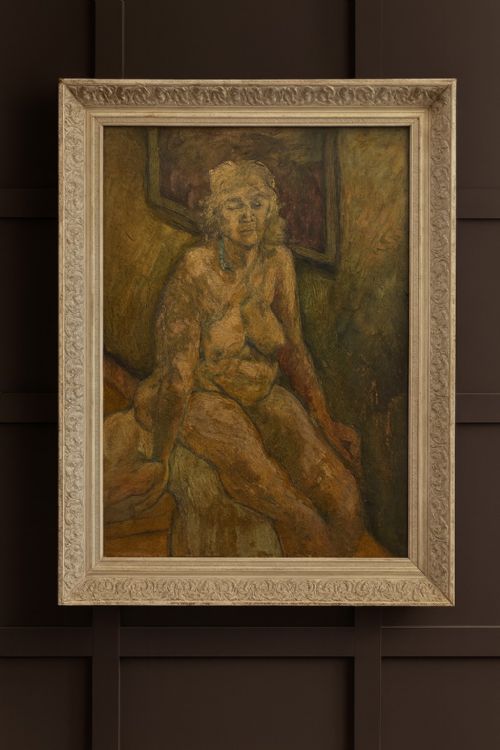


Expressionist Female Nude
An expressionist female nude captures raw human form through bold brushwork and dramatic palettes across the mid twentieth century.
Expressionist Female Nude
An expressionist female nude centres on the human figure rendered through the lens of twentieth century movements such as expressionism, cubism, and modern british figurative art. These works range from French avant garde pieces to Cornish and British studies produced between the 1920s and the 1960s.
Buyers encounter oil paintings on canvas, board, and paper, often housed within wood and gilt plaster frames. The subjects appear as seated figures, reclining studies, and intimate indoor scenes created by named artists and anonymous hands alike.
Materials and methods
Artists deployed oil paint directly onto canvas, prepared board, or paper supports to build tactile surface textures and deep tonal contrasts. These paintings often utilise heavy impasto and expressive brushstrokes that define the contours of the body rather than relying on precise academic lines.
Framing forms an integral part of the physical object, utilising period wood frames and gilt plaster mouldings that reflect the aesthetic tastes of the 1920s through to the 1960s.
The listings span the 1920s, 1930s, 1950s, and 1960s, utilising oil paint on canvas, board, and paper.
Assessing quality
Quality rests upon the strength of the composition and the confidence of the brushwork in handling the human form. Stronger examples demonstrate a distinct personal vision within styles like mid-century expressionism or cubism, where distortion serves emotional intensity.
The integrity of the physical support, whether oil on canvas or oil laid on board, alongside the harmony of the original frame, contributes significantly to the standing of an individual piece.
Tony Giles·Gaetan Dumas·Peter Jackson·Jean Hippolyte Marchand·Pinchus Krémègne·Yetta Kane·Raymond Arthur Roadnight
The Expressionist Female Nude Glossary
- Impasto
- Paint applied thickly to a canvas or board, standing out from the surface so that texture and brush marks remain visible.
- Chiaroscuro
- The strong contrast between light and dark areas within a painting, used to give volume and dramatic weight to the female form.
- Avant-garde
- Works and artists that push boundaries ahead of traditional cultural norms, seen here in early twentieth-century French and British pieces.
- Gilt plaster
- A decorative surface treatment applied to wood frames, providing a metallic gold finish typical of period framing.
Expressionist Female Nude: Frequently Asked Questions
How do I date an expressionist female nude painting?
Dating relies on stylistic markers within the brushwork, such as the flat planes of 1920s cubism or the looser gestural application typical of 1950s and 1960s expressionism.
Physical evidence like canvas types, board supports, and period wood or gilt plaster frames also help establish the decade of creation.
Where should I hang an oil painting on board?
These works suit spaces away from direct sunlight and fluctuating household humidity to protect the oil paint and canvas or board supports.
Pairing them with neutral walls allows the bold palettes of mid-century expressionism and fauve scenes to stand out clearly.
What is the difference between an oil on canvas and oil on board?
Canvas offers a flexible woven textile support that often shows the natural texture of the fabric beneath the pigment layers.
Board provides a rigid foundation, sometimes used when artists mounted canvas or painted directly onto a firm wooden substrate.