

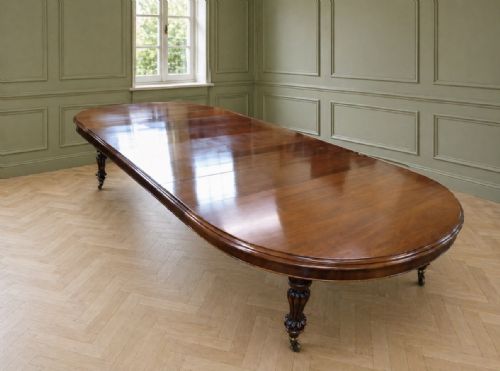


Expandable Dining Room Table
An expandable dining room table brings adaptability to large gatherings, offering solid timber construction and clever leaf systems that adjust your seating space effortlessly.
Expandable Dining Room Table
An expandable dining room table is a practical antique furniture piece designed to alter its length for daily meals or larger dinner parties. Buyers searching this phrase will find sturdy timber frames built with clever leaf mechanisms to alter the seating capacity.
The versions met most frequently on this page originate from the nineteenth century and the early twentieth century. They span distinct periods including the Regency, William IV, and Victorian eras, alongside later revival styles.
Makers fashioned these dining tables primarily as large banquet pieces or smaller family tables. Many examples include extra leaves that store separately when not in use to shorten the overall length.
How they were made
Cabinet makers utilised dense timbers like mahogany to construct the primary tabletops, frames, and supporting legs. Brass components frequently appear on castors or sliding mechanisms to assist the heavy extending action.
Some examples incorporate upholstered fabric chairs when sold as complete dining sets alongside the main table. Carpenters joined the sections using robust internal wooden runners and winding gears to support multiple removable leaves.
Listings feature pieces from the nineteenth and early twentieth centuries, spanning the William IV, Victorian, and Regency periods.
What varies in quality
The overall standard of an expandable dining room table depends upon the quality of the timber selection and the precision of the extending mechanism. Finer pieces demonstrate superior joinery in the leaf tracks and greater depth of grain in the polished mahogany surfaces.
Proportion and scale also distinguish the categories, ranging from standard domestic models seating eight to ten people up to board room tables built to seat over twenty guests. Attribution to known workshops or adherence to specific historical styles further elevates the standing of an individual piece.
The Expandable Dining Room Table Glossary
- Leaf
- A removable section of the tabletop inserted to increase length. These extra boards are stored separately when the table is closed.
- Extending mechanism
- The internal runners, tracks, or screw-wind system that pulls the table apart to receive extra leaves. Smooth operation relies on solid construction.
- William IV
- A British design period spanning the 1830s characterised by robust proportions, scrolled legs, and dark mahogany timber. Pieces from this era often feature heavy pedestals or turned legs.
- Regency
- An architectural and furniture style dating from the early nineteenth century inspired by classical antiquity. Tables from this period display refined reeded edges and elegant brass fittings.
- Chippendale Revival
- A later reproduction style imitating the mid-eighteenth-century carved designs of Thomas Chippendale. These tables showcase elaborate decorative motifs on the legs and frame.
Expandable Dining Room Table: Frequently Asked Questions
How do you open an antique extending table?
Most antique extending tables operate by pulling the two main ends apart along internal wooden runners or tracks. This motion creates a central gap large enough to drop in one or more extra timber leaves.
Some nineteenth-century examples utilise a winding handle connected to a wooden screw mechanism to separate the top smoothly. Once the leaves are secured in place, the table is pushed back together to lock the surface tight.
How many people can these tables seat?
Seating capacity varies widely depending on the number of removable leaves supplied with the table. Standard domestic versions comfortably accommodate eight to ten guests during everyday use.
Larger banquet or board room models extend significantly further to seat anywhere from twenty to twenty-six people. Checking the length with all leaves inserted provides the exact dining capacity.
What wood were these tables made from?
Cabinet makers relied predominantly on mahogany for these dining tables due to its strength, rich colour, and durable grain. This dense timber supported the heavy weight of large extending frames and multiple leaves.
Occasional brass hardware appeared on the castors and internal extension mechanisms to assist movement. The polished wood surfaces required careful maintenance to preserve the deep reddish-brown finish.
How do you identify a Victorian extending table?
Victorian extending tables generally date from the mid-to-late nineteenth century and display heavier proportions than earlier Regency designs. They frequently feature turned or fluted legs supporting a solid mahogany top.
Many of these pieces include two or more matching leaves designed to increase the length for hosting guests. Examining the construction of the runners and the finish of the timber helps confirm the period.