


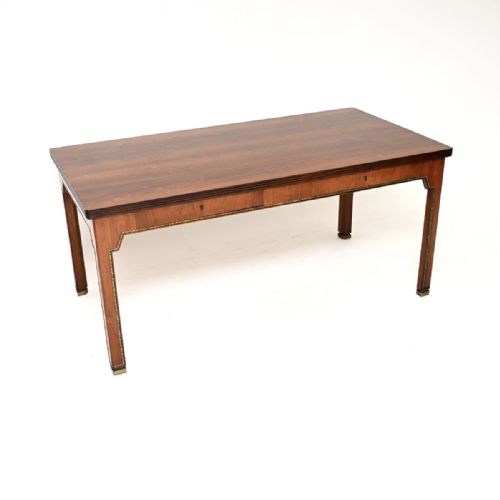
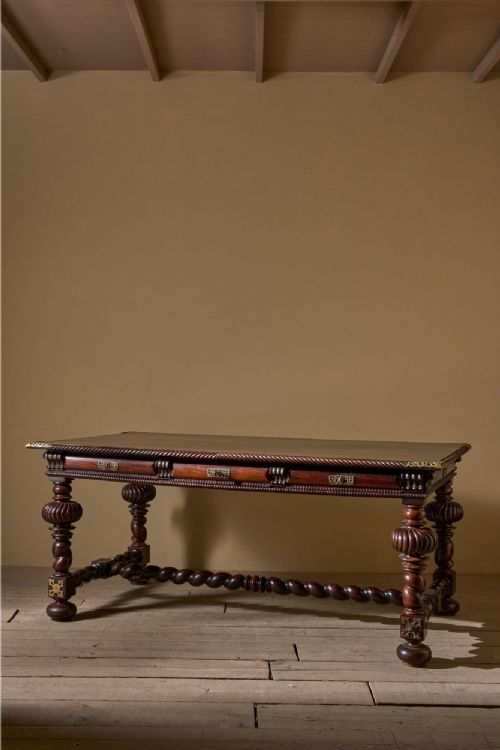
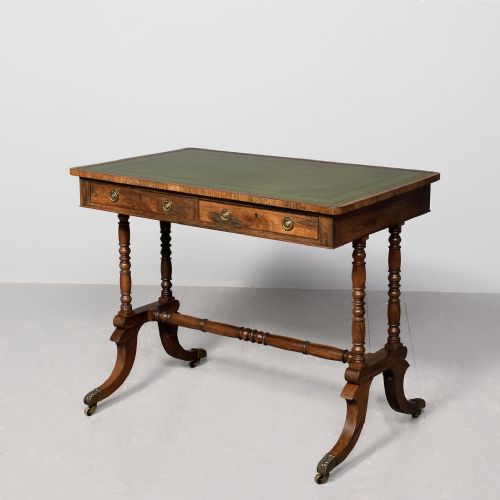


Executive Rosewood Writing Table
An executive rosewood writing table brings rich timber grain and classic authority to a study, offering a substantial surface designed for serious correspondence.

Executive Rosewood Writing Table
When you search for an executive rosewood writing table, you encounter substantial furniture pieces designed for administrative tasks and library use. Most examples you meet on this page date from the 19th century, with Regency and Victorian periods strongly represented alongside later styles such as French Art Deco and Danish Modern.
The forms vary from freestanding library tables and partners desks to bureau plat designs and pedestal desks. These tables often serve as central room pieces rather than items pushed against a wall, finished carefully on all sides to allow flexible placement.
Origins stretch across English, French, and Danish workshops, displaying influences from George IV, William IV, and Louis XV aesthetics. You find pieces varying from restrained classical lines to more ornate marquetry and parquetry surfaces.
Materials and construction methods
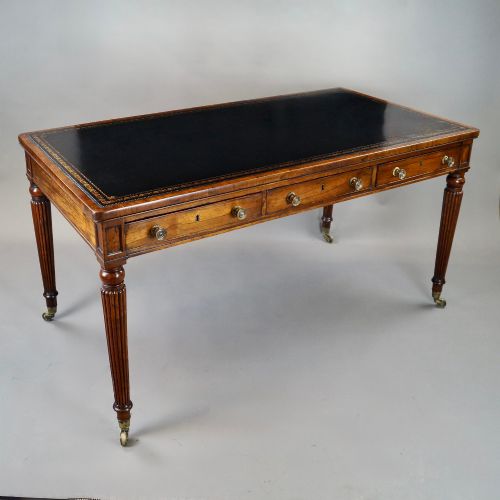
Makers utilised dense rosewood as the primary timber, often complemented by contrasting woods like kingwood, tulipwood, satinwood, and goncalo alves for decorative banding or marquetry panels. Leather inserts frequently provide a durable writing surface atop the desk.
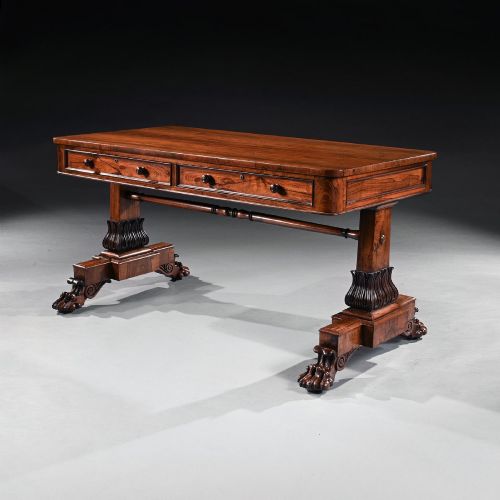
Metal mounts in brass, ormolu, and gilt bronze accentuate structural corners and drawer framing, while carved details such as lions paw feet appear on select Regency and William IV examples. Cabinetmakers combined solid framing with figured veneers to achieve striking grain patterns across large writing surfaces.
Lions paw feet occasionally hold up centuries of paperwork without breaking a sweat.
Assessing quality and execution
The calibre of an executive rosewood writing table rests on the selection of timber veneers and the crispness of any carved or cast metal detailing. Superior examples display continuous, book-matched grain patterns across the top and well-executed joinery in the drawer construction.
Attribution to known makers or documented workshops elevates a piece, as seen in items linked to Gillows, Donald Ross, Maurice Dufrêne, or William Trotter. The integration of finished backs and well-preserved leather inserts further distinguishes high-ranking pieces from standard utilitarian desks.
Donald Ross·Maurice Dufrene·Gillows·William Trotter·Gillows of Lancaster
The Executive Rosewood Writing Table Glossary
- Rosewood
- A dense, heavily figured timber valued for dark grain patterns and polished finishes. It forms the primary visual identity of these tables.
- Bureau Plat
- A French freestanding writing table, typically featuring a leather inset top and multiple drawers. These pieces often include ormolu mounts and cabriole legs.
- Ormolu
- Gilded bronze applied as decorative mounts on furniture. It appears frequently on French designs from the 19th century.
- Partners Desk
- A large double-sided desk allowing two people to work opposite one another. These incorporate banks of drawers and cupboards on both sides.
- Marquetry
- Decorative patterns formed by inserting pieces of wood veneer into a background structure. It creates complex floral or geometric imagery on desk tops.
Executive Rosewood Writing Table: Frequently Asked Questions
What is a library table?
A library table is a large freestanding desk designed to sit in the middle of a room rather than against a wall. These pieces feature finished backs and sides, making them accessible from multiple angles.
Historically, they served scholars and readers who needed ample surface area for books and manuscripts. Today, they function well as large executive desks in open-plan studies.
How do I identify Regency style?
Regency style draws heavily on classical Greek and Roman motifs, showing clean lines, rosewood surfaces, and occasional brass inlay. Proportions remain balanced and architectural.
You might spot carved paw feet or restrained reeding rather than heavy Victorian ornamentation. This aesthetic dominated British furniture design during the early 19th century.
Where should I place a freestanding desk?
A freestanding desk looks best positioned in the centre of a room where its finished back and detailed grain remain visible. Because these tables lack a traditional front-and-back hierarchy, they anchor a study layout effectively.
Ensure you leave adequate clearance around all sides for chairs and movement. This placement highlights the quality of timber used on secondary facades.