

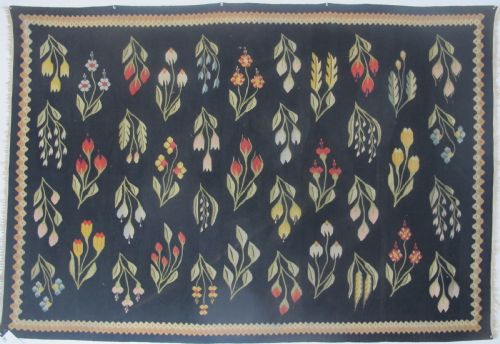


European Tapestry Rug
These european tapestry rug examples bring deep regional character and flat-woven warmth to a room.
European Tapestry Rug
A european tapestry rug encompasses flat-woven floor coverings and wall hangings originating from Eastern Europe, predominantly represented here by Bessarabian kilims and Sharkoy pieces. These textiles carry rich regional traditions that bridge decorative arts and everyday domestic use.
Buyers browsing this selection will most frequently encounter antique Bessarabian kilims dating across the late nineteenth and early twentieth centuries. Such pieces often display distinct floral motifs and dark grounds that set them apart from traditional Anatolian flat-weaves.
How they were made
The construction relies on traditional flat-weaving techniques utilising natural wool and cotton fibres to create durable yet supple textiles without a traditional pile. Artisans worked these materials by hand to build intricate patterns directly into the warp and weft structure.
The combination of wool for its rich dye uptake and cotton for structural stability allowed makers to achieve the characteristic flat finish of these regional weaves. This technique produces a reversible or semi-reversible textile well-suited for both floor placement and display.
European Tapestry Rug Retail Price Guide 2026
Typical asking prices for european tapestry rug among the pieces listed under this phrase on Sellingantiques today, from the lower quarter to the upper quarter. They describe what is for sale here now, not the wider market.
The listings span from the 1880s to the 1930s, exclusively utilising wool and cotton materials across Bessarabian and Balkan styles.
What varies in quality
Quality in a european tapestry rug rests upon the clarity of the design execution and the preservation of the original hand-spun wool fibres. Finer examples maintain crisp boundaries between distinct colour fields and dense tension in the weave.
The sophistication of the floral compositions and the depth of the regional folk art aesthetic further separate standard output from superior specimens. Tighter structural integrity ensures the textile retains its form through decades of use.
The European Tapestry Rug Glossary
- Kilim
- A flat-woven carpet or rug produced in countries of the former Ottoman Empire, Persia and Central Asia. These textiles are made by tightly interweaving warp and weft strands to create a smooth surface without pile.
- Bessarabian
- Pertaining to the historical region situated between the Prut and Dniester rivers, known for distinct dark-ground flat-weaves featuring naturalistic floral sprays. These rugs reflect a blend of local folk traditions and Western European design influences.
- Sharkoy
- A type of flat-woven textile originating from the Balkans, often characterised by banded designs and bold geometric or linear patterns. They share technical similarities with kilims but exhibit a distinct regional aesthetic.
- Warp
- The lengthwise threads held under tension on a loom before the weaving process begins. The weft is passed over and under these foundational threads to form the cloth.
European Tapestry Rug: Frequently Asked Questions
What is a european tapestry rug?
A european tapestry rug is a flat-woven textile, typically a kilim from Eastern Europe, created using wool and cotton.
These pieces combine traditional folk art styles with floral or banded designs suited for interior decoration.
How do I care for my rug?
Protect these antique textiles by placing them in low-traffic areas and using a suitable underlay to prevent sliding.
Vacuum gently with a suction-only attachment and avoid abrasive beating or excessive moisture.
Are these rugs reversible?
Many flat-woven kilims share a similar appearance on both sides due to the nature of tapestry weaving techniques.
However, structural repairs or finishing techniques on the reverse may dictate which side faces upward.
How are different regional styles told apart?
Distinctions rely on motifs and colour palettes, such as the dark floral grounds of Bessarabian pieces versus the banded designs of Sharkoy rugs.
Examining the specific weave density and regional execution helps identify the origin.