






Etched Wine Goblets
These etched wine goblets bring pattern and weight to the table, combining clear and amber glass with period cut designs from the Georgian era onward.
Etched Wine Goblets
When you search for etched wine goblets, you encounter drinking vessels and stemware spanning the Georgian, Victorian, and Edwardian periods. The selection encompasses faceted rummers, large engraved ale glasses, and coloured roemers alongside delicate white wine glasses.
Most examples you meet on this page hail from the Victorian era, often appearing in sets of matching dessert wine glasses or amber-toned glassware. Forms range from square base rummers to substantial chalices, reflecting centuries of changing dining habits.
Makers and origins stretch from British workshops to Bohemian furnaces and continental centres, utilising distinct styles such as Art Nouveau, Art Deco, and Jugendstil. Each piece serves as a functional drinking vessel carrying historical decorative motifs.
How they were made
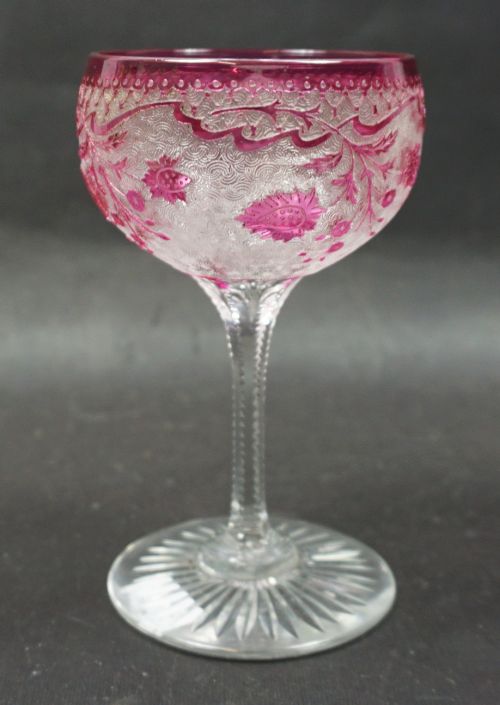
Glassmakers utilised clear glass, lead crystal, lead glass, and amber glass, forming vessels through blowing and pressing before applying surface decoration. Some pieces incorporate gold leaf details or acid cut cameo work to build contrasting textures.
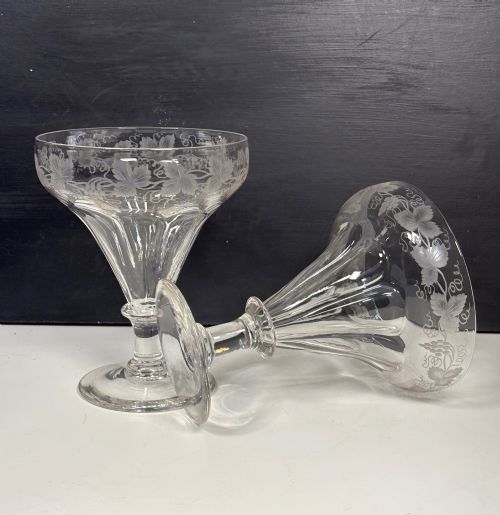
Decoration relied on engraving, cutting, and etching techniques to create hunting scenes, frosted finishes, and intricate botanical patterns upon the bowls. Stems varied from simple faceted posts to air twist formations characteristic of earlier Georgian work.
Etched Wine Goblets Retail Price Guide 2026
Typical asking prices for etched wine goblets among the pieces listed under this phrase on Sellingantiques today, from the lower quarter to the upper quarter. They describe what is for sale here now, not the wider market.
Several Victorian glasses display etched hunting scenes where hounds chase stags in circles around your claret.
What varies in quality
Quality rests upon the crispness of the wheel engraving or the precision of the acid etching across the surface of the bowl. Sharper lines and deeper wheel cuts demand greater skill from the glasscutter.
The weight and clarity of the metal, whether standard glass or heavy lead crystal, dictates the presence and resonance of the piece. Consistency across a harlequin set or a matched group influences desirability.
Baccarat·Stevens & Williams·Riihimaki·Adelbert Niemeyer
The Etched Wine Goblets Glossary
- Rummer
- A heavy, short-stemmed drinking glass popular in the Georgian and Victorian periods, often featuring a wide foot base and an etched or engraved bowl.
- Roemer
- A traditional continental European large wine glass, frequently produced in amber glass with a decorated bowl and a studded stem.
- Air twist
- A decorative stem formation containing spiral threads of tiny air bubbles trapped inside the glass during the manufacturing process.
- Acid cut cameo
- A technique where layers of coloured glass are partially eaten away by acid to create a raised design against a contrasting background.
- Faceted
- Having multiple flat polished surfaces cut into the glass stem or lower bowl to catch the light.
Etched Wine Goblets: Frequently Asked Questions
How do I clean antique etched wine glasses?
Wash them gently by hand in warm water using a mild detergent, avoiding harsh scrubbing brushes that might scratch the surface.
Dry them immediately with a lint-free cloth to prevent water spots from forming on the clear or amber glass.
Can I still drink wine from these goblets?
Yes, these historical drinking glasses remain fully functional for modern use provided you handle them with appropriate care.
Keep them away from sudden temperature changes to prevent thermal shock from cracking the older glass.
How do I tell a Georgian goblet from a Victorian one?
Georgian examples frequently feature heavier square bases and air twist stems with simpler, hand-engraved motifs.
Victorian pieces often display more complex combination etching and cutting, with amber glass and matched sets becoming common by the later nineteenth century.
What is an amber roemer?
An amber roemer is a traditional Germanic wine glass made from coloured glass, typically featuring a wide bowl and a decorative studded stem.
These glasses were designed for hock and white wines, utilising the amber hue to complement the drink.