

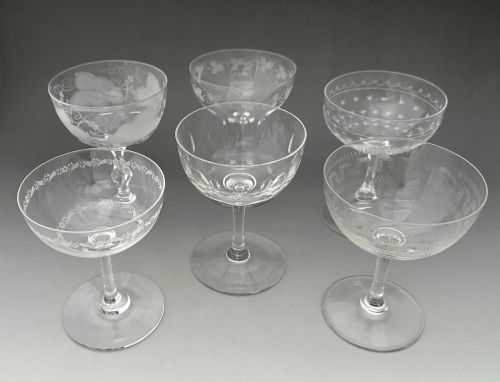


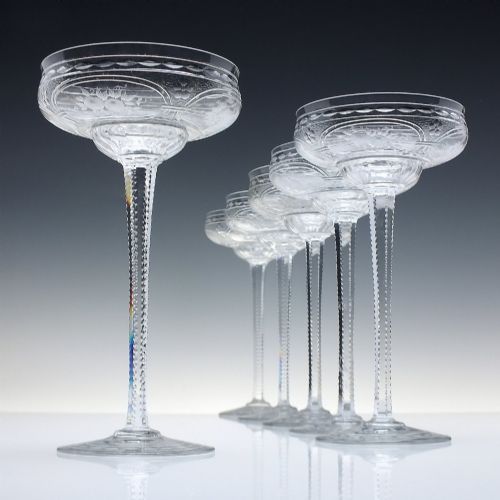


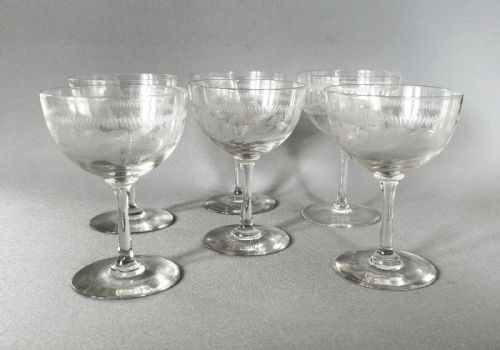



Etched Glassware Set
An etched glassware set brings matched pattern and clarity to the table, uniting drinking vessels and serving pieces through surface decoration.
Etched Glassware Set
When you search for an etched glassware set, you encounter matching ensembles spanning the Georgian, Victorian, Edwardian, and Art Deco periods. These groupings range from small tasting sets of cordial or dram glasses to large suites of drinking glasses, wine glasses, champagne coupes, and matching decanter sets.
The most common versions met on this page include Victorian dessert wine glasses and amber glasses, Edwardian Greek key pattern champagne glasses and cordial glasses, and French or Czech Art Deco drinking glasses paired with jugs or decanters. You also find specialised forms such as finger bowls and custard cups.
Originating across Britain, France, and Bohemia, these sets reflect the domestic dining and entertaining habits of their respective eras. Whether composed of six dram glasses or thirty-four drinking glasses with engraved decoration, each set provides a unified aesthetic for the table.
How they were made
The material foundation of these pieces rests on clear glass, crystal, lead crystal, moulded glass, and frosted glass. Makers shaped these substances through blowing, moulding, and cutting before applying surface decoration.
Decoration was achieved primarily through acid etching or engraving to create motifs such as Greek key patterns, jazz man designs, and Savoy vine patterns. Faceted stems and wide foot bases were often worked into Georgian and Victorian drinking vessels to add weight and balance.
Etched Glassware Set Retail Price Guide 2026
Typical asking prices for etched glassware set among the pieces listed under this phrase on Sellingantiques today, from the lower quarter to the upper quarter. They describe what is for sale here now, not the wider market.
Materials span plain clear glass, lead crystal, frosted glass, moulded glass, and engraved glass.
What varies in quality
Quality in an etched glassware set lies in the crispness of the surface decoration and the uniformity across the pieces in the suite. A superior set displays consistent depth in the etching and precise symmetry in the bowls, stems, and feet.
The choice of material also dictates distinction, moving from standard clear glass up to brilliant lead crystal and fine moulded glass. Completeness and matching provenance elevate a suite, particularly in larger French or Czech Art Deco decanter sets and extensive wine glass collections.
Baccarat·Rene Lalique·Riihimaki
The Etched Glassware Set Glossary
- Etched glass
- Glass decorated by applying acid to eat away the surface design. This technique allows for fine, detailed patterns like floral motifs or geometric bands.
- Crystal
- A high-clarity glass containing metal oxides that increase weight and refractive index. It produces a clear ring when struck and sharper facets than standard glass.
- Champagne coupe
- A shallow, broad-bowled stemmed glass designed originally for sparkling wine. Its wide rim showcases surface engraving while altering how the bubbles disperse.
- Finger bowl
- A small, bowl-shaped vessel used for rinsing fingers between courses at formal dinners. These often feature matching etched borders or Greek key patterns.
- Decanter set
- A matched grouping comprising a stoppered bottle for spirits or wine alongside several drinking glasses. They were centrepieces for after-dinner entertaining in the Art Deco period.
Etched Glassware Set: Frequently Asked Questions
How do I tell Victorian sets from Art Deco ones?
Victorian sets tend to feature ornate floral or Greek key patterns on traditional bowl shapes, often accompanied by amber hues or heavier faceted stems. Art Deco sets favour stylised motifs like jazz figures or Savoy vines, clean geometric lines, and streamlined silhouettes.
The manufacturing techniques also shift, with earlier pieces relying heavily on hand-engraving and traditional cutting, while later sets embrace moulded forms and acid-etching across larger suites of matching glassware.
Were these sets used daily or saved for guests?
Many larger suites, such as the extensive French drinking glass collections and decanter sets, were reserved for formal dinner parties and entertaining. Smaller groupings like cordial glasses or custard cups saw more specific domestic use during dessert courses or evening gatherings.
Survival rates indicate that while some sets experienced heavy household use, others were carefully stored between special occasions, preserving their matched appearance down to the present day.
What is the difference between etched and engraved glass?
Engraved glass is worked mechanically using a small wheel or diamond point to cut lines directly into the surface. This method creates deeper grooves and varying widths determined by the engraver's hand.
Etched glass utilises acid to eat away exposed areas of the glass around a protective resist. This chemical process achieves consistent, fine-lined patterns across multiple pieces with great uniformity.