


Equestrian Art Stable Interior
Equestrian art stable interior works capture the quiet dignity of nineteenth-century horses resting in their stalls, bringing heritage charm to any room.
Equestrian Art Stable Interior
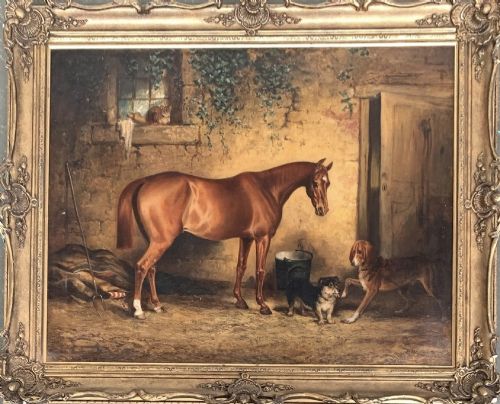
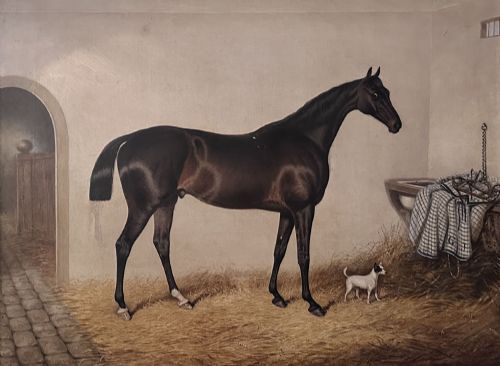
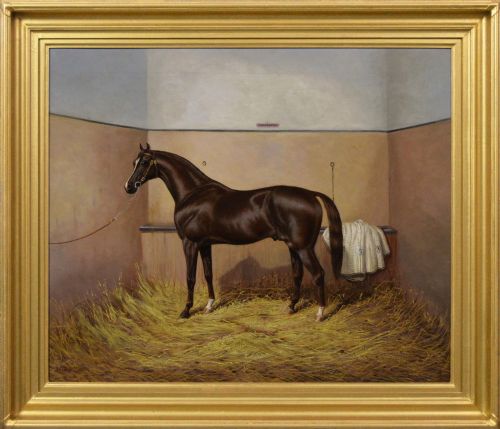
Equestrian art stable interior works focus primarily on horses housed within traditional wooden stalls, often accompanied by grooms or terriers. These pieces belong to the nineteenth century, spanning Victorian and Georgian stylistic traditions.
You will most frequently encounter oil paintings on canvas or board housed in gilt frames, depicting hunters, racehorses, and prize stallions. The subjects range from individual portraits of named animals like Worcester and Balmoral to broader scenes attributed to period artists.
How they were made
Artists of the period applied oil paint to stretched canvas or wooden boards, building up rich layers to render the musculature and coats of the horses. Canvases were typically set into heavy wood frames finished with gold leaf or gilt.
The compositions rely on traditional nineteenth-century painting techniques, balancing the dark timber tones of the stable interior with the highlighted form of the animal.
All listed pieces utilise oil paint as the primary medium, applied to either canvas or board across the nineteenth century.
What varies in quality
Quality rests on the precision of the animal's anatomy and the artist's handling of light within the confined stable setting. Superior works capture convincing depth and texture in both the horse's coat and the surrounding oak woodwork.
Attribution plays a role, with works connected to named painters such as Albert Clark or Benjamin Cam Norton carrying distinct artistic weight compared to anonymous studio pieces.
Albert Clark·Benjamin Cam Norton·Edwin Frederic Holt·Charles Bilger Spalding·John Nost Sartorius·John Ferneley Jnr·William Shayer Snr
The Equestrian Art Stable Interior Glossary
- Oil on Canvas
- Pigment mixed with drying oil applied to a woven fabric support. This was the standard medium for substantial nineteenth-century sporting art.
- Gilt
- A thin layer of gold applied to wood framing. It provides a bright border that contrasts with the dark tones of an oil painting.
- Bay
- A horse coat colour characterised by a reddish-brown body with black points on the mane, tail, and lower legs. It appears frequently in Victorian equine portraiture.
- Roan
- A horse coat pattern featuring an even mixture of white and pigmented hairs. This coloration distinguishes specific hunter types in period paintings.
Equestrian Art Stable Interior: Frequently Asked Questions
What is equestrian art stable interior?
These works are nineteenth-century oil paintings depicting horses inside stable settings, often showing hunters, racehorses, or individual named animals.
They offer a direct glimpse into Victorian and Georgian sporting culture, focusing on the relationship between horses, grooms, and their environment.
How were these paintings displayed originally?
Period paintings were typically hung in country houses, sporting estates, and stable offices to celebrate prize animals and successful hunting mounts.
Their heavy gilt frames were designed to project status and complement the dark wood panelling common in nineteenth-century interiors.
How do I identify the period?
Period attribution relies on material clues such as nineteenth-century canvas supports, oak stretcher frames, and traditional oil painting techniques.
Stylistic markers like Victorian sporting conventions and named subjects also help date the work to the eighteen-fifties, eighties, or nineteen-hundreds.
Who are the notable artists?
The evidence includes works by painters such as Albert Clark, Benjamin Cam Norton, and John Ferneley Jnr, alongside pieces in the manner of John Nost Sartorius.
These artists specialised in sporting animal subjects, capturing the precise conformation of horses during the nineteenth century.