


Entryway Wall Mirror
An entryway wall mirror greets guests and finishes a hallway, spanning Victorian wood to French Art Deco iron.
Entryway Wall Mirror
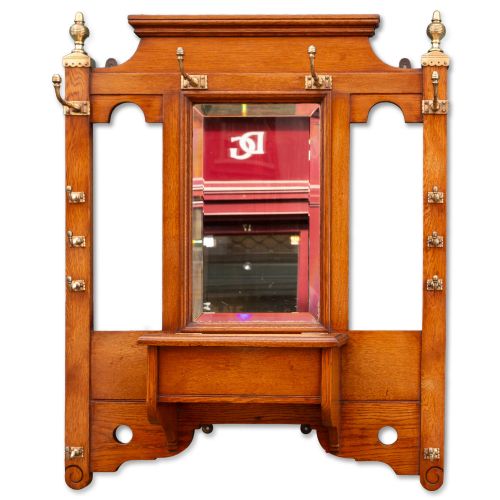
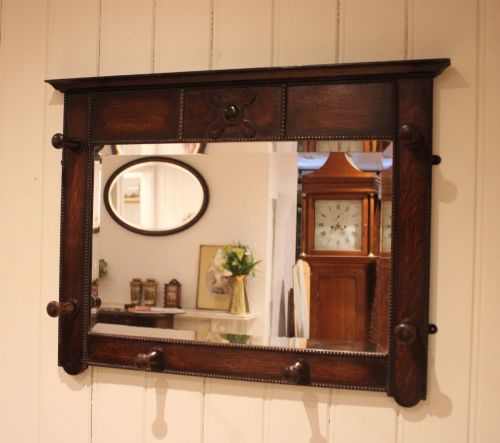
An entryway wall mirror serves utility and decoration near a door, appearing in forms from simple oak panels with coat hooks to ornate French chateau and giltwood designs. These pieces date across the nineteenth and early twentieth centuries, encompassing Victorian, Edwardian, and Art Deco styles.
The most common examples on this page combine glass with timber frames, often incorporating shelves, umbrella stands, or brass coat hooks for functional hallway use. Larger country house mirrors and console table pairings also feature prominently among the selections.
Materials and Construction
Carpenters utilised solid woods such as oak, walnut, and mahogany, frequently pairing timber frames with bevelled glass plates and brass fittings. Giltwood and gilt gesso examples rely on carved wooden bases finished with gold leaf or paint.
Metal elements appear in wrought iron and brass, particularly within French Art Deco and industrial pieces. Marble surfaces top associated console tables, providing a durable and decorative counterpoint to the wooden frameworks.
A velvet-covered mirror from 1890 softens the hard geometry of the hallway.
Assessing Quality
Quality rests upon the depth of the carving, the crispness of classical motifs, and the integration of auxiliary functions like shelves and hooks. Superior examples display refined proportions and harmonious material combinations, such as parcel gilt accents on walnut or oak.
The standard of glass silvering, the weight of the timber, and the integrity of original fixings further distinguish finer pieces from simpler domestic utility items.
The Entryway Wall Mirror Glossary
- Giltwood
- Wood that has been coated with gold leaf or a gold-coloured metallic preparation. This finish frequently highlights ornate frames and console tables.
- Console Table
- A table fixed to a wall or supported by console brackets, often paired with a matching wall mirror in hallways. These pieces provide a surface for letters and decorative objects.
- Parcel Gilt
- Partially gilded woodwork where gold leaf highlights specific carved details against a contrasting painted or stained background. It accentuates classical motifs.
- Hall Stand
- A composite piece of furniture combining a mirror, coat hooks, umbrella wells, and sometimes a small bench or glove box. They organise entranceways in larger Victorian and Edwardian homes.
- Art Deco
- A design style emerging in the early twentieth century characterised by geometric shapes, stylised motifs, and industrial materials like wrought iron.
Entryway Wall Mirror: Frequently Asked Questions
What is a last look mirror?
A last look mirror is a small wall-mounted glass positioned near a door for a final check of attire before departure. These compact pieces date predominantly to the Edwardian period.
They offer practical function without occupying the space of a full hall stand.
How were hall mirrors used?
Hall mirrors functioned as central entryway fixtures for checking appearance and reflecting light into dark corridors. Many incorporated shelves and hooks for hats and coats.
Their placement near the front door served both domestic convenience and decorative display.
Are coat hooks original?
Coat hooks on older frames are typically brass or iron, screwed directly into the timber backplate. Determining originality involves inspecting the wear around the screw heads and patina on the metal.
Replacements remain common due to heavy daily use in hallways.
How do I identify Victorian pieces?
Victorian mirrors often employ dark hardwoods like walnut and heavy oak, featuring deep mouldings and occasionally gilt gesso ornamentation. Stylistic cues draw from Baroque revivals and country house aesthetics.
Construction methods typically show hand-cut joinery and heavy backboards.