
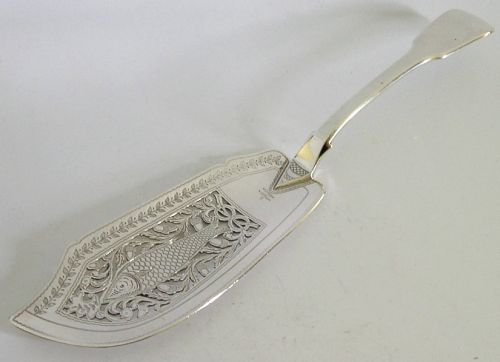
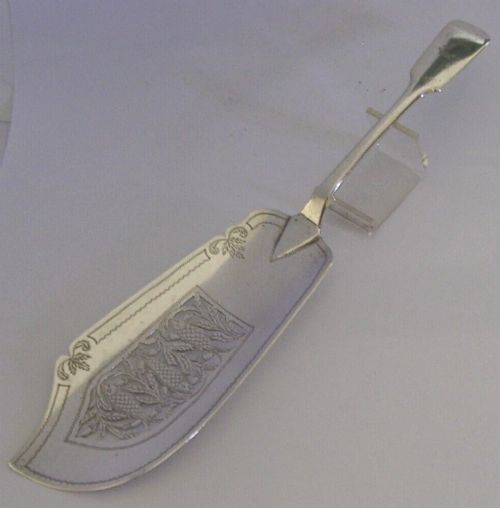
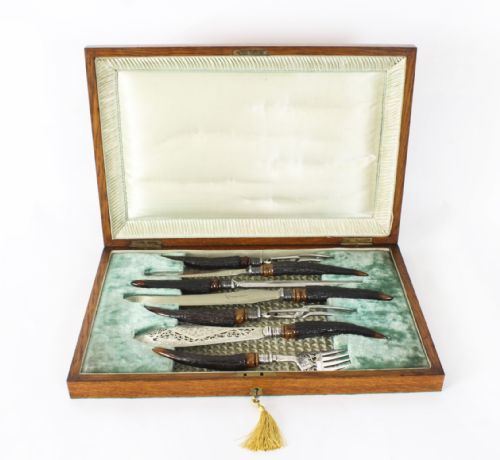


Engraved Silver Fish Slice
These engraved silver fish slice examples bring distinct period craftsmanship to the table, offering both decorative pierced blades and functional service.

Engraved Silver Fish Slice
An engraved silver fish slice is a specialised serving utensil designed for presenting fish at the dining table. Most examples encountered here date from the Georgian and Victorian periods, showcasing flat blades shaped for lifting portions.
The forms range from traditional fiddle pattern servers to French sardine servers and cased matching sets. Pierced decoration frequently adorns the blade, allowing liquid to drain when serving delicate fish courses.
Originating largely from English and French workshops, these servers often feature familial crests or detailed hunting engravings. Collectors will find both solid sterling silver and silver-plated iterations across the selection.
Materials and construction methods
The primary material is sterling silver or silver plate, shaped by hand and pierced with intricate patterns to create the characteristic blade. Silversmiths utilised traditional forging techniques to balance rigidity and elegance.
Handles introduce contrasting textures, incorporating wood, bone, stag antler, or horn secured to the metal shank. These organic materials are shaped and polished to fit comfortably in the hand during formal dining.
Engraving was applied by hand using sharp gravers to cut decorative motifs, crests, and hunting scenes directly into the metal surface. Piercing work required meticulous hand-sawing to form geometric or naturalistic voids.
The listings include sterling silver, silver plate, wood, stag antler, steel, bone, and silk across Georgian and Victorian periods.
Distinguishing quality in period servers
Quality rests in the crispness and depth of the hand engraving and the precision of the pierced blade work. Finer examples display balanced proportions between the decorated blade and the shaped handle.
The choice of handle material and its secure attachment to the shank differentiate standard production from superior pieces. Organic handles like stag antler or carved bone require careful fitting to remain flush with the metal.
Maker marks and clear hallmarking provide evidence of origin and standard, adding historical weight to the piece. The overall weight and gauge of the silver further determine the durability and tactile presence of the server.
Thomas Daniell·Charles Boyton
The Engraved Silver Fish Slice Glossary
- Sterling silver
- A silver alloy containing 92.5 percent pure silver and 7.5 percent other metals, usually copper, chosen for durability.
- Pierced
- A technique where metal is cut through to create openwork decorative patterns on the blade.
- Fiddle pattern
- A nineteenth-century flatware style featuring a stem that broadens near the end into a shoulder resembling a violin.
- Crest
- An engraved heraldic device representing a family lineage, commonly found on Victorian and Georgian silver.
- Silver plate
- A base metal coated with a thin layer of silver, offering the appearance of solid silver at a different cost.
Engraved Silver Fish Slice: Frequently Asked Questions
What is a fish slice used for?
A fish slice is a wide-bladed serving utensil created specifically for lifting and portioning fish at the dining table. The broad surface supports delicate fillets without breaking them during serving.
In period settings, these utensils formed part of formal dinner service, often accompanied by a matching fork. The pierced designs allowed oils and liquids to drain away before the food reached the plate.
How do I date a silver fish slice?
Dating relies heavily on the hallmarks stamped into the metal, which indicate the assay office, year of production, and maker. These official marks provide precise chronological markers for English pieces.
Stylistic elements like fiddle patterns, handle materials, and the style of engraving also offer strong clues to the period. Victorian pieces often show heavier ornamentation, while Georgian designs tend toward restrained elegance.
Why are some handles made of antler?
Antler and horn were utilised during the Victorian era to match the rustic themes popular in dining accessories, particularly for game and fish services. These materials provided a secure, textured grip for the user.
Such handles reflect the broader nineteenth-century interest in outdoor pursuits and naturalistic design. They were shaped to fit the hand while complementing the engraved hunting scenes on the blades.