


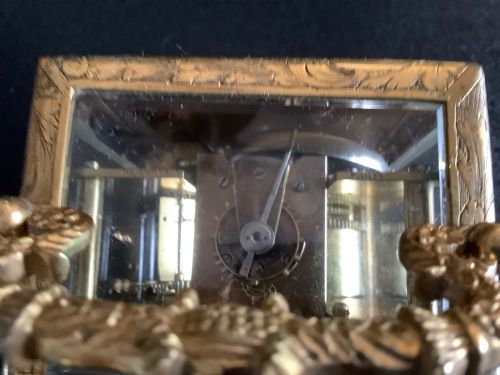


Engraved Gilt Dial Clock
An engraved gilt dial clock brings precision movement and polished brass presence to any mantel, combining functional timekeeping with decorative metalwork.
Engraved Gilt Dial Clock
When you search for an engraved gilt dial clock, you encounter timepieces predominantly built as carriage clocks or mantel clocks from the nineteenth century and the Edwardian era. These pieces frequently originate from French workshops or English makers, spanning periods from the 1850s to 1900.
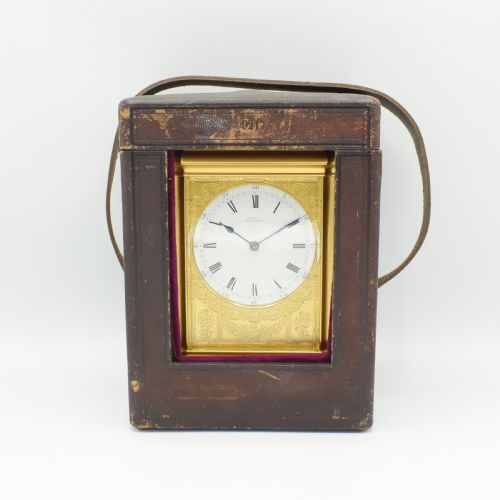
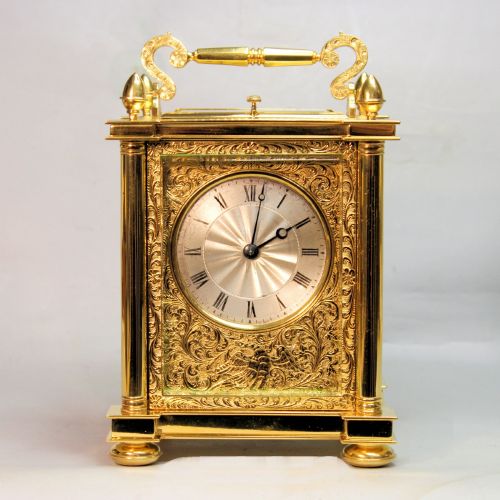
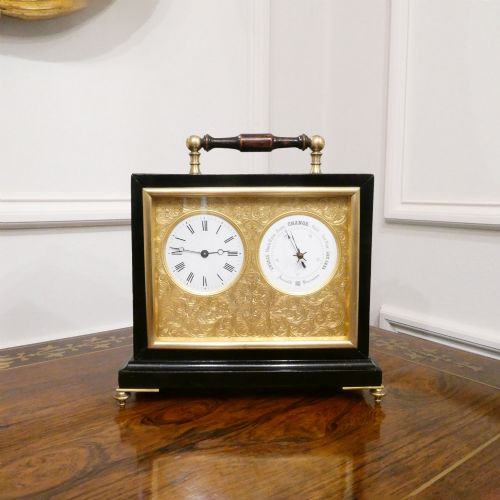
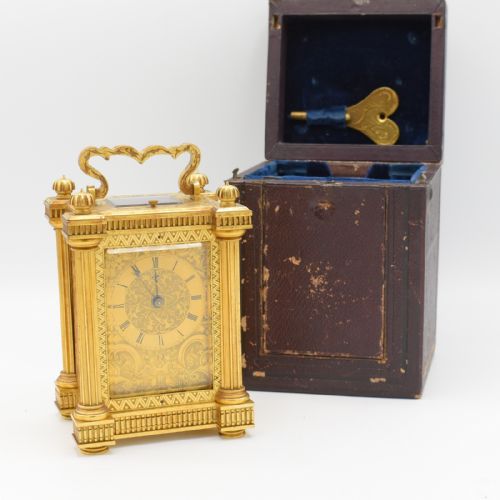
The selections on this page centre upon carriage clocks and mantel clocks featuring gilt brass cases and engraved dials. Many examples incorporate repeating mechanisms, alarms, or barometer combinations set behind glass panels.
Makers and retailers such as Howell & James, Mappin and Webb, and Charles Frodsham appear alongside French names like Drocourt and Paul Garnier. Buyers find both miniature travel pieces and substantial fusee clocks among the current selection.
Materials and Technique
The construction relies heavily on gilt brass for the cases, paired with glass panels that reveal the interior escapement and gear trains. Enamel dials and silvered metal masks provide contrasting surfaces for the numerals, while leather travel cases occasionally accompany the pieces.
Engraving techniques transform the gilt brass surfaces and mask plates with scrolling foliage, geometric patterns, or floral motifs. Mechanical complexity is achieved through eight-day movements, platform escapements, and fusee gear systems.
Listings feature brass, gilt brass, ebonised wood, and glass across Victorian and Edwardian periods.
Assessing Quality
Quality reveals itself in the crispness and depth of the hand engraving across the brass case and dial mask. Deeper, more intricate incisions indicate superior craftsmanship compared to shallow or machine-assisted marking.
The sophistication of the movement dictates another tier of distinction, with fusee movements and repeating complications representing higher manufacturing skill. Makers who signed their work or supplied retailers like Hunt and Roskell typically demonstrate superior internal finishing and platform escapement design.
Cousens & Whiteside·Howell & James·Delépine-Barrois·Gontard & Bolviller·Mappin and Webb·Arnold and Frodsham·Thomas Cole·James Cole·Hunt And Roskell·Charles Frodsham·Holingue Frères·Drocourt·Paul Garnier·Tiffany
The Engraved Gilt Dial Clock Glossary
- Gilt brass
- Brass coated with a thin layer of gold or gold-coloured alloy to provide a bright, corrosion-resistant finish. This material forms the primary housing for the majority of nineteenth-century carriage clocks.
- Platform escapement
- A self-contained regulating mechanism mounted on a small platform inside the clock. It replaced the pendulum in portable timepieces, allowing them to keep accurate time while moving.
- Fusee
- A conical pulley used in mechanical clocks to maintain even power delivery as the mainspring unwinds. This mechanism improves timekeeping accuracy across the duration of the wind.
- Repeater
- A complication that strikes the hours and quarters on demand when a button or lever is pressed. It allowed owners to check the time in darkness without lighting a candle.
- Gorge case
- A specific style of carriage clock case featuring stepped mouldings at the top and base. This design is frequently associated with makers like Drocourt.
Engraved Gilt Dial Clock: Frequently Asked Questions
What is a carriage clock?
A carriage clock is a small, portable spring-driven timepiece designed for travel during the nineteenth century. They usually feature a brass case with glass panels and a handle on top.
Most examples run for eight days on a single wind and sit upon a platform escapement that maintains accuracy despite movement.
How do repeating mechanisms work?
A repeating mechanism sounds the last elapsed hour and quarter-hour when the owner presses a button on the top of the case. This complex internal addition relies on extra gongs and hammers.
Clocks with this feature were particularly useful at night before electric lighting made checking the time straightforward.
How do I wind these clocks?
Winding requires a matching key inserted into the arbours located through the back door or the base of the case. Turning the key tensions the mainspring inside the barrel.
Care must be taken not to overwind the movement, stopping as soon as resistance is felt to protect the internal spring.
How do I date a French carriage clock?
Dating relies on stylistic shifts in the case shape, the engraving patterns, and occasionally serial numbers stamped on the backplate. Earlier pieces from the 1850s often display simpler one-piece frames and silvered masks.
Maker marks and retailer signatures engraved on the dial or movement backplate also help narrow the decade of production.