


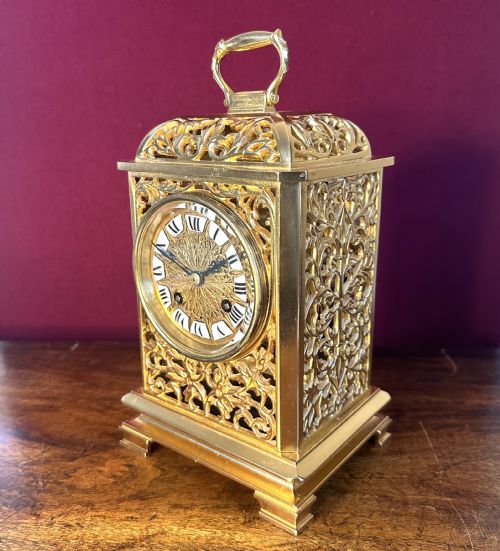




Engraved French Carriage Clock
An engraved french carriage clock brings precise timekeeping and intricate brasswork together in a portable form that suits any mantelpiece.
Engraved French Carriage Clock
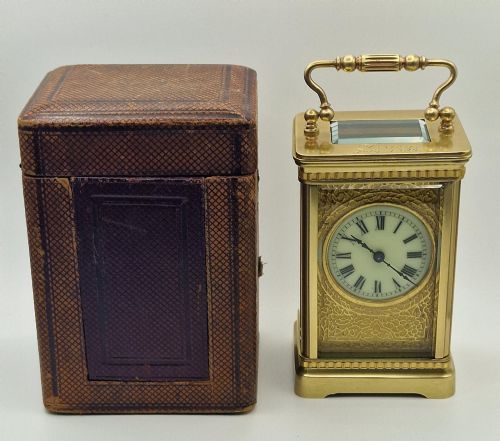
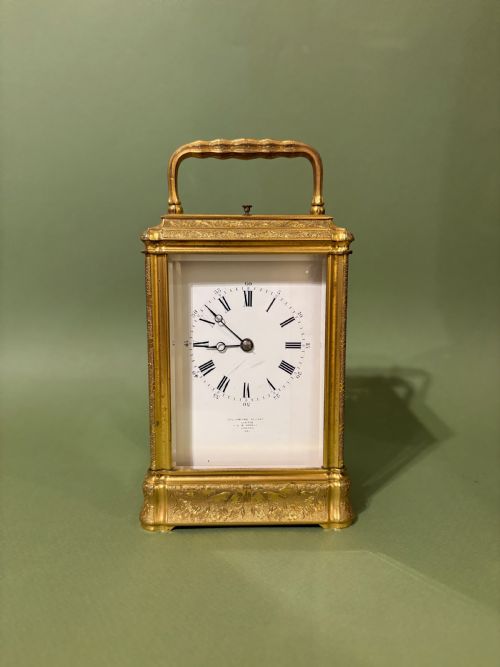
When you search for an engraved french carriage clock, you encounter portable timepieces produced across the nineteenth century by makers working in France. These clocks combine bevelled glass panels with cast metal frames, designed originally for travel before becoming staples of nineteenth-century interiors.
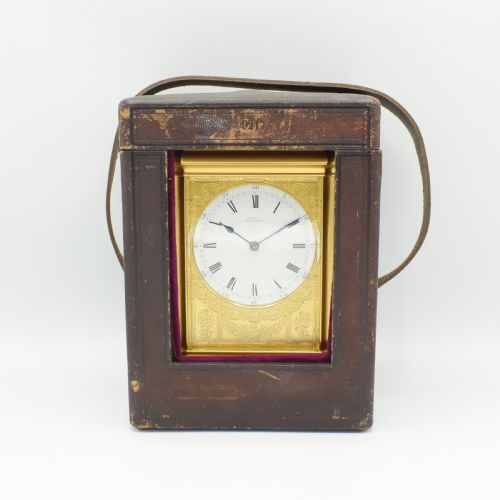
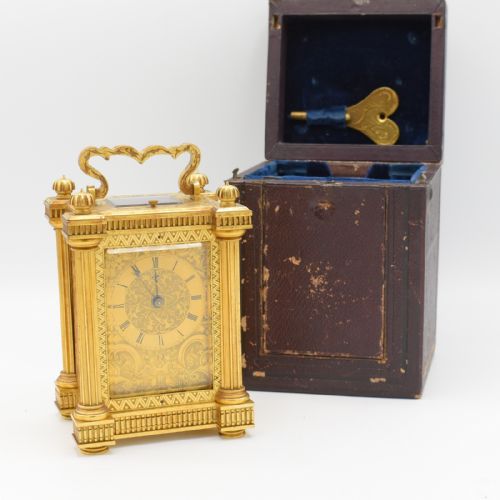
The versions most common on this page date from the mid-to-late Victorian era, featuring brass cases decorated with hand-engraved scrollwork, floral motifs, or architectural patterns. They range from miniature examples to giant repeating models, often retaining their original leather travelling cases and winding keys.
Makers such as Drocourt, Henri Jacot, and Margaine signed many of the finest surviving pieces, marking them with specific maker's marks on the backplate. Unsigned examples remain common, yet share the same heavy gilt bronze construction and escapement mechanisms.
Materials and Technique
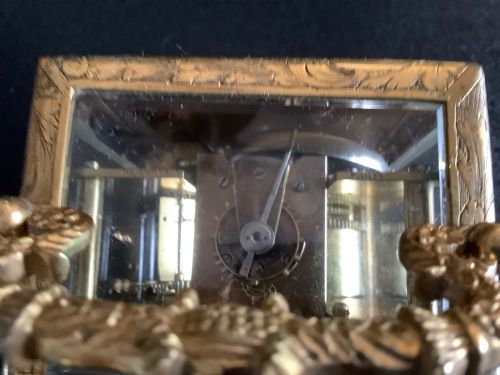
Makers constructed these clocks using heavy brass frameworks, often applying a layer of fire gilding or mercury gilding to create the characteristic warm finish. Heavy glass panels, secured by the brass housing, allow light to reach the internal gear trains and white enamel dials.
Engravers worked by hand directly onto the metal cases, cutting floral patterns and geometric borders into the solid brass surfaces with sharp burins. The dials frequently feature subsidiary enamel chapters or gilt brass masks, surrounded by further engraved scrollwork.
Several clocks were built specifically for export markets, carrying travellers across continents long before commercial aviation existed.
Distinctions in Quality
Quality depends upon the depth and crispness of the hand engraving across the brass case, alongside the complexity of the internal movement. Clocks with repeating mechanisms, alarm functions, or grand sonnerie strikes represent a higher tier of horological production than standard time-only pieces.
The weight and thickness of the gilt brass casting also dictate quality, with superior pieces showing tight tolerances in the fit of the bevelled glass and sturdy platform escapements. Maker signatures from known houses add documented precision to the mechanical work.
HENRI JACOT·Howell and James London·Margaine Of France·Delépine-Barrois·Gontard and Bolviller Paris·Mappin and Webb·Charles Frodsham and Holingue Frères·Drocourt·Paul Garnier Paris·Bourdin Paris·Tiffany·E.J.Dent - Paul Garnier·L Epee·Alfred Hollinge·Francois Arsene Margaine·Soldano·Pons
The Engraved French Carriage Clock Glossary
- Carriage clock
- A small, portable spring-driven timepiece designed for travel during the nineteenth century. These clocks typically feature a rectangular brass case with glass panels on all four sides and the top.
- Gorge case
- A specific style of carriage clock case featuring a stepped, stepped-cornice top and distinctively shaped pillars. This form appeared frequently in work by makers such as Drocourt.
- Platform escapement
- The horizontal assembly containing the balance wheel and hairspring, visible through the glass top of the clock. It regulates the timekeeping by controlling the release of power from the gear train.
- Repeating mechanism
- A complication that strikes the hours and quarters on demand when a button on the case is pressed. This allowed owners to check the time in the dark without lighting a candle.
Engraved French Carriage Clock: Frequently Asked Questions
How do I wind a carriage clock?
Most pieces require a key inserted into the winding square on the underside or backplate of the movement. Turn the key gently until resistance signals the mainspring is fully wound.
Avoid overwinding the mechanism, as this places undue tension on the internal springs. Regular winding at the same time each week keeps the escapement running consistently.
What is a platform escapement?
The platform escapement is the small self-contained regulating unit mounted visibly at the top of the movement. It replaces the pendulum used in stationary clocks, allowing the timepiece to keep accurate time while portable.
Inspect this area for dust or accumulated debris, which can impede the tiny balance wheel. Professional cleaning ensures this delicate assembly maintains its rhythm.
How do repeating clocks work?
A repeating movement sounds the last elapsed hour and quarter hours when a plunger or button on the top case is pressed. Internal racks and gongs orchestrate these chimes independently of the running train.
This function relies on a secondary spring train dedicated solely to striking the bell or gongs. Operating the repeater requires a firm, deliberate press until the sequence finishes.
Are original travel cases common?
Original leather-covered travelling cases occasionally survive alongside the clocks, often lined with velvet or silk. These sturdy outer boxes protected the gilt brass and glass during transit.
Finding a clock with its matching case adds context to its history as a portable object. The leather surfaces show wear consistent with nineteenth-century journeys.