
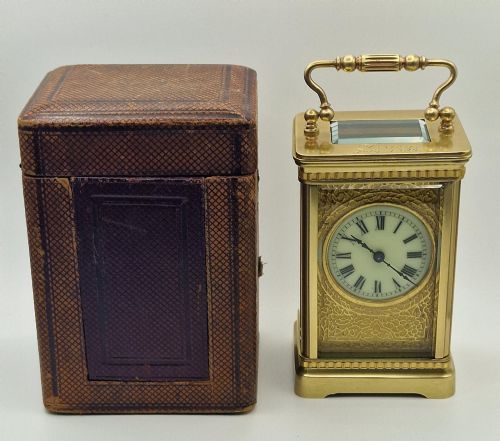
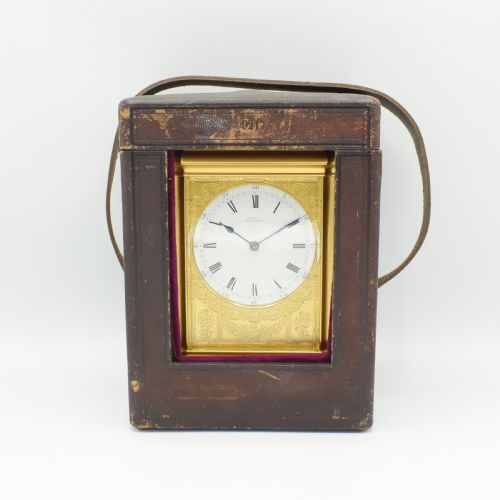
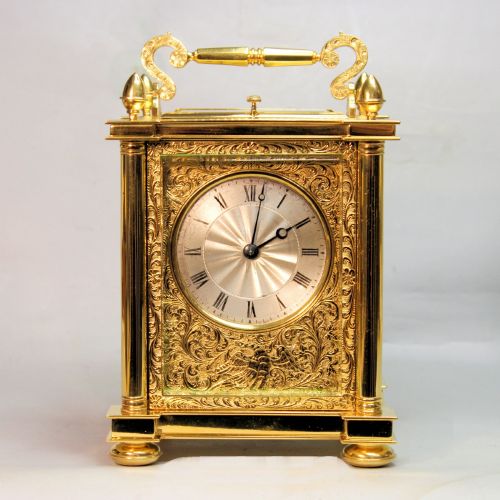
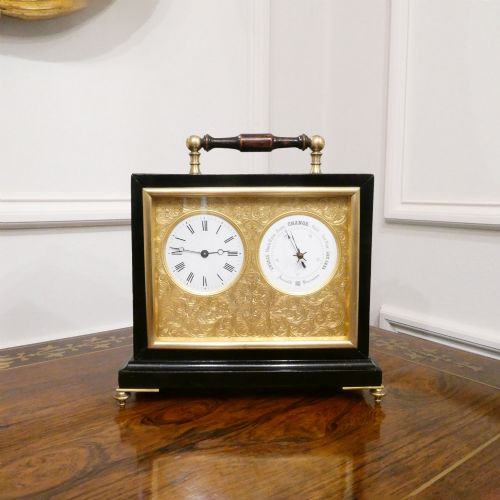
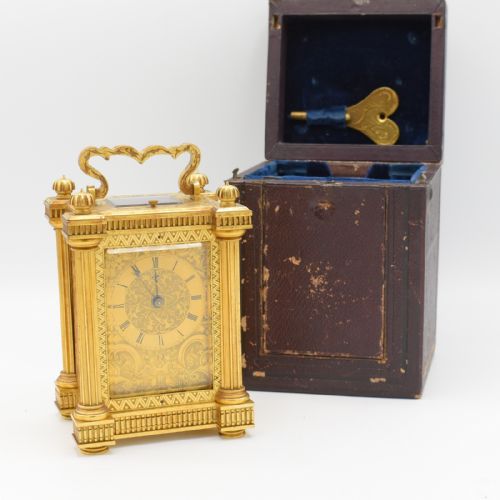




Engraved Dial Carriage Clock
An engraved dial carriage clock combines precision horology with decorative metalwork, offering a portable timepiece built for travel and formal interiors.
Engraved Dial Carriage Clock
Assessing Quality and Execution
Quality rests in the crispness and depth of the hand engraving across both the dial mask and the exterior brass case. Finer examples display intricate, uniform patterns without shallow cuts or blurring.
The sophistication of the internal movement dictates overall standing. Pieces featuring complications like repeating mechanisms, alarm functions, or platform escapements by known makers represent the higher tier of production.
The listings here include nineteenth-century French and English pieces utilising gilt brass, enamel, and glass across Victorian and Edwardian periods.
Cousens and Whiteside·Margaine·Delépine Barrois·Gontard and Bolviller·Mappin and Webb·Arnold and Frodsham·Thomas Cole·James Cole·Hunt and Roskell·Charles Frodsham·Holingue Freres·Drocourt·Paul Garnier·Tiffany·E J Dent·L Epee·Alfred Hollinge·Richard and Co
The Engraved Dial Carriage Clock Glossary
- Carriage clock
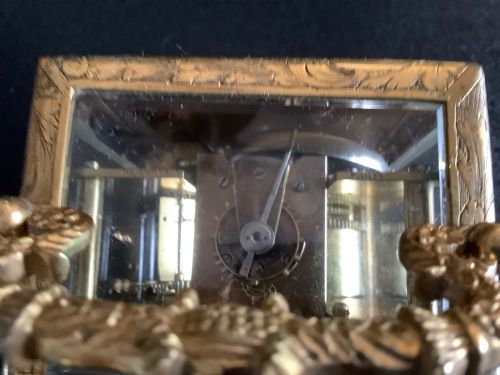
- A small, spring-driven portable clock fitted with a carrying handle, originally developed for travellers in the nineteenth century. These clocks usually feature glass panels that expose the escapement.
- Escapement
- The mechanical mechanism that controls the release of power to maintain the motion of the clock. Platform escapements sit visibly on top of the movement train.
- Fusee
- A conical pulley used in higher-grade clocks to equalise the decreasing power of the mainspring as it unwinds. This mechanism ensures even tension throughout the running period.
- Mask
- The decorative metal plate surrounding the central dial face, frequently engraved with floral or geometric motifs. It serves to frame the chapter ring and hide the front plate of the movement.
- Repeater
- A mechanism that strikes the hours and quarters on demand when a lever or button is pressed. This feature allowed owners to check the time in the dark.
- Chapter ring
- The circular band on the dial face that bears the numerals for the hours and minutes. On engraved dials, this ring is often set against a richly carved background.
Engraved Dial Carriage Clock: Frequently Asked Questions
What is a repeating carriage clock?
A repeater is a clock that sounds the last elapsed hour and quarter-hour when a button on top of the case is depressed. This function was designed for checking the time during the night without striking lights.
Mechanically, it uses an independent train of wheels and hammers operating on a small internal bell or gong.
How do I set the time safely?
Move the minute hand forward by hand when adjusting the time, taking care not to push the hand backward through the gear train. On striking models, pause briefly at each hour mark to allow the striking sequence to complete.
Avoid touching the delicate escapement visible through the top glass panel during adjustment.
Where should I place a carriage clock?
Position the clock on a stable, level surface away from direct sunlight, draughts, and damp environments. A mantelpiece, desk, or secure table provides a suitable environment for daily viewing.
Ensure the surface does not experience heavy vibrations that might disrupt the beat of the platform escapement.