




Engraved Barware Glass
Engraved barware glass brings together heavy decanters, spirit dispensers and matched sets that hold and pour your drinks with historic character.
Engraved Barware Glass
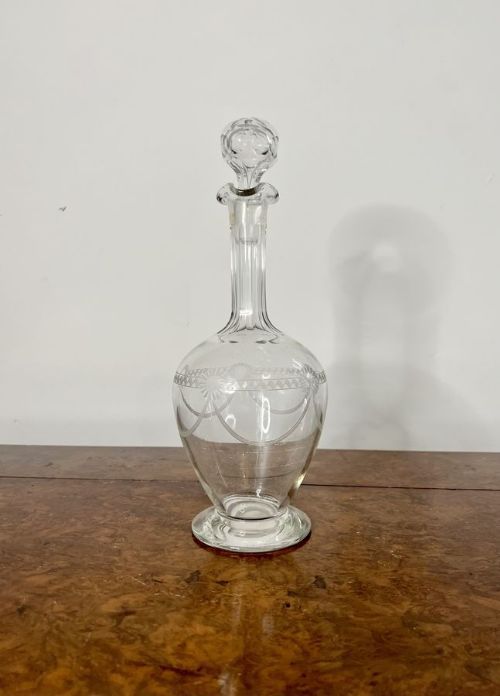
When you search for engraved barware glass, you encounter vessels designed for serving wine, spirits and ale across several historic eras. The selection on this page centres on decanters, claret jugs, spirit dispensers and goblets spanning from the Georgian period through to the Edwardian years.
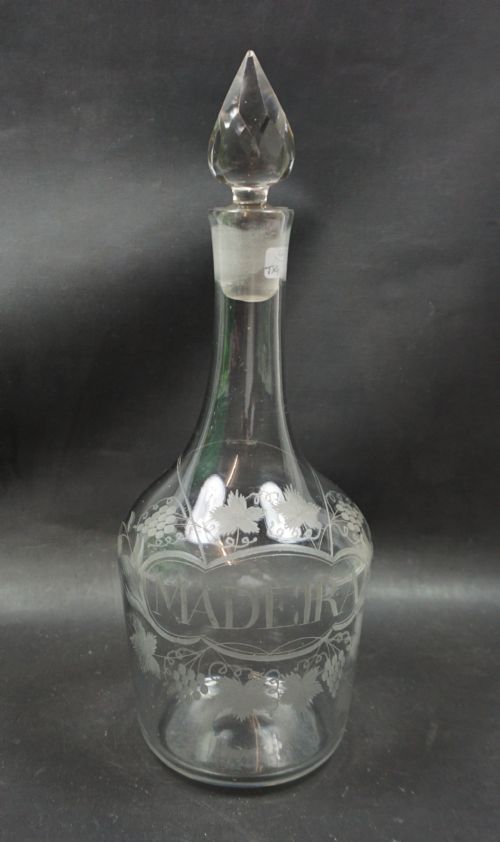
You meet Georgian shoulder decanters alongside Victorian spirit dispensers and Edwardian ale glasses. Many pieces display specific drink labels such as 'Madeira', 'Brandy' or 'Whisky' etched directly into the clear surface.
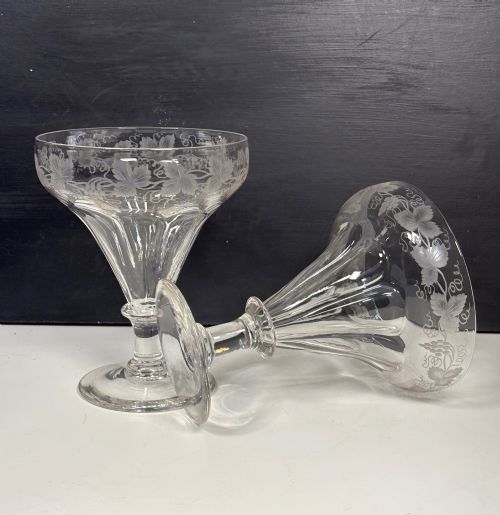
The assortment also includes matched drinking sets, champagne coupes and silver-mounted wine carafes. These items reflect the domestic routines of dining rooms and drawing rooms from the eighteenth century into the early twentieth century.
Materials and construction
The foundation of these objects is clear glass, lead crystal or lead glass, formed through blowing and sometimes heavy cutting. Makers utilised optical blowing techniques to create subtle internal patterns within the vessel walls.
Metal mounts in sterling silver, silver plate, brass and wrought iron frequently encase the glass bodies. Silversmiths and metalworkers added hinged lids, handles, collars and decorative trays to complete the drinking vessels.
Surface decoration relies on wheel engraving and etching to produce lettering and ornamental motifs. Parcel gilt finishes and wrought iron frames further enhance specific Victorian and Art Nouveau examples.
Engraved Barware Glass Retail Price Guide 2026
Typical asking prices for engraved barware glass among the pieces listed under this phrase on Sellingantiques today, from the lower quarter to the upper quarter. They describe what is for sale here now, not the wider market.
Listings span Victorian, Edwardian, Georgian and Regency periods, utilising glass, sterling silver, silver plate, brass and lead crystal.
The markers of distinction
The distinction between standard production and top-tier execution rests on the crispness of the glass cutting and the depth of the wheel engraving. Finer pieces demonstrate precise control in lettering and ornamentation without surface blurring.
The integration of metal mounts dictates overall calibre, particularly where hallmarked sterling silver or substantial silver-plate frames secure the glass. Superior makers combined heavy crystal weights with balanced mounts that feel substantial in the hand.
Completeness within sets and matched pairs elevates the standing of individual items. Matched groupings of glasses or decanters paired with original trays maintain higher integrity than isolated survivors.
William Comyns·James Powell·Aleksandr Timofeyevich Shevyakov
The Engraved Barware Glass Glossary
- Shoulder decanter
- A decanter with a broad, flat shoulder tapering down to a cylindrical or panel-cut base. This form was common in eighteenth-century English glass production.
- Claret jug
- A pouring vessel designed specifically for red wine, usually featuring a metal handle, hinged lid and collar mounted onto a glass body. Silver plate and sterling silver mountings are typical.
- Parcel gilt
- A surface treatment where selected areas of metalwork are highlighted in gold while the surrounding silver retains its natural finish. This technique appears on Victorian goblets and cups.
- Optical blown
- A glassblowing method where molten metal is inflated inside a ribbed or patterned mould to create subtle internal ripples or optic effects in the walls of the vessel.
- Champagne coupe
- A shallow, broad-bowled stemglass designed for sparkling wines. Edwardian sets frequently employ etched crystal for these celebratory glasses.
Engraved Barware Glass: Frequently Asked Questions
What are engraved barware glass decanters?
Engraved barware glass decanters are historic vessels created to hold and serve wines and spirits at the dining table. They feature wheel-cut designs, decorative motifs and often inscribed beverage labels.
Craftsmen produced these vessels in clear glass and lead crystal, sometimes mounting them with silver or metal hardware for pouring.
How do I identify Georgian decanters?
Georgian decanters typically display heavy lead glass construction with distinct shoulder profiles and hand-engraved labels. They rely on simple, robust proportions rather than ornate Victorian ornamentation.
Many examples from this era feature faceted necks and polished pontil marks on the underside.
Were these glass sets used daily?
These pieces served practical functions in formal dining rooms and private drawing rooms for serving wine, whisky and ale. Families utilised them during meals and evening gatherings.
Over time, many of these functional items transitioned into display pieces and collector cabinets.
How should I clean antique glass?
Antique glass requires gentle hand washing in lukewarm water with mild soap to preserve the surface finish and engraving. Avoid extreme temperature changes to prevent cracking.
Metal mounts need separate care using appropriate polishes that will not stain the surrounding glass.