





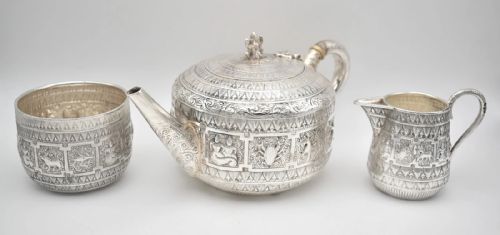
English Silver Tea Service
An English silver tea service brings the weight and ceremony of the table into daily life, offering coordinated elegance in sterling or plate.
English Silver Tea Service
An English silver tea service encompasses matching or assembled sets designed for the formal serving of tea and coffee, frequently appearing alongside individual teapots, cream jugs, and sugar bowls. These gatherings of vessels span periods from the Georgian era through the Victorian age and into the Art Deco epoch.
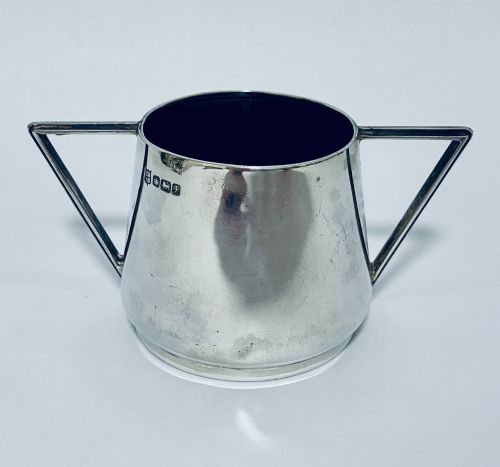
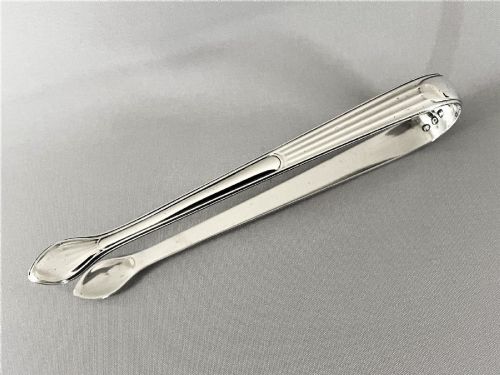
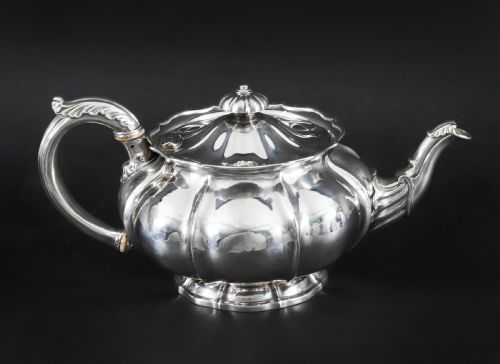
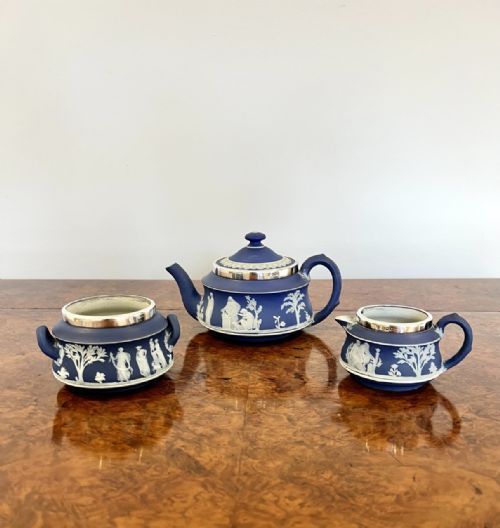
The configurations on this page range from simple three-piece assemblies to substantial four-piece sets comprising teapots, coffee pots, creamers, and sugar basins. Materiality shifts between solid sterling silver and silver plate, often augmented by elements of wood, bone, or ceramic bodies such as Jasperware.
Makers and silversmiths of various historical periods shaped these objects in distinct stylistic idioms, including George III, George IV, Regency, Edwardian Rococo Revival, and Victorian Anglo-Indian. Buyers encounter both provincial British pieces and metropolitan London work, each bearing the marks of its specific time.
How they were made
Silversmiths constructed solid sterling silver vessels through hammering, raising, and soldering sheet metal, shaping bodies to rest on tailored feet or bases. Handles frequently incorporate insulating spacers of wood or bone to prevent heat transfer during use.
Silver plated sets rely upon a base metal foundation coated with a layer of silver, achieving substantial decorative presence without the weight or cost of solid metal. Many pieces integrate non-silver elements, such as Wedgwood Jasperware or stoneware bodies, mounted securely in silver collars.
Decoration stems from techniques such as chasing, embossing, and engraving, producing naturalistic foliate designs, zodiac motifs, or ornate rococo scrollwork. Makers also applied gold gilt wash to the interior surfaces of sugar bowls and cream jugs to protect the metal from acidic contents.
English Silver Tea Service Retail Price Guide 2026
Typical asking prices for english silver tea service among the pieces listed under this phrase on Sellingantiques today, from the lower quarter to the upper quarter. They describe what is for sale here now, not the wider market.
Listings feature periods spanning from the Georgian era and Regency through Victorian times, Edwardian years, and into the 1920s Art Deco period.
What varies in quality
The standard of a service rests on the crispness of its chasing and the structural integrity of its joints, spouts, and hinges. Master silversmiths like Paul Storr or Benjamin Smith achieved a weight and balance in their handles and finials that lesser workshops rarely matched.
Coherence sets multi-piece services apart, as matched sets produced concurrently by a single maker hold a distinct design harmony compared to assembled groups gathered later. The presence of clear, legible hallmarks confirms the provenance and standard of the silver.
Bateman Family·Paul Storr·Benjamin Smith·Francis Higgins·George Fox
The English Silver Tea Service Glossary
- Sterling silver
- A silver alloy containing 92.5 percent pure silver by mass, with the remainder composed of copper or other metals. This standard has served as the baseline for British silver manufacture for centuries.
- Silver plate
- A manufacturing method where a thin layer of silver is bonded to a base metal substrate. This technique allowed wider households to own expansive tea services during the nineteenth and twentieth centuries.
- Jasperware
- A type of fine stoneware developed by Josiah Wedgwood, characterised by its matte finish and applied white reliefs. Examples in tea sets are often mounted in silver frames.
- Hallmark
- A system of official marks stamped on precious metals in Britain to indicate the purity, the assay office, the maker, and the year of production. These stamps provide the primary evidence for dating an antique.
- Chasing
- A metalsmithing technique where the artisan pushes metal from the exterior using hammers and punches to create raised decorative designs. It differs from engraving, which removes metal from the surface.
English Silver Tea Service: Frequently Asked Questions
How do I clean a silver tea service?
Maintenance requires gentle washing in warm, soapy water followed by thorough drying with a soft cloth to preserve the finish. Avoid abrasive dips or harsh scrubbing that can damage delicate chased details and historic hallmarks.
Regular handling naturally retards tarnish on high points, while stored pieces benefit from occasional application of specialist silver polish used sparingly. Keeping wooden and bone handle components dry prevents the natural materials from cracking or loosening over time.
What is the difference between a tea set and a tea service?
A tea set typically focuses solely on the preparation and pouring of tea, usually consisting of a teapot, cream jug, and sugar bowl. A full tea service often expands to include coffee pots and larger hot water vessels.
Many surviving groupings are assembled over time rather than created as a single unit by one silversmith. Examining the hallmarks across each component reveals whether the pieces were manufactured together or matched up later.
How can I date an English silver tea service?
Dating relies primarily on the stamped hallmarks found on the base or rim of solid silver components. These marks include a date letter corresponding to the assay office and year of testing.
Stylistic cues such as the neoclassical lines of the Georgian period or the geometric shapes of Art Deco provide secondary confirmation. Comparing the form and decorative motifs to documented examples helps narrow the production window.
Were these services used every day?
Historic tea services served central roles in household entertaining and daily domestic rituals, particularly among affluent families. The inclusion of internal gilt washes in sugar and cream vessels helped protect the silver from corrosive contents during regular service.
Heavier Victorian and Edwardian examples were built to withstand active use in busy drawing rooms. Over generations, many pieces transitioned from active hospitality items to decorative display objects.