

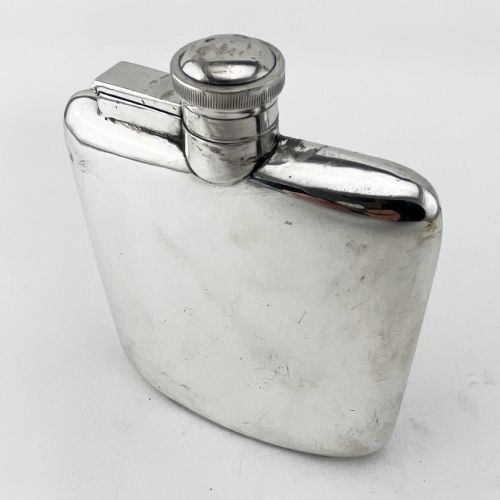


English Silver Flask
An english silver flask brings pocket-sized elegance to spirits and scents, offering tactile history from Victorian and Edwardian days.
English Silver Flask
When searching for an english silver flask, buyers encounter pocket containers designed for spirits or perfume, predominantly dating from the late Victorian period through the Edwardian era and into the Art Deco years of the twentieth century.
The selections available range from curved metal hip flasks meant for hunting and shooting to glass scent bottles with silver screw caps and liquor flasks wrapped in crocodile skin or leather.
Most pieces stem from Birmingham or London silversmiths, combining sterling silver mounts, collars or entire bodies with clear, cut or coloured glass.
Materials and Construction
Makers utilised sterling silver and silver plate for bodies, caps and mounts, often combining metal with heavy clear or cut glass, Mary Gregory glass, or green overlay glass.
Organic textures appear through the use of crocodile skin, alligator hide and leather wrapped around glass or metal cores, secured with tight stitching or silver collars.
Metal fabrication involved hammering, plain polishing, and enamelling, paired with hinged flip tops, screw mechanisms and secure bayonet closures for liquid containment.
Listings feature sterling silver and silver plate combined with clear glass, cut glass, crocodile skin, and enamel across Victorian and Art Deco forms.
Assessing Quality
Quality rests in the weight of the silver, the crispness of maker marks and hallmarks, and the precision with which metal mounts fit glass or leather bodies.
The refinement of decorative elements, such as chased cherub motifs, hammered surfaces, or smooth enamel work, separates standard utility pieces from high workshop productions.
Survival of original components, including tight-sealing flip tops, matching screw caps, and intact skin or glass without internal fractures, determines the standing of an example.
Asprey London·Henry Perkins·William Neale·JB Chatterley and Sons·Barnsley and Co·Mappin and Webb·James Dixon and Sons
The English Silver Flask Glossary
- Sterling silver
- A silver alloy containing 92.5 percent pure silver and 7.5 percent other metals, typically copper, used for durable durability and hallmarks.
- Flip top
- A hinged lid mechanism on a flask designed for quick access to contents while maintaining a tight seal against leakage.
- Mary Gregory glass
- Victorian glass decorated with white enamel silhouettes of children or figures amidst foliage, frequently mounted with silver tops.
- Overlay glass
- Glass featuring a clear or coloured base covered by a second layer of contrasting glass, cut away to reveal the design beneath.
- Hallmark
- Official stamps struck on precious metals indicating the maker, assay office, standard of purity, and year of testing.
English Silver Flask: Frequently Asked Questions
What were english silver flasks used for?
These pieces served as portable containers carried in pockets during hunting, shooting, and riding expeditions to hold spirits or liquor.
Smaller variations functioned as perfume or scent bottles, keeping personal fragrances ready for daily use or travel.
How do I know the date of my flask?
Assay office hallmarks stamped onto the silver metal provide exact dating letters corresponding to specific registry years.
Stylistic markers such as Edwardian restraint or geometric Art Deco lines also point to the decade of manufacture.
Are crocodile skin flasks genuine?
Period pieces frequently incorporated genuine crocodile or alligator skin wrapped around glass or metal body frames.
These natural textures were chosen for grip and durability during outdoor pursuits.
How should I clean silver and glass?
Sterling silver components respond well to gentle cleaning with a soft polishing cloth specifically formulated for precious metals.
Glass bodies can be washed with warm water, keeping moisture away from glued or skin-wrapped exterior sections.