

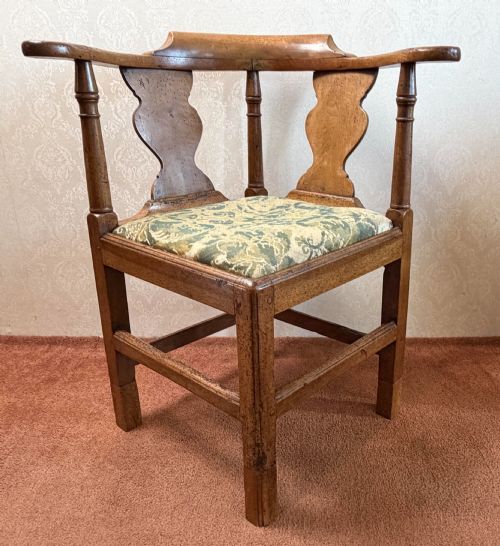


English Oak Corner Chair
An english oak corner chair provides a sturdy seat designed to fit snugly into a room junction.
English Oak Corner Chair
An english oak corner chair is a specialised seating form built to occupy room angles efficiently, offering a curved backrest supported by multiple uprights above a corner seat. Examples on this page span the eighteenth century, the Victorian era, and nineteen hundred, taking the shape of armchairs and side chairs.
The styles range from George II and Georgian vernacular pieces to Victorian Gothic Revival and Saxon Revival interpretations. Buyers encounter standard corner armchairs alongside related vernacular forms like turner's chairs and spinning chairs.
Materials and construction
Makers built these pieces primarily from English oak and beech, sometimes combining woods within a single frame. Certain examples incorporate rush or fabric upholstery to form the seat.
Construction techniques include traditional turning and carving, visible in the spindled backs and structural supports seen across Victorian Gothic and eighteenth-century pieces.
English Oak Corner Chair Retail Price Guide 2026
Typical asking prices for english oak corner chair among the pieces listed under this phrase on Sellingantiques today, from the lower quarter to the upper quarter. They describe what is for sale here now, not the wider market.
Some Victorian examples mimic ancient Saxon thrones, letting you command your living room like a minor Anglo-Saxon king.
Assessing quality
Quality rests in the crispness of the turning and the depth of the carved detail on the crest rails and splats. Pieces that retain their original timber surfaces show superior integrity compared to heavily altered examples.
The proportion of the curved back and the soundness of the corner joints distinguish standard vernacular production from finer stylistic expressions.
The English Oak Corner Chair Glossary
- Corner chair
- A chair specifically designed to fit into a room angle, featuring a diagonal seat plan and a continuous curved backrest. This form maximises seating space in compact areas.
- Turner's chair
- A sturdy armchair constructed entirely from turned wooden spindles and rails, often associated with early vernacular traditions. These seats reflect heavy, solid woodworking techniques.
- Gothic Revival
- A nineteenth-century design style drawing inspiration from medieval architecture and ornament. It frequently employs pointed arches and elaborate tracery on wooden furniture.
- Rush
- A natural material woven to create traditional seats. It provides a durable and flexible surface for daily sitting.
English Oak Corner Chair: Frequently Asked Questions
What is an english oak corner chair?
An english oak corner chair is a domestic seat built on a diagonal plan to slot directly into the corner of a room.
These pieces feature curved back rails supported by pillars above a square or horseshoe-shaped seat.
How were they used historically?
These seats served primarily in parlours and studies where space was at a premium and corner placement kept the floor clear.
Their enclosed backs offered protection from draughts near fireplaces and windows.
How do I date an antique example?
Dating relies on examining construction methods, timber patination, and the stylistic vocabulary of the turnery or carving.
Eighteenth-century models display simpler vernacular framing, whereas Victorian examples often incorporate Gothic Revival motifs.
What woods were used?
Makers relied heavily on English oak as the primary structural timber, occasionally supplementing it with beech.
Seats were finished with solid wood, woven rush, or added fabric upholstery.