




English Music Canterbury
English music canterbury pieces are tiered wooden stands made to hold scores and papers, offering refined utility for any room.
English Music Canterbury
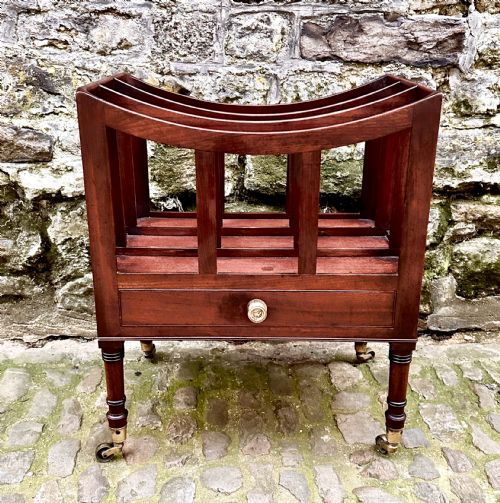
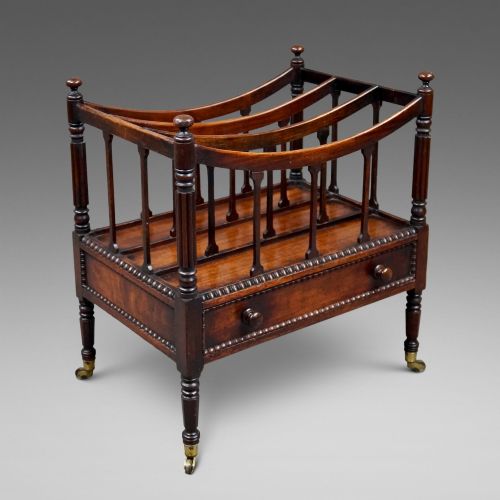
An english music canterbury is a distinct compartmentalised stand designed to hold sheet music, newspapers, and periodicals within domestic interiors. These pieces appear across the Georgian, Regency, William IV, Victorian, and Edwardian periods.
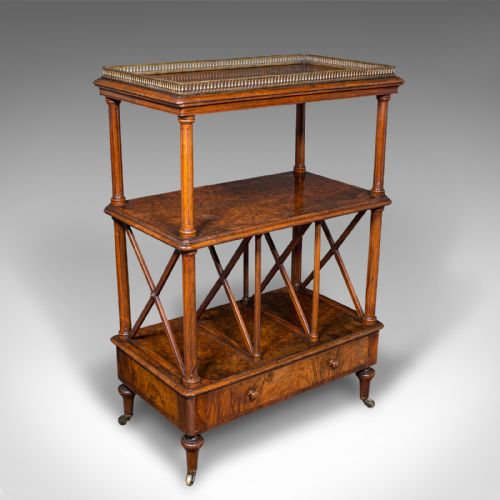
The most common format encountered here is the mahogany or rosewood canterbury featuring slatted dividers above a low drawer, sometimes combined with a whatnot or etagere structure. Alongside traditional stands, the selection includes music cabinets and folio stands from similar English workshops.
Materials and construction
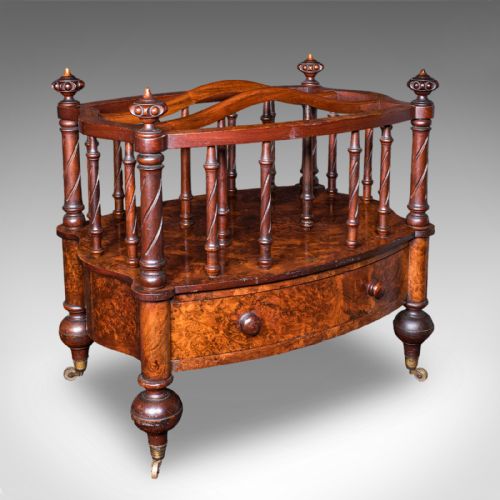
Cabinet makers built these pieces primarily in figured mahogany, richly grained rosewood, and burr walnut, occasionally incorporating brass castors and glass doors. Timber selection dictated the visual weight, from warm reddish mahogany to deep dark rosewood.
Joinery involved sturdy vertical divisions for the paper racks, often supported by turned columns or pilasters, and dovetailed joints on the underlying drawer boxes.
A canterbury supposedly gained its name when an archbishop requested a music stand like the one built for his diocese.
What separates examples
Quality rests upon the crispness of the turned details, the depth of figure in the mahogany or rosewood veneer, and the structural integrity of the slatted dividers. Finer examples display meticulous attention to timber matching and robust joinery that withstands daily handling.
The presence of secondary functions, such as integrated lower drawers, double-size capacity, or tiered whatnot shelving, elevates the sophistication of the design.
J C Loudon·Gillows of Lancaster
The English Music Canterbury Glossary
- Canterbury
- A low stand with upright divisions for holding sheet music, books, or newspapers. This form originated in the late eighteenth century.
- Whatnot
- An open set of freestanding shelves used for displaying ornaments or books. These often incorporate a canterbury base.
- Etagere
- A piece of furniture consisting of a series of open shelves for displaying small objects. The term derives from French usage common in the nineteenth century.
- Folio Stand
- A large adjustable rack designed for holding large books, prints, or music folios. These items provide sturdy storage in country house libraries.
- Fall Front
- A hinged panel that drops down to form a writing surface or access interior compartments. This mechanism appears on music cabinets.
English Music Canterbury: Frequently Asked Questions
What were canterburys originally used for?
These stands were created to hold sheet music near pianos and musical instruments in period drawing rooms. They also served as tidy receptacles for daily newspapers and periodicals.
Over time, owners adapted them to hold books, folios, and writing papers in studies and libraries.
How do I date an english music canterbury?
Dating relies on the prevailing style of the timber, turning, and feet, moving from Georgian mahogany simplicity to Regency rosewood elegance and Victorian walnut ornamentation. Cabinet proportions and structural details align closely with the reigning monarch's period.
Examining the secondary woods inside drawers and the wear on the feet provides further clues to age.
Where should I place a canterbury at home?
Position a canterbury beside a piano, armchair, or sofa where its open divisions can hold current reading material or music sheets. Their compact footprint allows them to fit neatly into corners or alongside larger case furniture.
Avoid placing antique rosewood or mahogany directly against hot radiators to protect the timber and polish.
Are music cabinets different from standard canterburys?
Music cabinets enclose the storage space behind doors, frequently featuring glass panels or fall-front compartments rather than open slatted divisions. They emerged more prominently during the Victorian and Edwardian eras.
Standard canterburys keep sheet music visible and accessible in open vertical racks.