



English Library Shelving
English library shelving brings architectural gravity and warm timber to a room, offering open display for serious volumes.
English Library Shelving
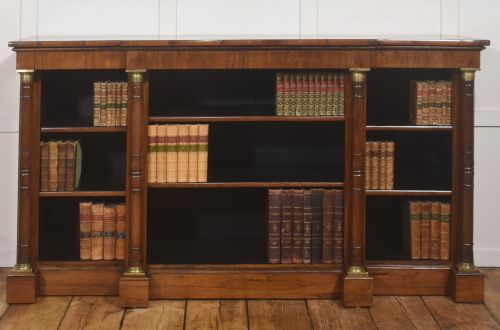
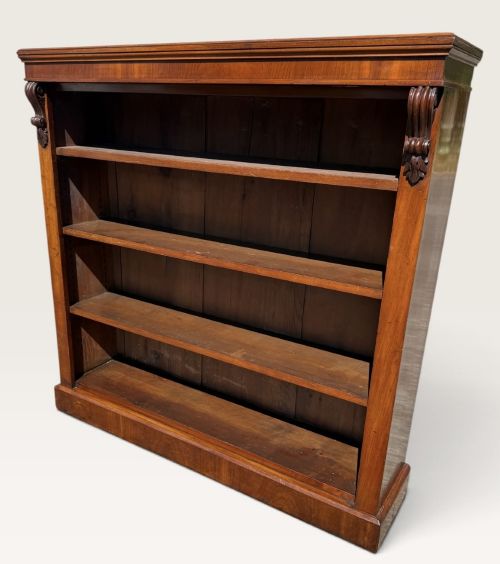
When you search for English library shelving, you encounter substantial bookcases and open shelves designed for formal rooms, most frequently originating from the Regency and Victorian eras.
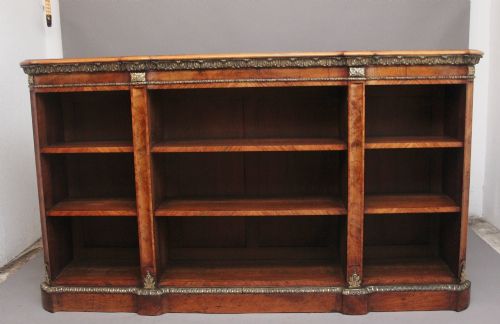
The pieces appearing on this page take the form of open bookcases, breakfront designs, and dwarf waterfall shelves rather than enclosed cabinetry.
Makers utilised rich timbers such as walnut, mahogany, rosewood, oak, and birdseye maple, often accented with brass or ormolu mounts to elevate the architectural presence of the furniture.
Materials and construction
Cabinetmakers constructed these bookcases using dense hardwoods like mahogany and walnut, frequently selecting figured veneers such as burr walnut or birdseye maple for the primary display surfaces.
Metal detailing played a structural and decorative role, with brass and ormolu mounts, galleries, and inlay integrated into Regency and Victorian pieces.
Joinery remained robust to support heavy collections of books, employing graduated shelving formats and breakfront proportions to distribute weight and visual mass.
English Library Shelving Retail Price Guide 2026
Typical asking prices for english library shelving among the pieces listed under this phrase on Sellingantiques today, from the lower quarter to the upper quarter. They describe what is for sale here now, not the wider market.
Form variations range from grand breakfront bookcases to compact dwarf waterfall shelves with graduated tiers.
Distinguishing quality across the range
The upper tier of English library shelving is defined by architectural ambition, such as breakfront proportions and documented provenance linking a piece to designers like Sir Charles Barry or makers like Johnstone and Jeanes.
Material selection dictates the grade of the piece, moving from plain timber carcasses to richly figured rosewood, burr walnut, and birdseye maple paired with heavy cast ormolu mounts.
Refinement in secondary details, such as graduated shelving tiers, integrated brass galleries, and precise inlay, separates standard utilitarian shelving from high-status library furnishings.
Johnstone and Jeanes·Sir Charles Barry
The English Library Shelving Glossary
- Breakfront
- A piece of furniture with a central section that projects forward from the flanking wings. This architectural arrangement creates depth and shadow in large bookcases.
- Waterfall bookcase
- A set of open shelves where each tier steps back progressively from the one below it, creating a profile resembling descending water. This form appears frequently in Regency library pieces.
- Ormolu
- Gilt bronze mounted onto furniture as a decorative trim. It provides a sharp metallic contrast against dark woods like walnut and rosewood.
- Rosewood
- A dense, heavily figured timber prized during the Regency period for its deep reddish-brown colour and dark grain patterns. It takes a high polish suitable for formal library settings.
- Dwarf bookcase
- A low-standing bookcase designed to sit beneath dado height, allowing wall space above for pictures or mirrors. These pieces often feature graduated shelves for smaller volumes.
English Library Shelving: Frequently Asked Questions
What defines English library shelving?
These pieces comprise open bookcases and shelf units constructed from dense hardwoods like mahogany, walnut, and rosewood. They are built to hold heavy volumes while serving as architectural focal points within a room.
Most examples date from the Regency and Victorian periods, often incorporating brass mounts, breakfront layouts, or graduated tiers.
How do I date an open bookcase?
Dating relies on timber selection, style markers, and structural hardware. Regency pieces frequently employ rosewood with brass inlay, while Victorian examples lean toward walnut and oak with heavier mouldings.
Mid-century nineteenth-century pieces may also bear maker attribution or specific architectural traits linked to designers of the era.
Where were these bookcases used?
They originated in the libraries, studies, and formal reception rooms of substantial English residences. Their open construction allowed for immediate access to working libraries rather than archival storage.
Dwarf versions were often placed beneath windows or against low walls to preserve upper wall space for art.
How do I care for antique library shelving?
Maintenance requires stable indoor humidity to prevent the timber and veneers from splitting or warping. Regular dusting with a soft cloth preserves the polish on woods like mahogany and walnut.
Avoid placing heavy concentrated loads on unsupported shelf spans to maintain the structural integrity of antique joinery.