
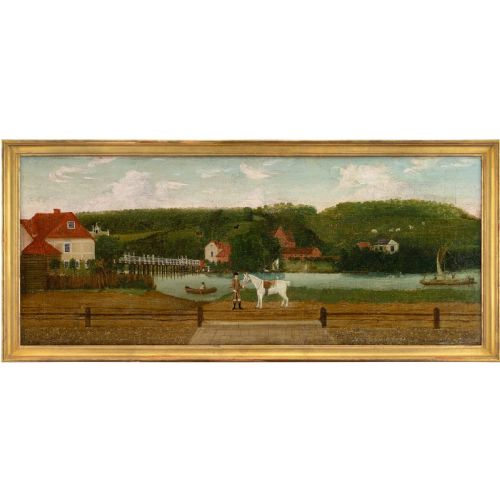


English Countryside Horse Painting
An English countryside horse painting captures rural life through working animals, cart horses and riders set against rural landscapes.
English Countryside Horse Painting
An english countryside horse painting depicts rural scenes featuring horses, farm carts, hunt gatherings and country lanes across the nineteenth and early twentieth centuries. These works record agricultural labour, village life and rural transport before mechanisation altered the landscape.
The versions most frequently met on this page combine oil on canvas or watercolour pigment on paper with pastoral settings. They range from expansive views of shire horses at work to intimate watercolours of village lanes and moorland ponies.
Materials and methods
Artists relied primarily on oil paint applied to stretched canvas or watercolour pigment worked on paper. Frames were commonly constructed from wood, occasionally finished in giltwood.
Techniques span British Impressionism, realism and traditional approaches. Painters built up compositions using layered brushwork for oils or transparent washes for watercolours to capture natural light and atmospheric country conditions.
Artistic movements represented include British Impressionism, realism and Victorian pastoral styles.
Judging quality
Quality rests upon the artist's ability to render the anatomy and movement of working horses alongside the convincing atmosphere of the surrounding landscape. Stronger examples display confident handling of light, depth and proportion rather than rigid formulaic composition.
The relationship between the figures, animals and landscape marks the distinction between standard topographical records and superior works of fine art painting. Condition of the canvas or paper surface also influences standing.
Charles Walter Simpson·John Sanderson Wells·James William Booth·John Linnell·Charles Faulkner·Will Anderson·Robert Hollands Walker·Basil Bradley·Herbert Royle·Rowland Henry Hill·Henry Charles Fox·Ernest Higgins Rigg·George Hamilton Constantine·George Turner·John Richard Worsdale·Georgina Lara·Edward Lloyd·Henry H Parker·Alfred George Stevens·Reginald Mills·Lois Wilton
The English Countryside Horse Painting Glossary
- Oil on canvas
- Pigment suspended in drying oil applied to a woven fabric support stretched over a wooden frame. This medium allowed artists rich colour saturation and textured brushwork.
- Watercolour pigment
- Fine pigment particles mixed with a water-soluble binder, applied to paper in transparent washes. It produces luminous effects favoured for landscape sketches.
- Giltwood
- Wood carved and coated with a thin layer of gold leaf or metallic gilt. It provided ornate framing for traditional paintings.
- British Impressionism
- A painting style focusing on light, brushstroke and everyday subjects developed in Britain during the late nineteenth and early twentieth centuries. It influenced how artists recorded rural outdoor scenes.
English Countryside Horse Painting: Frequently Asked Questions
What periods do these paintings date from?
The works span the nineteenth century and the early decades of the twentieth century, including Victorian, Edwardian and Georgian periods.
Dates recorded range from the early eighteen hundreds up to the nineteen thirties.
What mediums were used by the artists?
Painters utilised oil on canvas alongside watercolour pigment on paper and occasional gouache.
Frames are typically constructed from wood or giltwood.
How should I care for an antique painting?
Keep works away from direct sunlight and steady humidity fluctuations to protect canvas, paper and pigment.
Avoid hanging watercolours in damp rooms or areas exposed to strong heat.
What styles do these artworks represent?
Styles include British Impressionism, Victorian realism, pastoral scenes and English traditional landscape painting.
Artists recorded rural life with varying degrees of academic precision and loose brushwork.