



English Chaise Lounge
An english chaise lounge is a classic seating form designed for reclining, offering deep comfort and refined period elegance.

English Chaise Lounge
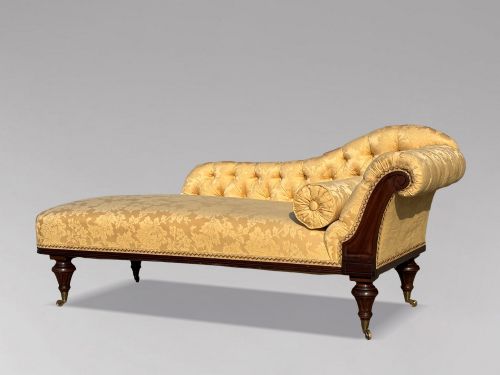
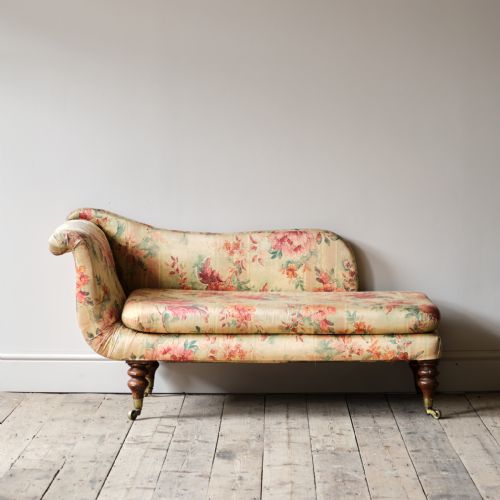
When you search for an english chaise lounge, you encounter nineteenth-century day beds and couches shaped for recumbent rest. These pieces emerge predominantly from the Regency and Victorian eras, spanning early nineteenth-century designs through to the late Victorian period.
The versions most commonly met on this page include mahogany frames from the Regency period, alongside rosewood, walnut, and upholstered day beds from the 1860s and 1870s. Makers such as Howard and Sons, H. Goodall and Sons, and Jas Shoolbred occasionally appear among the nineteenth-century examples.
Forms range from double spoon back settees and Chesterfield daybeds to reversible box ottomans and country house styles. Many rest upon turned legs fitted with original metal or brass castors.
How they were made
Makers constructed the structural frames of an english chaise lounge using dense timbers such as mahogany, rosewood, and general wood. These sturdy foundations support elaborate scrolling headrests and carved wooden rails.
Upholstery defines the surface character, utilising fabrics like velvet, damask, and standard upholstery fabric. Details such as bobbin turnings, turned legs, and brass castors complete the construction of nineteenth-century examples.
English Chaise Lounge Retail Price Guide 2026
Typical asking prices for english chaise lounge among the pieces listed under this phrase on Sellingantiques today, from the lower quarter to the upper quarter. They describe what is for sale here now, not the wider market.
Listings feature 19th century pieces spanning the Regency period, 1860, 1870, 1880, and the Victorian era, utilising mahogany, rosewood, velvet, and brass.
What varies in quality
The distinction between standard examples and superior pieces rests upon the integrity of the timber frame and the refinement of the carved details. Regency mahogany and rosewood frames exhibit sharper joinery and more substantial proportions than later country house variants.
Attribution to notable makers such as Howard and Sons or Jas Shoolbred elevates a piece through documented craftsmanship. Furthermore, the presence of original castors and undisturbed period upholstery fabric preserves the historical authenticity of the couch.
Howard And Sons·H Goodall And Sons·Jas Shoolbred
The English Chaise Lounge Glossary
- Regency
- A British design period spanning the early nineteenth century, known for classical restraint and elegant mahogany frames. Pieces from this era often display clean architectural lines.
- Victorian
- A nineteenth-century period encompassing diverse revival styles and heavier, deeply upholstered seating forms. Furniture from this era ranges from early Victorian rosewood to late Victorian turned leg designs.
- Castor
- A small wheel fitted to the base of a furniture leg to facilitate movement. Original brass castors frequently appear on nineteenth-century day beds.
- Damask
- A reversible figured fabric traditionally used for rich upholstery. It adds texture and visual depth to nineteenth-century couches.
English Chaise Lounge: Frequently Asked Questions
What is an english chaise lounge?
An english chaise lounge is a nineteenth-century day bed or couch designed for reclining with a raised end. These pieces combine wooden frames of mahogany or rosewood with upholstered surfaces.
They serve as both functional seating and decorative furniture within a drawing room or country house interior.
How do I date an english chaise lounge?
Dating relies on identifying stylistic markers associated with the Regency and Victorian periods. Regency examples often feature clean mahogany frames, while 1860s and 1870s pieces display rosewood, bobbin turnings, or turned legs.
Maker attributions and construction details also help narrow the specific decade of origin.
Where should I place a chaise lounge?
These pieces suit principal reception rooms, studies, or large bedrooms where adequate floor space allows for a full view of the profile. Position them away from direct sunlight to protect sensitive velvet and damask upholstery fabrics.
Allow enough clearance around the turned legs and brass castors to move the piece without damaging the timber.
What materials are used in these pieces?
Frames are primarily constructed from hardwoods such as mahogany and rosewood, alongside general wood and metal internal components. Brass frequently appears in the form of original castors.
Surface coverings consist of various textiles, including velvet, damask fabric, and traditional upholstery fabric.