


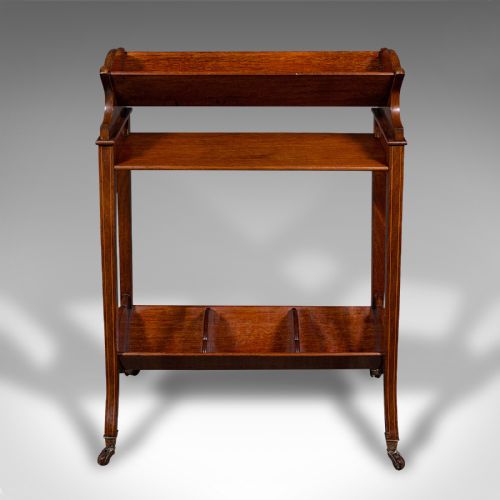


English Book Rack
An English book rack organises volumes on a desk or table, and these practical pieces bring period character to any room.
English Book Rack
An English book rack encompasses extending book slides, book troughs, and revolving stands designed to hold volumes upright. When you search for an english book rack, you encounter formats ranging from simple desktop troughs to expanding slides with novel rests.
The selections span the nineteenth century, the Edwardian era, and the nineteen-twenties. Victorian and Edwardian examples predominate, alongside Regency and Georgian revival pieces.
Forms include book slides, book troughs, magazine racks, and rotary bookstands. Walnut, oak, and ebonised wood appear frequently alongside brass and painted finishes.
Materials and construction
Cabinet makers utilised hardwoods such as walnut, oak, rosewood, and coromandel to build sturdy book racks. Boxwood inlay and Tunbridge ware decoration embellished many nineteenth-century sliding designs.
Extending mechanisms utilised brass hinges and rails to allow book slides to expand smoothly. Ebonised wood and painted finishes provided alternative surfaces, while carved oak defined revival styles.
Materials span walnut, oak, coromandel, brass, and ebonised wood.
Assessing quality
The refinement of the timber and the crispness of the carving distinguish finer examples from standard production. Finely figured walnut or coromandel and precise Tunbridge ware marquetry elevate a piece above plain oak or painted items.
Mechanical smoothness in extending book slides and rotary bookstands demonstrates superior workmanship. Integrated brass mounts and labelled maker details signify higher grade construction.
Arthur Simpson
The English Book Rack Glossary
- Book slide
- An adjustable desktop rack designed to hold a varying number of volumes upright between two ends. These pieces often feature extending actions to accommodate more books.
- Book trough
- An open-topped container with sloping sides used to store books upright on a table. They frequently appear in oak, walnut, or painted finishes.
- Tunbridge ware
- Wood marquetry work characterised by minute mosaic pictorial decoration. Craftsmen created geometric or pictorial scenes using thousands of tiny coloured wood blocks.
- Rotary bookstand
- A revolving desktop or floor-standing rack allowing easy access to multiple volumes. These items rotate on a central pivot.
- Ebonised wood
- Timber stained or treated to imitate ebony. This dark finish was popular during the nineteenth century for decorative effect.
English Book Rack: Frequently Asked Questions
How do extending book slides work?
Extending book slides feature a central base with movable ends that pull apart or slide along brass tracks to accommodate more volumes. This clever mechanism keeps books upright as the collection grows or shrinks on the desk.
Most nineteenth-century versions rely on smooth wooden channels or brass rails. Users simply adjust the width by hand to fit the desired number of books.
Where were book troughs used?
Book troughs sat on library tables, desks, or sideboards to keep frequently referenced volumes close at hand. Their open design allowed readers to see titles at a glance.
Edwardian and Victorian homes utilised these compact stands in studies and lounges. They provided accessible storage without requiring full-sized cabinetry.
What is a rotary bookstand?
A rotary bookstand is a revolving rack designed to hold several books simultaneously within arm's reach. The rotating mechanism allows a reader to spin the stand and select a volume easily.
These pieces often stood on tables or desks in libraries and studies. Walnut and oak versions appeared during the Edwardian period.
How do I identify Victorian pieces?
Victorian book racks often display darker timbers like walnut, rosewood, or ebonised wood, sometimes decorated with Tunbridge ware. The craftsmanship reflects nineteenth-century revival styles such as Gothic or Jacobean.
Cabinet makers also incorporated brass hardware and carved details during this era. Examining the timber and construction methods helps confirm the nineteenth-century origins.