


English Agricultural Artwork
English agricultural artwork captures the rural economy through oil and watercolour, offering a direct view of nineteenth and early twentieth-century farm life.
English Agricultural Artwork
When you search for English agricultural artwork, you encounter paintings that record the traditional working life of the countryside, from haymaking and ploughing to prized livestock. These works span the Victorian, Edwardian and later periods, capturing the rhythm of rural labour and pastoral scenes.
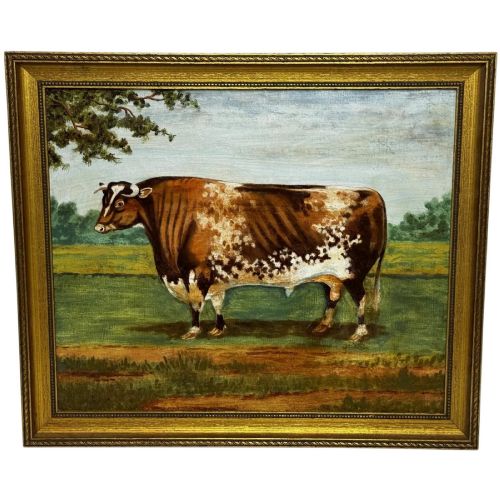
The pieces on this page mostly take the form of framed oil paintings and watercolours on paper or canvas. Subjects range from heavy horses and shorthorn bulls to farmyard scenes and harvest landscapes by British artists.
Materials and techniques
Artists painted these rural subjects primarily using oil paint on canvas or watercolour on paper, often housed in wood and gilt frames. The handling ranges from the fine detail of Victorian realism to the looser brushwork of British impressionism.
Painters worked either in the field to capture immediate light during haymaking and harvest time or finished their large animal and farmyard compositions in the studio.
The listings span from the nineteenth century into the 1930s, executed in oil and watercolour on canvas, paper and wood.
Factors of quality
Quality rests on the artist's ability to render anatomy and movement correctly, particularly in complex subjects like working horses and cattle. The strongest works display confident brushwork and a convincing sense of light and atmosphere rather than stiff representation.
Condition also plays a part, as canvases and watercolours suffer from environmental exposure over time. Original gilding on the frames and good preservation of the paint surface elevate a piece.
James William Booth·Henry Bailey·Herbert Royle·Arthur Charles Dodd·Vernon Stokes·Rowland Henry Hill·Joseph Kirkpatrick·W.A. Clark·W E Millner·George Hamilton Constantine·William Greaves·William Huggins·William Sidney Cooper·George Graham·George Cole·Fred Lawson·Frederick J Haycock·Charles James Adams
The English Agricultural Artwork Glossary
- Oil on canvas
- A painting technique using pigments bound in a drying oil applied to a stretched woven fabric support. This medium allowed artists to build rich textures and deep tones suitable for large farmyard scenes.
- Watercolour
- A paint where the colour pigments are suspended in a water-soluble vehicle, typically applied to paper. It was frequently used by British landscape painters for spontaneous views of haymaking.
- British Impressionism
- An art movement focusing on light, everyday subjects, and looser brushstrokes applied outdoors. Painters adopted these techniques to capture bright conditions during rural harvests.
- Victorian Pastoral
- A genre celebrating rural life, agriculture, and pastoral scenery during the nineteenth century. These works often idealised the harmony between agricultural workers and the English countryside.
- Gilt frame
- A wooden picture frame coated with a thin layer of gold leaf or gold paint. Many nineteenth-century oils retain their original ornamented surrounds.
English Agricultural Artwork: Frequently Asked Questions
What subjects appear in these paintings?
These works depict rural life, featuring heavy horses, plough teams, prize shorthorn bulls, and farm workers engaged in haymaking and harvest.
The focus remains squarely on the traditional agricultural economy of the nineteenth and early twentieth-century English countryside.
Are these works original paintings?
Yes, the selection consists of original hand-painted works in oil and watercolour rather than prints or reproductions.
Artists painted these directly on canvas or paper during the Victorian, Edwardian, and later periods.
How do I date an agricultural painting?
Dating relies on stylistic evidence, signatures, costume details of the farm workers, and framing techniques. Many works carry specific dates or reflect the distinct aesthetic of movements like British impressionism and Victorian realism.
Examines the canvas backing and stretcher bars for additional clues left by previous owners or framers.
How should I display an antique oil painting?
Hang the piece away from direct sunlight and damp environments to protect both the canvas and the gilt wood frame. Stable room temperatures prevent the oil paint from cracking over time.
Ensure the wall fixings can safely support the weight of the framed artwork.