





Enamelled Vanity Accessories
These enamelled vanity accessories bring colour and polish to a dressing table, joining fine metalwork with vitreous coatings.
Enamelled Vanity Accessories
When you search for enamelled vanity accessories, you are looking at items designed for the dressing table and personal use, spanning centuries from the Georgian period through to the Art Deco era. The selection centres heavily on the 1920s and 1930s, featuring practical and decorative objects that once sat upon dressing tables or travelled in handbags.
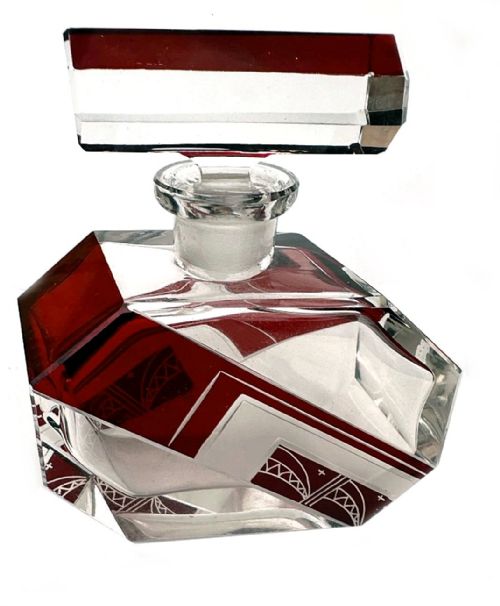
The most common forms you will encounter on this page are scent and perfume bottles, alongside hand mirrors, powder compacts, cigarette cases, dressing table jars, and small patch boxes. These items bridge the gap between functional toiletry containers and miniature works of applied art.
Origins range from English workshops in London and Bilston to continental makers such as Karl Palda. The materials combine sterling silver, copper, brass, and cut glass with vibrant enamel coatings.
How they were made
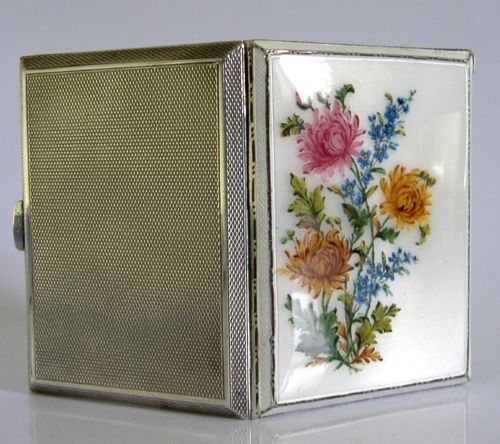
Makers fused vitreous enamel to metal surfaces, frequently applying guilloche techniques to engrave geometric patterns beneath translucent layers of colour. Glass vessels were cut, blown, or moulded to house perfumes and atomizers, then mounted with silver collars and enamelled stoppers.
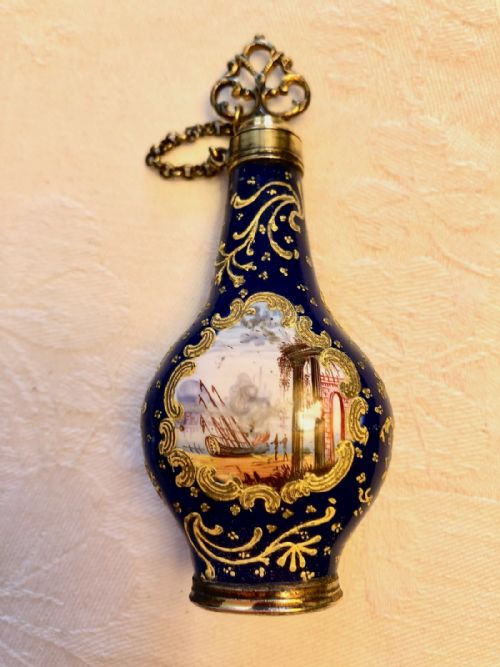
Craftsmen also utilised hand-painted decoration directly onto the enamel surface, particularly on eighteenth-century patch boxes and scent bottles. Sterling silver, gilt metal, and copper provided the structural foundations for compacts, cigarette cases, and travel clock stands.
Enamelled Vanity Accessories Retail Price Guide 2026
Typical asking prices for enamelled vanity accessories among the pieces listed under this phrase on Sellingantiques today, from the lower quarter to the upper quarter. They describe what is for sale here now, not the wider market.
Compact mirrors and patch boxes survive from eras when concealing a blemish required an enamelled accessory carried in a velvet pocket.
What varies in quality
The refinement of the underlying metal engraving dictates much of the visual depth in guilloche pieces, where precise engine-turning catches the light through translucent enamel. Crispness in hand-painted floral or figural scenes separates standard production items from finer studio output.
Weight and structural integrity in the silver mounts or glass bodies also distinguish pieces, alongside the preservation of the enamel surface without extensive restoration. Makers such as Karl Palda or Henry Perkins often display distinct stylistic execution that influences desirability.
Karl Palda·Henry Perkins
The Enamelled Vanity Accessories Glossary
- Guilloche
- A decorative engraving technique where a mechanical lathe cuts a precise, intricate geometric pattern into metal. This patterned surface is then covered with translucent enamel so the design shows through.
- Patch box
- A small, hinged container popular in the eighteenth century, used for storing small pieces of fabric or painted paper worn on the face to hide blemishes. They are frequently made of enamelled copper.
- Vitreous enamel
- A material made by fusing powdered glass to a substrate by firing, usually between seven hundred and nine hundred degrees Celsius. The powder melts, flows, and hardens to a smooth, durable coating.
- Atomizer
- A device used to create a fine mist of liquid perfume, typically consisting of a glass bottle fitted with a metal pump mechanism. In Art Deco examples, these often feature geometric glass bodies.
- Dressing table jar
- A small container with a fitted lid, designed to hold creams, pins, or cosmetics on a vanity. The lids are frequently decorated with matching enamel and silver work.
Enamelled Vanity Accessories: Frequently Asked Questions
What are enamelled vanity accessories used for?
These items were created for personal grooming and dressing table organisation, holding perfumes, powders, and small personal items. They served as both functional toiletries and decorative objects.
Today, they are collected for display, bringing period charm and colour to modern interiors.
How do I date an antique scent bottle?
Dating relies on hallmarks, maker stamps, and stylistic markers such as the clean geometric lines of the 1920s and 1930s. Georgian pieces often show hand-painted pastoral scenes on copper bases.
Examining the manufacturing techniques and material combinations also helps narrow down the period of origin.
What is guilloche enamel?
Guilloche is a decorative technique where metal is engine-turned with a repeating geometric design before transparent enamel is applied. This allows light to reflect through the coloured coating.
It appears frequently on silver compacts and perfume bottle lids from the early twentieth century.
How should I care for vintage enamel?
Clean enamel gently with a soft, dry cloth to remove dust, avoiding harsh chemical cleaners or abrasive dips. Enamel is essentially glass fused to metal, so it can chip if dropped.
Keep pieces away from direct, prolonged sunlight to prevent fading in coloured pigments.