


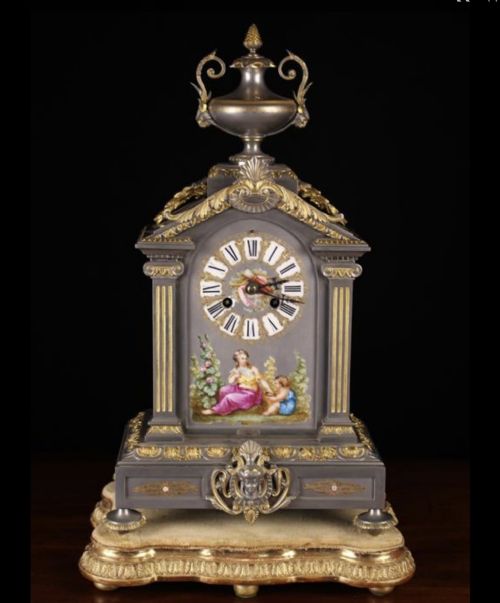


Enameled Mantelpiece Clock
An enameled mantelpiece clock brings nineteenth-century French and Victorian craft into a room, offering both reliable timekeeping and ornate metalwork.
Enameled Mantelpiece Clock
When you search for an enameled mantelpiece clock, you are looking at nineteenth-century French and Victorian timepieces designed to sit on a shelf or fireplace surround. These objects combine metal cases with decorative panels, dials, and ornamentation.
The version you are most likely to meet on this page is a French or Victorian mantel clock from the 1860s to 1900, often styled in Louis XVI Revival, French Rococo Revival, or Napoleon III aesthetics. Many examples include glass-sided four-glass designs or porcelain and champlevé enamel accents.
How they were made
Makers utilised brass, gilt bronze, and ormolu to build the structural cases of these clocks, casting the metal into ornate revivalist shapes. Ormolu and gilt brass provided a bright, reflective finish that suited formal nineteenth-century interiors.
Enamel and porcelain formed the visual centrepieces, applied to dials and inset panels through firing techniques that created smooth, colourful surfaces. Champlevé enamel work involved recessing the metal to hold vibrant coloured glass pastes before firing and polishing.
Materials recorded on this page include champlevé enamel, Sevres style porcelain, ormolu, and four-glass brass framing.
What varies in quality
The distinction between ordinary and superior pieces rests on the crispness of the metal casting and the depth of the gilding. Finer clocks display sharply chiselled details in the ormolu or bronze mounts rather than soft, smoothed edges.
The complexity of the enamel work also sets examples apart, with hand-painted porcelain plaques and intricate champlevé patterns representing higher tiers of manufacture than plain white dials.
Finnigan Manchester·Leroy and Fils·Joseph Soldano
The Enameled Mantelpiece Clock Glossary
- Ormolu
- Gilded bronze used widely for decorative mounts on nineteenth-century clock cases. The technique involves applying a mercury and gold amalgam to the bronze base.
- Champlevé enamel
- A technique where troughs are dug into a metal surface and filled with enamel powder before firing. This creates colourful decorative patterns across the clock body.
- Garniture set
- A clock accompanied by matching side pieces such as urns or candelabra. These sets were designed to sit together on a mantelpiece.
- Four-glass clock
- A clock design featuring glass panels on all four sides to expose the mechanical movement. These pieces often incorporate mercury pendulums and gilt brass frames.
Enameled Mantelpiece Clock: Frequently Asked Questions
What is an enameled mantelpiece clock?
An enameled mantelpiece clock is a nineteenth-century timepiece featuring a metal case adorned with enamel dials or decorative panels. They were primarily produced in France and Britain during the Victorian era.
These clocks served both practical timekeeping and decorative roles in period homes, often styled after earlier French design movements like Rococo and Louis XVI.
How do I wind the clock?
Most mechanical clocks of this period use a key inserted into holes on the enamel or porcelain dial to tension the springs. Winding frequency typically depends on whether the movement is an eight-day or shorter duration mechanism.
Care must be taken not to overwind the springs, as this can damage the internal gearing of the antique movement.
How do I tell Victorian from earlier periods?
Victorian clocks spanning the 1860s to 1900 often incorporate eclectic revival styles, combining French movement quality with British retail preferences. Maker signatures on the dial or movement backplate frequently help confirm the production era.
Materials like champlevé enamel and specific gilt bronze casting styles also point toward the later nineteenth century.
Where should I place it?
These clocks are designed to sit securely on a level mantelpiece, shelf, or bracket where they can remain stable. Keeping them away from direct sunlight and damp environments protects the delicate enamel and gilt surfaces.
Because many feature glass panels or delicate garniture sets, placement should minimise the risk of accidental knocks.