


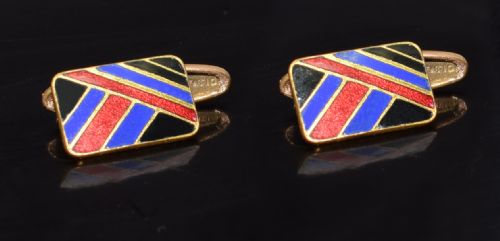


Enamel Shirt Cufflinks
Enamel shirt cufflinks bring bright colour and geometric design to formal attire, spanning the Belle Epoque and Art Deco periods.
Enamel Shirt Cufflinks
The pieces on this page comprise matching pairs of gents cufflinks alongside chain link variations. Most items reflect the geometric aesthetic of the 1930s, utilising vibrant green or blue enamel surfaces set into precious and base metals. French and English origins predominate amongst the listed inventory.
Buyers encounter forms that range from simple circular or rectangular faces to complex modernist geometric layouts. The pairing of vitreous enamel with precious metals remains a defining characteristic across these decades.
Materials and construction
The construction of these accessories relies on fusing powdered glass enamel to metal bases through kiln firing. Metals utilised in the evidence include silver, silver plate, brass, and 18K yellow gold, providing sturdy foundations for the decorative coloured glass surfaces.
Specialised techniques involve recessing the metal to hold vitreous enamel securely within geometric channels or borders. Organic elements such as pearl and mother of pearl also appear alongside enamel, adding subtle iridescence to the metallic settings.
Green and blue glass melted onto metal kept 1930s gentlemen looking sharp.
Distinctions in quality
Quality in these items rests on the precision of the metalwork and the condition of the fused glass surface. Pieces constructed from 18K yellow gold demonstrate a higher tier of manufacture compared to brass or silver plate alternatives.
The sophistication of the design, particularly within Art Deco modernist and geometric examples, separates standard production from finer workmanship. Intact enamel free from chipping distinguishes well-preserved specimens.
The Enamel Shirt Cufflinks Glossary
- Vitreous Enamel
- A material made by fusing powdered glass to a metallic substrate at high temperature. This technique produces a durable and glossy coloured surface resistant to fading.
- Art Deco
- A dominant design style from the 1920s and 1930s characterised by geometric shapes, stylised motifs, and modern industrial lines. It heavily influences the majority of cufflinks on this page.
- Belle Epoque
- A period of elegance spanning the late nineteenth century up to the First World War. Pieces from this era often display refined ornamentation and softer curves.
- Mother of Pearl
- An iridescent inner layer of pearl oyster shell used for decorative inlay. It provides a natural shimmering contrast to brightly coloured enamel work.
- Chain Link
- A traditional cufflink connection utilising a short length of metal chain between two decorative faces. This allows flexible movement when fastened through a shirt cuff.
Enamel Shirt Cufflinks: Frequently Asked Questions
How do I wear vintage cufflinks?
Vintage cufflinks fasten through the buttonholes of double cuffs on formal shirts. Ensure the decorative face aligns outward while the toggle or secondary link secures the back.
Store them in a dry compartment to protect the delicate glass enamel surfaces from scratching against other metal items.
What periods do these cufflinks cover?
The available selection spans several decades from the early to mid-twentieth century. You will encounter pieces dating from the 1910s, 1920s, 1930s, and 1940s.
Art Deco geometric styling from the 1930s forms the most common aesthetic across the listed items.
Are these made of solid gold?
Some pieces utilise precious metals such as 18K yellow gold, whilst others employ silver, silver plate, or brass. Each listing specifies the exact metal composition used in the construction.
Enamel is then applied directly to these metal bases using traditional kiln firing techniques.
What is the difference between geometric and modernist styles?
Geometric styles focus on repeating shapes, sharp angles, and symmetrical patterns typical of the 1930s. Modernist designs embrace industrial influences and abstract arrangements of colour.
Both styles frequently incorporate vibrant green or blue enamel across the cufflink face.