




Enamel Coffee Spoons
Enamel coffee spoons are miniature silver implements carrying brightly coloured vitreous decoration, offering a compact way to collect fine twentieth-century metalwork.
Enamel Coffee Spoons
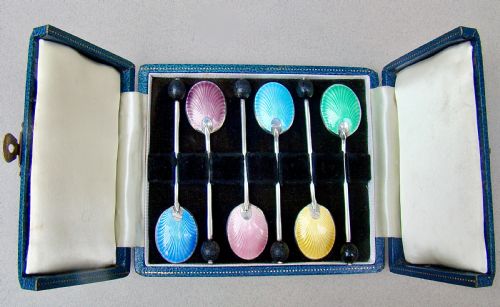
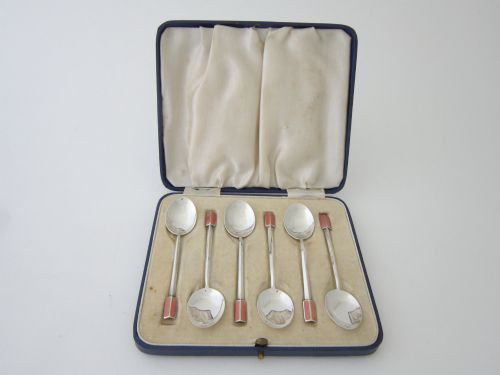
Enamel coffee spoons are small silver items produced primarily across the late nineteenth century and the mid twentieth century. Buyers seeking enamel coffee spoons frequently encounter cased sets containing six matching pieces housed in satin or velvet lined boxes.
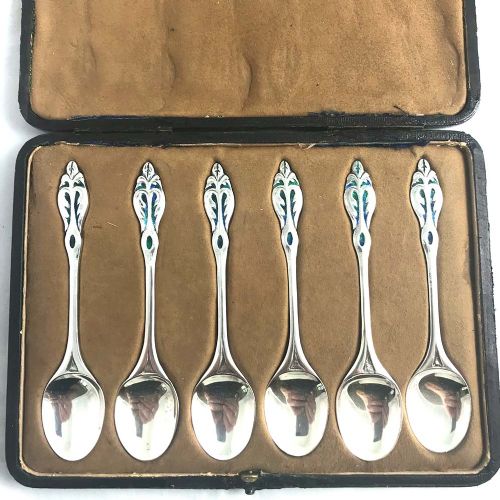
The objects recorded span several distinct design movements, including Art Deco, Art Nouveau, and Arts and Crafts styles. Many pieces originate from British workshops and retailers, alongside notable Scandinavian and Imperial Russian examples.
While individual teaspoons and flatware appear, the majority of surviving pieces take the form of dedicated coffee spoons or matched sets tied to specific clubs and institutions.
Materials and construction
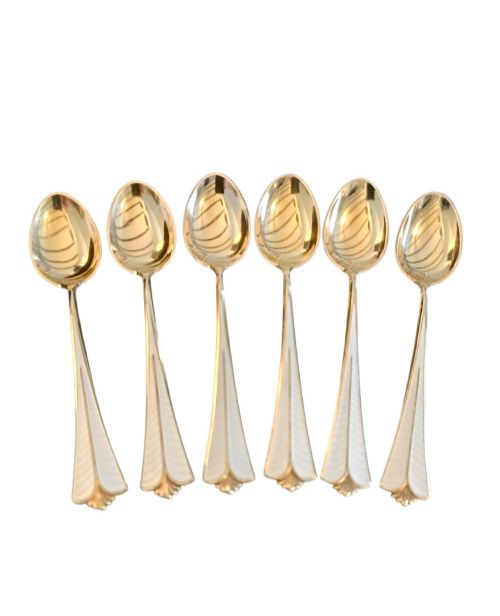
The foundation of these items is sterling silver, frequently finished with a gold gilt coating or described as silver gilt. Makers applied vitreous enamel into recessed channels or wirework compartments formed on the bowl backs or handle terminals.
Presentation packaging forms an integral part of the manufacturing record, with fitted cases lined in materials such as satin and velvet. Hallmarks stamped into the silver identify assay offices like Birmingham alongside maker marks.
Enamel Coffee Spoons Retail Price Guide 2026
Typical asking prices for enamel coffee spoons among the pieces listed under this phrase on Sellingantiques today, from the lower quarter to the upper quarter. They describe what is for sale here now, not the wider market.
Listings feature items spanning from 1890 through the 1960s, encompassing Art Nouveau, Art Deco, and Arts and Crafts styles.
Distinctions in quality
Quality rests upon the precision of the metalwork and the complexity of the enamelling technique, such as cloisonne work. Simpler geometric designs differ from elaborate pictorial or themed sets, including card suits and club commissions.
The presence of an original fitted case lined with satin or velvet elevates a set, as does documentation connecting the pieces to known designers and retailers like Liberty and Co or David Andersen.
David Andersen·Dmitrii Nikolaevich Nikolaev·Harrods London·Liberty and Co
The Enamel Coffee Spoons Glossary
- Vitreous Enamel
- A glass-like substance fused to a metal base through high-temperature firing. This material provides the bright colour seen on the bowls and handles.
- Silver Gilt
- Sterling silver that has been coated with a thin layer of gold. It creates a warm yellow sheen across the spoon.
- Cloisonne
- An enamelling technique where fine metal wires form cells to hold distinct colours of enamel paste. This method creates defined patterns on the metal surface.
- Flatware
- A collective term for spoons, forks, and other small dining implements. These sets form a distinct category within broader silver manufacturing.
Enamel Coffee Spoons: Frequently Asked Questions
How were enamel coffee spoons used?
These small spoons were designed for stirring sugar into after-dinner coffee. Their compact size suited demitasse cups.
Over time, many sets transitioned into display pieces housed within fitted presentation boxes rather than everyday table use.
Are these spoons made of solid silver?
Most pieces utilise sterling silver as the base metal, often indicated by standard assay office hallmarks. Some examples feature an additional layer of gold gilt over the silver.
The coloured sections consist of fired vitreous enamel rather than paint, bonded directly to the metal structure.
How do I identify Art Deco spoons?
Art Deco pieces typically display geometric patterns, clean lines, and stylised motifs reflecting the design trends of the 1920s and 1930s. Birmingham hallmarks from this era frequently appear on British examples.
These designs contrast with the organic flowing lines found on earlier Art Nouveau or Arts and Crafts items.
Why do some sets come in fitted boxes?
Many quality silver sets were retailed in purpose-built cases lined with satin or velvet to protect the delicate enamel surfaces from scratching.
Surviving in original boxes helps preserve the matching set and provides clues about the original retailer through box lid stamps.