

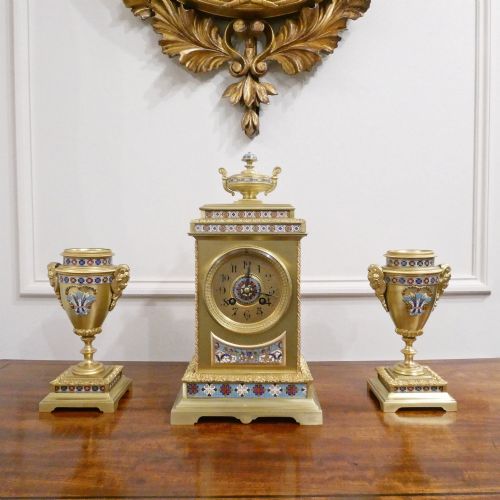
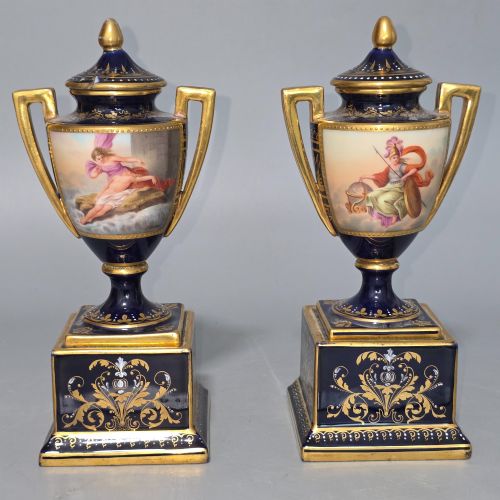


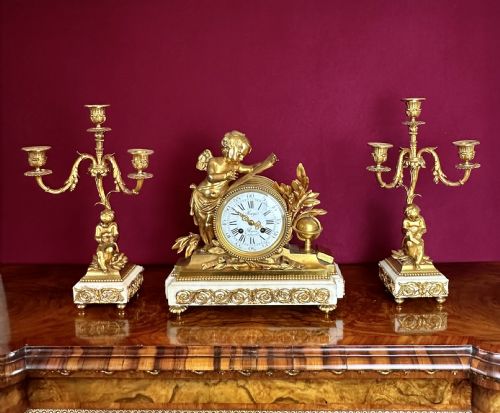

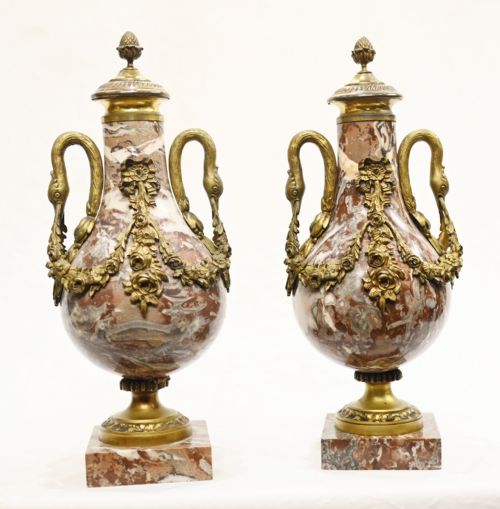


Empire Style Garniture
These empire style garniture sets bring heavy classical symmetry to a mantelpiece, combining monumental urns and striking clocks in bronze, ormolu and marble.
Empire Style Garniture
An empire style garniture is a matched decorative set usually consisting of a central mantel clock flanked by a pair of matching urns, vases, cassolettes or candlesticks. These ensembles follow classical architectural lines derived from French design, built to anchor a formal interior with balanced proportions.
The selections available here span the nineteenth century, taking in Victorian interpretations, Regency pieces and specific decades like the eighteen-eighties and eighteen-nineties. Forms range from heavy marble cassolettes and amphora vases to intricate clock sets driven by eight-day movements.
Originating predominantly from French workshops, these garnitures often incorporate porcelain elements from makers such as Vienna or Sèvres alongside traditional metalwork. Buyers encounter both complete three-piece clock sets and balanced pairs of decorative urns designed for symmetrical display.
How they were made
Maker's workshops cast ormolu and gilt bronze components with sharp chased detail, applying mercury gilding or modern electroplating to achieve deep metallic lustre. These metal mounts frame bodies carved from siena marble, onyx or porphyry, secured with threaded bolts and pins.
Ceramic components rely on hand-painted porcelain bodies fired with enamel pigments and gilt highlights, frequently depicting classical scenes or portraits. Glass and brass elements supplement the primary structures, housing mechanical clock movements driven by heavy brass gears and springs.
Empire Style Garniture Retail Price Guide 2026
Typical asking prices for empire style garniture among the pieces listed under this phrase on Sellingantiques today, from the lower quarter to the upper quarter. They describe what is for sale here now, not the wider market.
The design vocabulary draws heavily on French Empire, Regency, and Napoleon III revival styles through clock garnitures, mantel clocks, and decorative urns.
What varies in quality
The crispness of the ormolu chasing dictates the visual success of the metal mounts, with superior examples showing sharp relief rather than soft, cast-over edges. Heavier marble blocks and accurately turned stone urns demonstrate greater material cost and stability in the finished piece.
Painted porcelain panels reveal the hand of skilled artists through fine brushwork and rich enamel depth, whereas lesser examples rely on flat transfers or muddy tones. Movement complexity and signed brass clock mechanisms also elevate the standing of a garniture set.
F. Koller·Vincenti of Paris
The Empire Style Garniture Glossary
- Ormolu
- Gilded bronze produced by applying a mercury-gold amalgam to cast brass or bronze, then heating the piece to drive off the mercury. This technique yields a warm, enduring finish characteristic of fine nineteenth-century French decorative arts.
- Cassolette
- A dual-purpose decorative vase or urn featuring a reversible lid that transforms the vessel from a closed urn into a burner or candle holder. These pieces frequently appear in marble and ormolu within nineteenth-century garniture sets.
- Amphora
- A classical two-handled vessel with a narrow neck, adapted by nineteenth-century porcelain factories for decorative garnitures. They often stand on fixed plinths and display hand-painted classical motifs.
- Garniture
- A set of matched ornamental objects designed to be displayed together on a mantelpiece, sideboard or console table. The arrangement typically comprises an odd number of pieces, most commonly a clock flanked by two urns or candelabra.
Empire Style Garniture: Frequently Asked Questions
What pieces make up a complete garniture set?
A standard nineteenth-century set comprises a central mantel clock accompanied by two matching side pieces, such as decorative urns, cassolettes, vases or candlesticks. These companion items mirror the materials and ornamentation of the clock to create a unified display.
Buyers also encounter matched pairs of urns or vases offered independently of a clock, serving the same symmetrical decorative function on large mantelpieces or console tables.
Where should an empire style garniture be displayed?
These imposing sets demand substantial surfaces with adequate depth and weight tolerance, such as large fireplace mantelpieces, heavy sideboards or dedicated pier tables. Their classical symmetry requires central placement where the flanking urns can sit equidistant from the central clock.
Because many pieces incorporate delicate ormolu mounts, marble, and hand-painted porcelain, placement should avoid direct sunlight and areas prone to high humidity or temperature fluctuations.
How do I date a nineteenth-century garniture?
Dating relies on examining the style of the cast ormolu mounts, the type of marble used, and any maker signatures stamped on the brass clock movements. Pieces from the Regency period exhibit distinct English classical restraint, while later Victorian and Napoleon III items favour heavier, more ornate French Empire revival details.
Inscribed dates, commemorative subjects like Napoleon Bonaparte, and specific ceramic factory marks further narrow the manufacturing window to precise decades within the eighteen-hundreds.
Do the clocks in these sets still function?
Many nineteenth-century clock sets retain their original eight-day striking movements and mechanical gear trains, though operational status varies by individual piece. Some require professional servicing or adjustment by a clockmaker to run reliably after transit.
Even when movements need attention, the architectural bronze and marble cases remain complete decorative works of art suitable for display.