





Empire Settee
An empire settee brings commanding neoclassical form and rich timber to a room, offering the structured elegance collectors seek.
Empire Settee
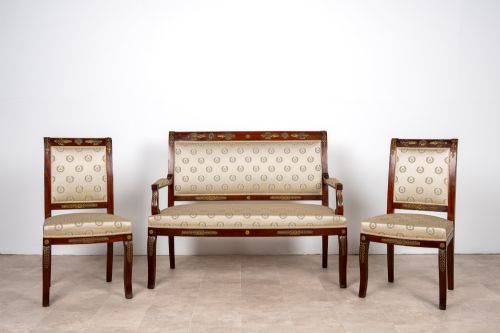
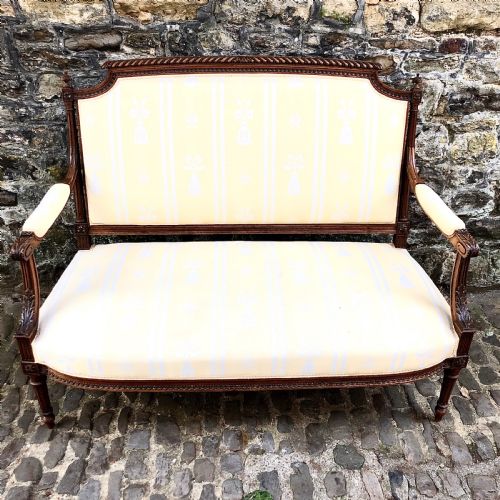
The empire settee represents a grand tradition of seating shaped by nineteenth-century neoclassicism and continental design. When collectors search for an empire settee, they encounter robust forms rooted in French, Swedish, and Italian traditions alongside Regency and Biedermeier interpretations.
The versions most commonly met on this page span the nineteenth century, including specific periods like the Regency era, Victorian decades, and the later revival movements. These seating pieces appear as individual couches, salon suites, and day beds fashioned from substantial timbers.
Makers utilised various regional interpretations, balancing classical restraint with ornate detail such as ormolu mounts and marquetry inlay. Each piece reflects the enduring appeal of nineteenth-century continental design principles within domestic interiors.
How they were made
Makers constructed these settees using dense foundational woods like mahogany, walnut, and birch, often embellished with giltwood and gesso. Artisans applied intricate marquetry inlay directly onto the timber surfaces to create striking decorative contrasts.
Metal ornamentation played a crucial role in the aesthetic, with brass and ormolu mounts affixed to structural elements. Upholstery relied on traditional fabric and textile applications to complete the seating surface.
Empire Settee Retail Price Guide 2026
Typical asking prices for empire settee among the pieces listed under this phrase on Sellingantiques today, from the lower quarter to the upper quarter. They describe what is for sale here now, not the wider market.
Some nineteenth century settees arrived with matching armchairs, ensuring the household could converse in uniform neoclassical style.
What varies in quality
The standard of carving and timber selection dictates the distinction between ordinary execution and finer cabinetwork. Superior examples display crisp detail in giltwood and precise alignment in marquetry inlay.
The integration of metal mounts, such as ormolu and brass, separates workshop output, where heavier casting and careful placement elevate the overall presence of the settee.
The Empire Settee Glossary
- Ormolu
- Gilded bronze ornamentation applied to furniture. This technique gained prominence during the neoclassical and empire periods.
- Marquetry
- Decorative inlay work utilising different wood veneers to create pictorial patterns. It surfaces frequently on continental European seating.
- Giltwood
- Timber treated with gold leaf or gilt paint to achieve a brilliant metallic finish. It defines the surface of many Swedish empire pieces.
- Biedermeier
- A central European style emphasising utility and clean lines without excessive ornamentation. This aesthetic influenced nineteenth-century domestic seating.
Empire Settee: Frequently Asked Questions
What defines an empire settee?
An empire settee draws upon nineteenth-century neoclassical design, featuring structured timber frames and classical ornamentation.
These pieces often incorporate mahogany, birch, or walnut, sometimes enhanced with giltwood or ormolu mounts.
Where were empire settees made?
Production spanned across continental Europe, with notable French, Swedish, and Italian variations appearing in the records.
Regency and Biedermeier interpretations also emerged during the nineteenth century, reflecting regional stylistic shifts.
How do I style a settee?
These large seating forms suit prominent positions in reception rooms or as part of a matching salon suite.
Their strong architectural lines pair well with period interiors and understated contemporary backdrops.
Are these settees comfortable?
Comfort depends on the original construction and the condition of the internal webbing and textile upholstery.
Most nineteenth-century examples were built for formal reception rather than lounging.