





Empire Bronze Desk Set
An empire bronze desk set brings neoclassical French discipline to the writing table through heavy cast metal and polished stone.
Empire Bronze Desk Set
When you search for an empire bronze desk set, you encounter nineteenth-century writing equipment dominated by inkstands, encriers, and office sets rooted in French Empire and Neoclassical styles. These pieces combine sculptural metalwork with substantial stone bases designed to anchor a desktop.
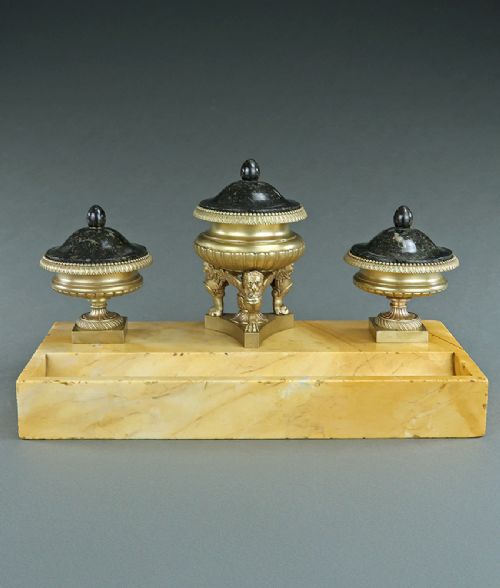
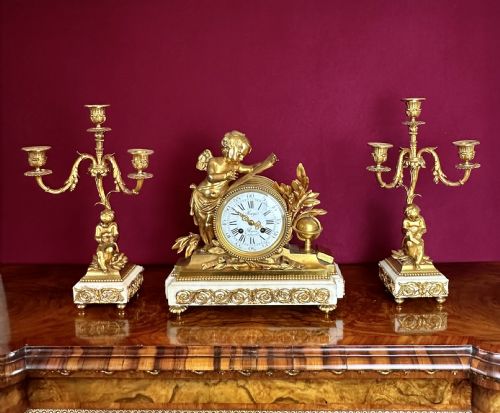
The most common versions on this page are inkstands and desk sets pairing bronze, ormolu, and gilt bronze with Sienna, vert, or onyx marble. You also find desk accessories, clock garnitures, and figural desk pieces featuring subjects such as Napoleon.
Originating largely from nineteenth-century France and Belgium, these items reflect the enduring influence of classical motifs on nineteenth-century workspace design. They range from compact single inkwells to expansive office sets complete with matching candlestands.
How they were made
The construction relies on the pairing of cast metals with heavy mineral bases, specifically utilising bronze, patinated bronze, ormolu, and gilt bronze mounted onto marble. Workshops shaped these metals through casting and chasing before applying mercury gilding or patination.
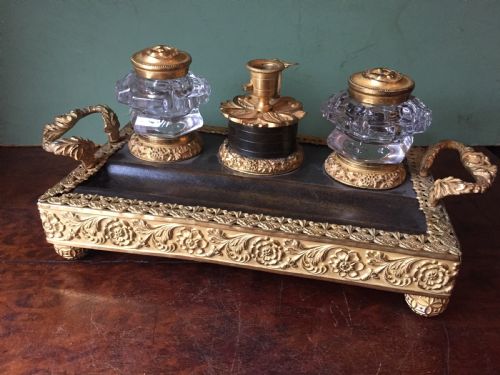
Marble bases, including Sienna marble and vert marble, were cut and polished to provide stable, decorative platforms for inkwells and desk accessories. Glass inserts frequently serve as the removable ink reservoirs within the metal housings.
Empire Bronze Desk Set Retail Price Guide 2026
Typical asking prices for empire bronze desk set among the pieces listed under this phrase on Sellingantiques today, from the lower quarter to the upper quarter. They describe what is for sale here now, not the wider market.
Listings feature nineteenth-century pieces incorporating ormolu, bronze, marble, glass, and mahogany across styles like French Empire and Neoclassical.
What varies in quality
Quality in these desk sets rests upon the crispness of the metal chasing and the depth of the gilding or patination. Superior examples display sharp detailing in sculptural elements like foliage, figures, and classical mounts.
The selection and finish of the marble base also differentiate pieces, with rich veining and precise corner work marking the upper tier. Furthermore, the integration between the metal mounts and the stone foundation reveals the original maker's standard of assembly.
Mercier Frères·Lefebvre of Belgium
The Empire Bronze Desk Set Glossary
- Ormolu
- Gilt bronze produced by applying a mercury and gold amalgam to a bronze object and heating it to drive off the mercury. This technique creates a durable, golden surface typical of nineteenth-century French luxury goods.
- Encrier
- A French term for an inkstand or inkwell. These portable writing vessels usually hold one or more glass ink reservoirs alongside pen trays.
- Garniture
- A set of matching ornamental objects designed to be displayed together on a mantelpiece or desk, often comprising a clock accompanied by side pieces like candlestands.
- Patinated bronze
- Bronze that has been chemically treated to alter its surface colour from bright metallic brown to darker tones. This finish provides contrast against bright ormolu mounts.
- Sienna marble
- A decorative yellow and purple-veined marble quarried in Italy. It provides a warm, colourful foundation for nineteenth-century desk pieces.
Empire Bronze Desk Set: Frequently Asked Questions
What is included in an empire bronze desk set?
An empire bronze desk set typically centres on an inkstand, known as an encrier, featuring one or more inkwells mounted on a marble base. Many configurations also incorporate pen trays, matching candlestands, or small sculptural elements.
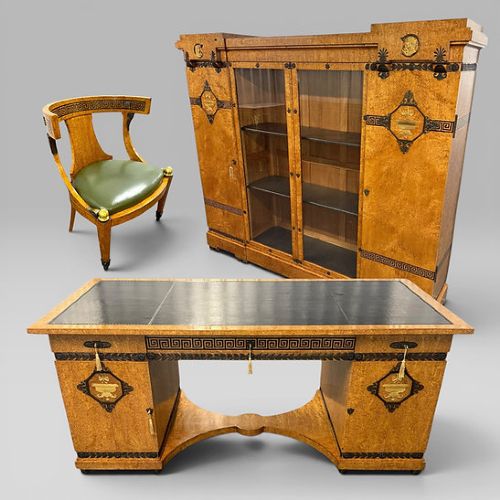
Larger office sets extend this grouping to include matching cabinets, desks, and chairs. Each component shares the neoclassical vocabulary of the nineteenth century, uniting cast bronze with polished stone.
How do I care for marble and ormolu?
Care for marble bases by dusting with a dry, soft cloth and avoiding acidic cleaners that etch the polished stone surface. Ormolu mounts require gentle cleaning without harsh abrasives to preserve the underlying gold layer.
Keep glass ink inserts clean by removing them for washing rather than using liquids directly against the surrounding metal and stone.
Are these desk sets from the nineteenth century?
The pieces listed span the nineteenth century, incorporating Victorian examples alongside items from the French Empire period and the 1850 to 1880 decades. Makers across France and Belgium produced these designs during the revival of classical styles.
Materials and construction methods match the manufacturing standards of this era, utilising heavy cast bronze and hand-finished marble.
How do I identify French neoclassical desk accessories?
French neoclassical desk accessories are recognised through their use of classical architectural motifs, symmetrical forms, and disciplined ornamentation. You will often see laurel wreaths, acanthus leaves, and urns rendered in gilt bronze and ormolu.
The inclusion of Sienna, vert, or onyx marble further supports the neoclassical aesthetic, anchoring the bright metalwork to a heavy mineral base.