


Empire Bedside Table
An empire bedside table brings architectural symmetry and classical proportions to a room, grounding the space with rich timber and cast metal mounts.
Empire Bedside Table
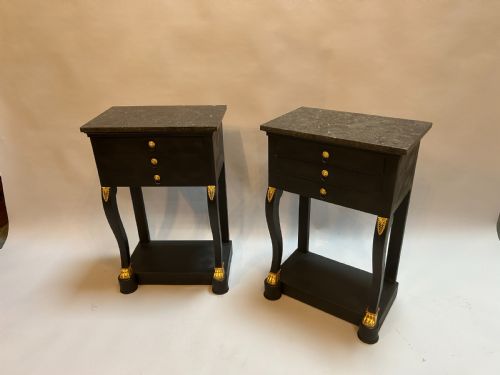
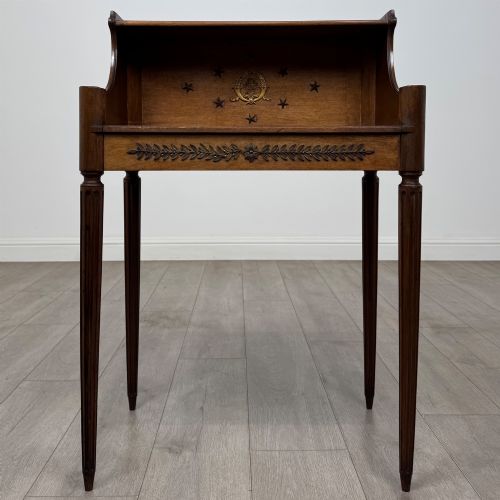
When you search for an empire bedside table, you encounter pieces designed to anchor a bedroom with formal geometry and classical restraint. The selection on this page ranges from authentic early nineteenth century French examples to later revivals from the Edwardian period and the early twentieth century.
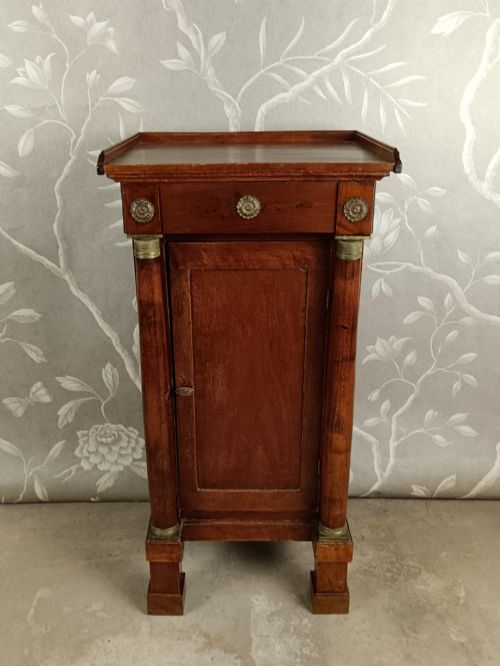
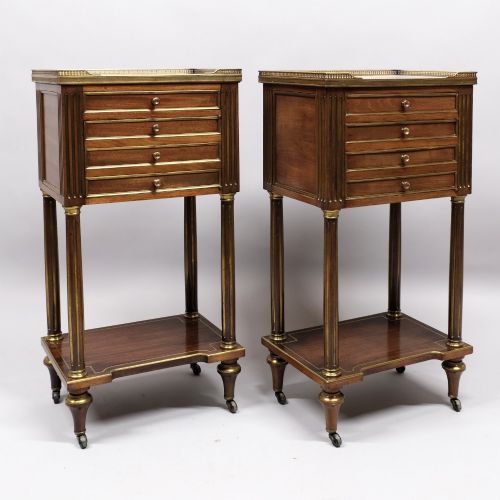
Most pieces take the form of cylindrical pedestals, small cabinets, or marble-topped stands designed to hold lighting and personal items beside a bed. Walnut and flame mahogany provide the primary wooden structures, often complemented by distinctive marble tops.
Stylistic influences stretch across French Empire, Italian Empire, and Neoclassical vocabularies, bringing architectural columns, understated pilasters, and clean lines into domestic spaces. Pairs appear frequently alongside single cabinets and circular side stands.
Materials and Construction Methods
Cabinetmakers utilised dense hardwoods like mahogany and walnut as the primary structural bodies, frequently selecting figured veneer for cylindrical pedestal doors and drawer fronts. Marble slabs, in white and variegated tones, were fitted neatly to the top surfaces to provide a durable, cool finish.
Cast bronze and ormolu mounts, often fire-gilt, define the aesthetic through classical masks, foliage, and geometric borders applied to corners and bases. Brass elements appear alongside gilt bronze to accent key architectural points on doors and columns.
Listings combine 19th-century mahogany cabinets with 1920s lighting and marble-topped cylindrical stands.
Distinctions in Quality and Craft
The precision of the bronze or ormolu casting separates standard production from exceptional work, visible in the sharpness of chased details like acanthus leaves and classical figures. Heavy fire-gilding retains its warm lustre over centuries, whereas secondary metal platings wear thin and reveal dull base metals underneath.
Cabinetmaking standards reveal themselves in the true fit of cylindrical doors, the thickness and selection of the marble slab, and the matching of flame mahogany veneers across curved surfaces. Finer examples maintain structural integrity in their internal framing without relying on heavy modern adhesives to conceal movement.
The Empire Bedside Table Glossary
- Ormolu
- Gilded bronze, where finely ground gold is amalgamated with mercury and applied to cast bronze before heating. This historical technique produces a deep, durable metallic lustre.
- Vide-poche
- An open or compartmented small table designed for emptying pockets at the end of the day. These pieces function well as compact bedside storage.
- Neoclassical
- A style spanning the late eighteenth and early nineteenth centuries that draws directly upon classical Greek and Roman architecture. It prioritises symmetry, columns, and restrained ornamentation.
- Flame mahogany
- Timber cut from the fork where a branch meets the trunk, producing a distinctive leaping flame pattern. Cabinetmakers use these veneers symmetrically on prominent surfaces.
Empire Bedside Table: Frequently Asked Questions
How do I identify a true period piece?
Examine the secondary timbers inside the cabinet, such as oak or pine drawer linings, which should match the expected regional construction methods of the nineteenth century.
Hand-cut dovetails and natural wax finishes inside drawers provide further confirmation of age against later revival pieces.
Are these tables sturdy enough for daily use?
Solid mahogany and walnut construction makes these pieces robust for holding lamps, books, and everyday bedside items.
The heavy marble tops also add considerable weight, keeping the small cabinets stable against the bedside.
How do I clean the marble top?
Use a damp cloth with mild, pH-neutral soap to wipe down the stone surface, avoiding acidic cleaners that etch polished marble.
Dry the surface immediately afterwards with a soft cloth to preserve the natural sheen of the stone.
What distinguishes French Empire from Italian Empire?
French Empire pieces, heavily influenced by Napoleonic design, lean towards strict military austerity combined with rich ormolu mounts and dark mahogany.
Italian Empire variants often incorporate lighter walnut timbers and softer classical carvings influenced by regional neoclassical traditions.