



Embroidered Fire Guard
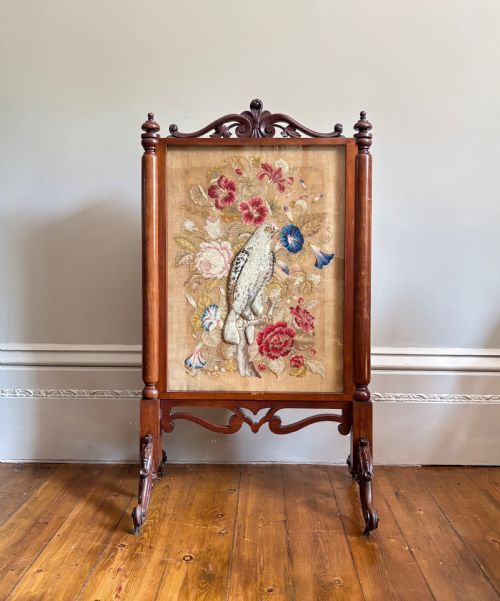
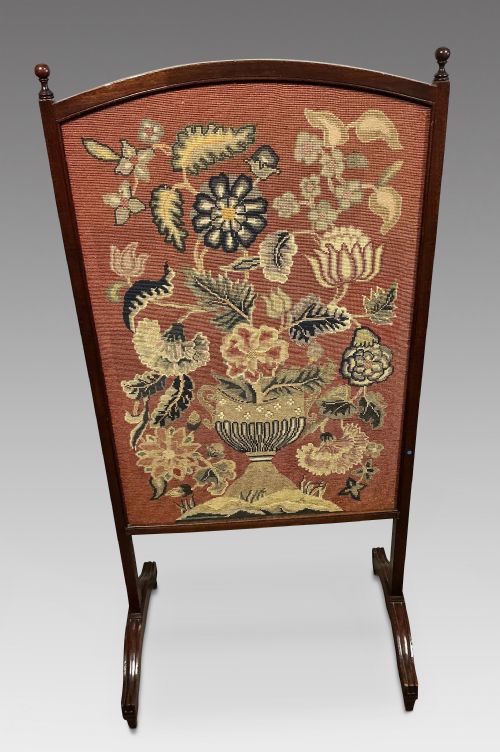
These embroidered fire guard examples combine textile panels with timber frames to block hearth heat.
Embroidered Fire Guard
An embroidered fire guard provides a decorative barrier in front of an unlit fireplace, historically used to protect people from the fierce heat of an open coal fire or to shield wallpaper from soot. When you search for an embroidered fire guard, you encounter pieces designed to stand on the floor or on a central pole, functioning simultaneously as home furnishings and as displays of needlework skill.
The most common examples on this page date from the nineteenth century, including Victorian and Georgian periods, alongside pieces from nineteen hundred and nineteen thirty. You will find object types ranging from standard fire screens to pole screens and metamorphic occasional tables, reflecting how domestic requirements shifted over time.
The frames take various forms, incorporating freestanding cheval designs, adjustable mechanisms, and occasional tables that double as screens. These items draw on styles such as Victorian, George III, Edwardian, Art Nouveau, Regency, and Rococo Revival.
How they were made
The structural frames are constructed from hardwoods including mahogany, walnut, rosewood, and giltwood, often shaped with carving or inlay. These timbers provide the rigid support necessary to hold the internal panels upright and stable on the floor.
The screens house textile panels worked in wool, silk, canvas, and needlepoint, frequently utilising Berlin work or tapestry techniques. Some examples incorporate brass fittings, such as poles, feet, or adjustable mechanisms, alongside glass reflectors.
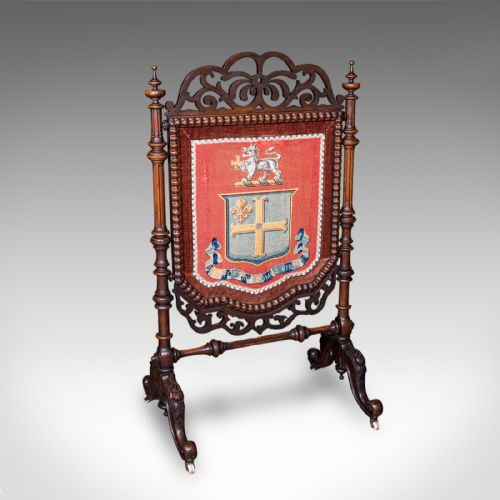
Clan Maclellan makes an unexpected appearance in the wool.
What varies in quality
Quality rests in the execution of the woodwork and the complexity of the textile panel. Pieces featuring finely carved walnut, mahogany, or giltwood frames paired with intricate needlework, Berlin work, or silk embroidery sit at the upper end of the range.
Simpler constructions, such as plain timber frames with basic canvas work, form the broader base of surviving examples. The presence of adjustable mechanisms, pole screen configurations, or metamorphic table functions also alters the character of individual pieces.
The Embroidered Fire Guard Glossary
- Berlin work
- A style of counted-thread embroidery popular in the nineteenth century, typically worked in wool on canvas from printed colour-coded grid patterns. This technique allowed makers to create detailed pictorial and geometric panels for fire screens.
- Pole screen
- A type of fire screen featuring a sliding panel mounted on a vertical wooden pole with a tripod base, allowing the textile screen to be adjusted vertically to block heat from the fire. These pieces were easily repositioned around a room.
- Cheval screen
- A freestanding fire screen supported by two lateral upright pillars and feet, allowing the central frame to pivot. This design offers a stable floor-standing alternative to pole screens.
- Needlepoint
- A form of canvas work embroidery stitched over a stiff open-weave grid, creating a durable surface suitable for domestic furnishings. It appears frequently on nineteenth-century hearth panels.
- Armorial
- A design incorporating heraldic coats of arms, often displayed in embroidery to denote family lineage and status. These heraldic panels appear in several nineteenth-century English and Irish examples.
Embroidered Fire Guard: Frequently Asked Questions
What is an embroidered fire guard?
An embroidered fire guard is a decorative screen designed to stand in front of a fireplace when the hearth is not in use. They combine timber frames with textile panels to block radiant heat and add colour to a room.
Surviving examples range from nineteenth-century pole screens to floor-standing cheval frames and metamorphic tables. Their primary purpose shifted over time from functional heat shields to ornamental furnishings.
How were fire screens used historically?
In period interiors, occupants placed them between their seats and the fireplace to protect their faces from the intense heat of open coal fires. They also prevented soot and sparks from soiling delicate furnishings.
Adjustable mechanisms allowed people to raise or lower the textile panel depending on where the heat was most intense. When the fire died down, the screens remained in place to conceal the empty grate.
What materials are used in these screens?
The frames utilise hardwoods such as mahogany, walnut, rosewood, and giltwood, occasionally enhanced with brass hardware. Some designs incorporate extending poles or folding mechanisms.
The inserted panels feature textiles like wool, silk, canvas, and needlepoint. Many employ Berlin work or tapestry techniques to depict pictorial scenes, coats of arms, or botanical patterns.
How do I tell Victorian screens apart from Georgian ones?
Victorian pieces frequently feature heavier carved walnut or rosewood frames, often accompanied by vibrant Berlin work panels or complex needlepoint. They encompass diverse formats, including adjustable pole screens and cheval designs.
Georgian examples tend to display earlier stylistic traits such as George III giltwood carving or simpler mahogany framing. Their proportions and decorative motifs align with eighteenth-century cabinet-making traditions.
Can these screens still be used in modern homes?
They function effectively as decorative room dividers or wall-adjacent ornaments in contemporary settings. Because historic textiles are sensitive to heat and light, they work best in front of unlit or electric fireplaces.
Their varied forms allow them to serve as occasional tables, freestanding panels, or focal points in living spaces.