

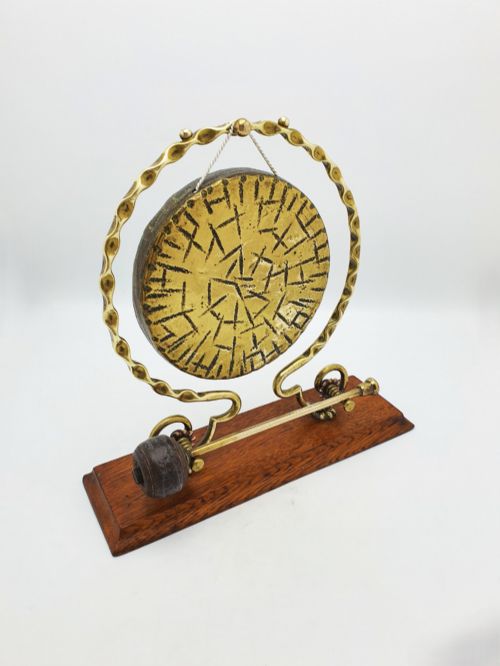


Edwardian Tabletop Gong
Edwardian tabletop gongs are striking decorative signals of arrival and mealtime, bringing rich acoustic presence and period craftsmanship directly to your dining table.
Edwardian Tabletop Gong
An edwardian tabletop gong sits ready to summon guests to dinner, combining a suspended metallic disc or bell with a supportive frame. You will frequently encounter compact variations that fit neatly on sideboards or serving tables rather than standing on the floor.
The form bridges practical domestic use with decorative display, incorporating materials that reflect the tastes of the early twentieth century alongside surviving nineteenth-century examples. Most pieces pair a resonant metal bell with a sturdy wooden, iron, or horn frame designed to hold the instrument securely.
Makers of the period drew upon diverse stylistic influences, ranging from straightforward rustic construction to exotic decorative motifs. This eclectic mix ensures that each surviving piece carries distinct character from its original domestic setting.
How they were made
Makers utilised resonant metals such as brass, bronze, and silver plate for the striking elements, paired with frames shaped from solid oak, walnut, wrought iron, and polished cattle horn. These materials were chosen both for their acoustic properties and their structural durability.
Frames often feature hand carving or curved supports, suspending the bell or gong by means of a cord to allow free vibration when struck. The accompanying strikers were fashioned to match the scale of the piece, completing the functional assembly.
Edwardian Tabletop Gong Retail Price Guide 2026
Typical asking prices for edwardian tabletop gong among the pieces listed under this phrase on Sellingantiques today, from the lower quarter to the upper quarter. They describe what is for sale here now, not the wider market.
Some nineteenth-century makers converted cattle horns into sturdy frames, proving that a dinner bell could double as a conversation piece about livestock.
What varies in quality
Quality rests in the harmony between the resonance of the metal and the structural integrity of the frame. A superior piece delivers a clear, sustained tone when struck, supported by tightly joined woodwork and well-fitted hanging cordage.
The level of detail in carved wooden stands and the finish applied to brass or bronze elements further distinguish finer examples. Simpler utilitarian versions prioritise basic serviceability over decorative elaboration.
The Edwardian Tabletop Gong Glossary
- Dinner gong
- A suspended metal instrument struck with a mallet to announce meals. It serves as both a musical signal and a decorative furnishing.
- Tabletop gong
- A reduced version designed for domestic placement on furniture rather than floor suspension. These pieces offer smaller dimensions while retaining full acoustic function.
- Japonisme
- The influence of Japanese art on Western design, visible in decorative motifs and forms. This style shaped many late-nineteenth and early-twentieth-century decorative objects.
- Silver plate
- A thin layer of silver applied to a base metal object to provide a bright finish. It allowed makers to achieve the appearance of solid silver at a lower cost.
- Aesthetic movement
- A nineteenth-century design current emphasising visual beauty over narrative or moral function. It encouraged artistic expression in everyday domestic items.
Edwardian Tabletop Gong: Frequently Asked Questions
How do you strike a tabletop gong?
You use the handheld striker provided with the piece, tapping the centre of the metal disc or bell firmly.
Allow the sound to resonate naturally without dampening the metal with your hand, ensuring a clear tone fills the room.
Where were these gongs placed in the home?
They typically rested on sideboards, dining buffets, or hall tables where they could be easily reached before a meal.
Their placement ensured the sound carried effectively to adjacent entertaining spaces when guests were called to dinner.
How do you tell Victorian pieces from Edwardian ones?
Victorian examples often feature heavier oak frames, cow horn supports, or elaborate carving reflecting revival styles.
Edwardian pieces tend toward slightly cleaner lines while still embracing historical motifs and varied materials like polished brass and walnut.
What maintenance do these gongs require?
Keep the metal components free from dust using a soft dry cloth and avoid harsh chemical polishes that might strip patination.
Check the suspension cord periodically to ensure it remains strong enough to support the weight of the hanging bell.