
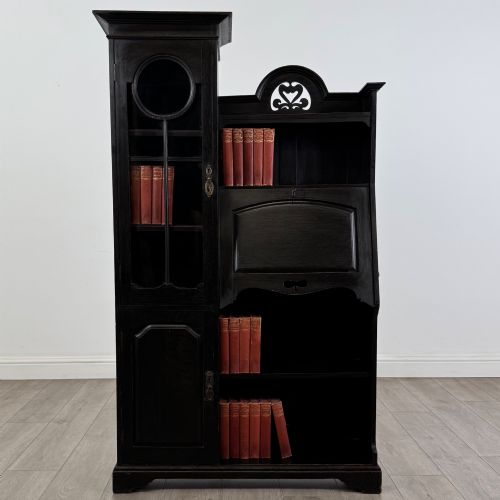
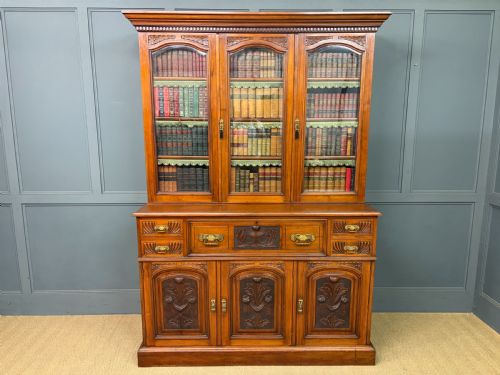
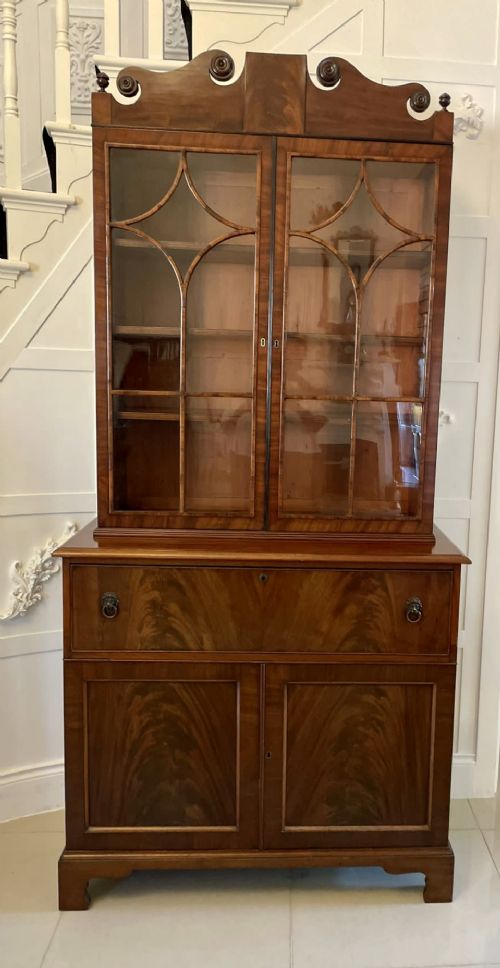


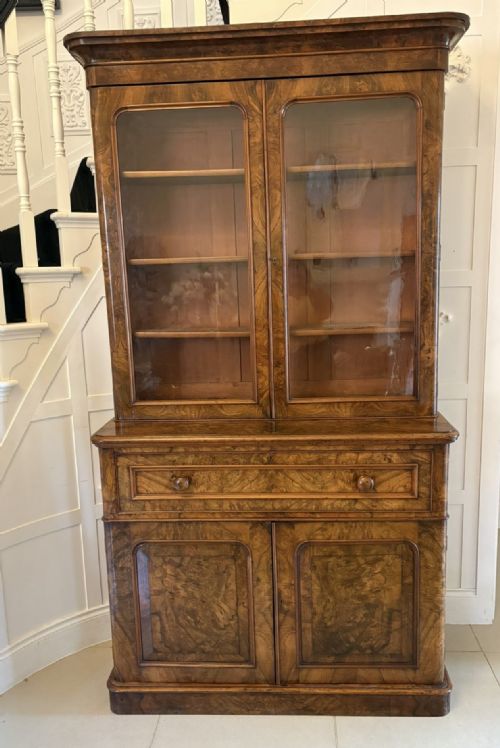


Edwardian Secretaire Bookcase
An Edwardian secretaire bookcase combines a fitted writing drawer with upper display shelves, offering practical utility and elegant home storage.
Edwardian Secretaire Bookcase
When searching for an edwardian secretaire bookcase, a buyer encounters hybrid furniture designed to save space in domestic interiors. These pieces unite a glazed upper cabinet for books with a lower section featuring a drop-front writing drawer that conceals a fitted interior of small drawers and pigeonholes.
The pieces on this page span the Edwardian period alongside earlier Georgian, Regency and Victorian interpretations. Mahogany, oak and walnut provide the primary carcases, often embellished with satinwood inlay or brass handles.
How they were made
Cabinet makers built these pieces using solid timbers alongside veneered surfaces on secondary woods. Mahogany and oak predominate, while satinwood and burr walnut appear as decorative veneers on drawer fronts and panels.
Glazing bars divide the upper cabinet glass into panes, and brass hardware secures the doors and drop-front mechanisms. Internal writing surfaces frequently feature leather or velvet inserts surrounded by pigeonholes and stationary drawers.
Many writing interiors hide tiny secret drawers behind pigeonholes for stashing love letters.
What varies in quality
Quality rests in the selection of timber veneers and the precision of the cabinet work. Finely figured mahogany or burr walnut with symmetrical grain patterns distinguishes superior examples from plain utility pieces.
Interior complexity dictates value, with secondary internal drawers, concealed compartments and fine marquetry inlay separating standard workshop production from notable maker output.
Maple and Co·Gillows·Edwards and Roberts·Christopher Pratt
The Edwardian Secretaire Bookcase Glossary
- Secretaire
- A writing cabinet featuring a drop-front drawer that conceals a fitted desk interior. It allows a chest of drawers or bookcase to double as a writing desk.
- Glazing bars
- The wooden strips that hold individual panes of glass within a cabinet door. They define the visual pattern of the upper bookcase section.
- Marquetry
- Decorative veneer work created by fitting together small pieces of different coloured woods to form pictorial or geometric patterns. It often embellishes satinwood surfaces.
- Pigeonhole
- Small, open compartments built into the interior of a desk or secretaire for sorting letters and papers. They form part of the fitted writing interior.
Edwardian Secretaire Bookcase: Frequently Asked Questions
What is an edwardian secretaire bookcase?
An edwardian secretaire bookcase is a dual-purpose piece of furniture featuring a glazed bookcase top above a pull-down writing drawer and lower storage cupboards or drawers.
These pieces were designed for Edwardian homes to provide both a library display and a private writing desk within a single footprint.
How do I use a secretaire drawer?
The front of the top drawer hinges downwards to form a flat writing surface supported by internal arms or brackets.
Opening this drop-front reveals a collection of pigeonholes and small accessory drawers designed for storing stationery and writing materials.
How do I tell Edwardian from Georgian styles?
Edwardian examples often incorporate lighter satinwood inlay, Sheraton Revival motifs and softer proportions compared to earlier Georgian carcases.
Georgian pieces rely on denser mahogany construction, heavier cornice mouldings and structural joinery typical of the eighteenth century.
What woods were used for these bookcases?
Cabinet makers utilised mahogany, oak and walnut as primary framing timbers, often applying figured veneers to the exterior surfaces.
Satinwood and burr walnut frequently appear on finer inlaid panels, whilst secondary woods like pine or oak form the interior drawer linings.