
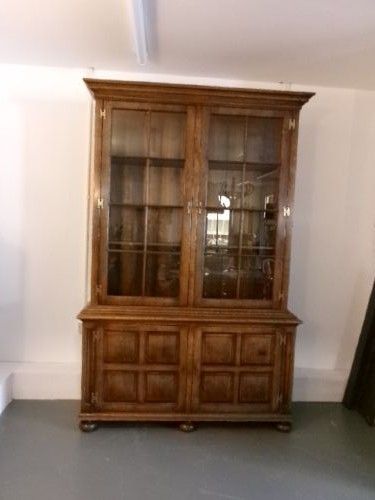
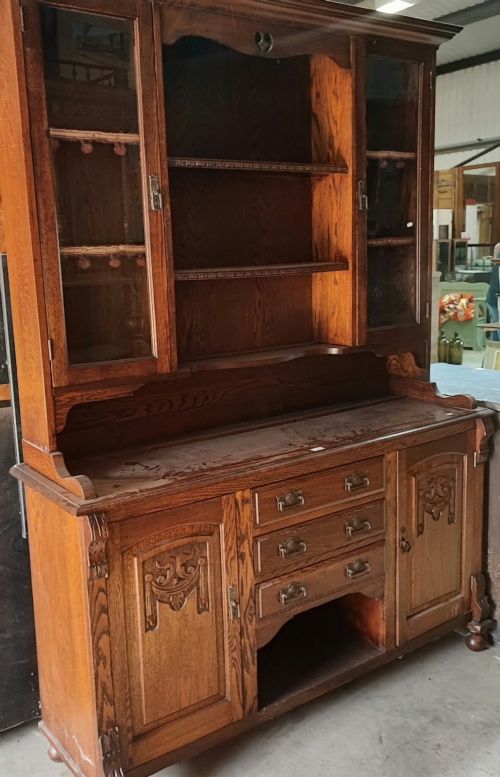
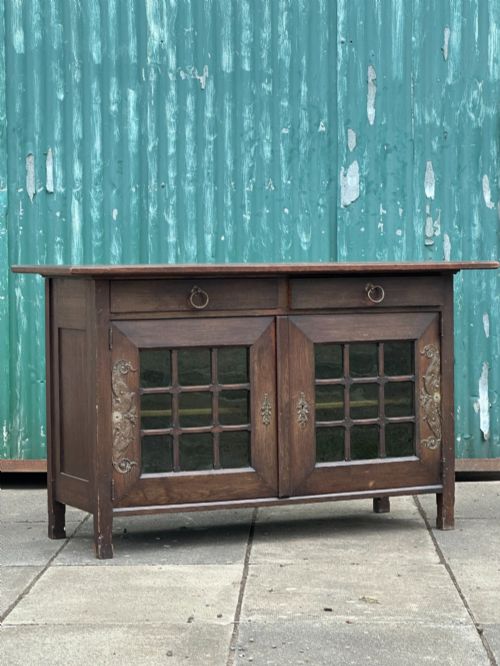


Edwardian Oak Glazed Dresser
These edwardian oak glazed dresser pieces bring practical storage and display to a room, offering the sturdy charm collectors seek.
Edwardian Oak Glazed Dresser
An edwardian oak glazed dresser combines lower storage compartments with upper shelving enclosed by glass doors, serving as both a sideboard and a display cabinet. The selection spans the Edwardian period alongside pieces from the nineteenth and early twentieth centuries, reflecting similar domestic utility.
Most examples lean towards Arts and Crafts, Jacobean Revival, or Art Nouveau styling, using golden, tiger, or heavy oak timbers. These forms appear as sideboards with mirror backs, library bookcases, and side cabinets with leaded glass panels.
Materials and construction
Makers built these pieces primarily from solid oak, sometimes utilising tiger oak or golden oak varieties to create distinct grain patterns. Glass and mirror glass form the upper display sections, occasionally held together with lead or supported by brass and iron hardware.
Construction techniques include carved cupboard bases and fitted shelving units. The joinery accommodates heavy timber doors, glass panes, and occasionally mirror backs without losing structural integrity.
Listings feature oak furniture spanning the nineteenth century through the nineteen-thirties, incorporating Arts and Crafts and Jacobean Revival styles.
Distinctions in quality
Quality rests upon the selection of the oak timber and the crispness of any carved ornamentation on the cupboard bases. Stronger examples exhibit thoughtful proportions and harmonious integration between the lower wooden storage and the upper glazed display area.
The execution of stylistic details, such as Arts and Crafts metalwork or Art Nouveau linear accents, separates standard utilitarian pieces from finer workshop productions.
Liberty & Co.
The Edwardian Oak Glazed Dresser Glossary
- Tiger oak
- A figure in oak timber showing dark, shimmering medullary rays resembling tiger stripes. This cut appears frequently in better nineteenth and early twentieth-century furniture.
- Leaded glass
- Small panes of glass held together by strips of lead cames. It forms decorative patterns on cabinet doors, particularly in Arts and Crafts design.
- Mirror back
- A polished glass plate fitted into the wooden superstructure above a sideboard surface. It reflects light and displays objects placed on the ledge below.
- Jacobean Revival
- A nineteenth and early twentieth-century style imitating seventeenth-century English furniture. It uses heavy dark oak, geometric moulding, and deep carving.
Edwardian Oak Glazed Dresser: Frequently Asked Questions
What is an edwardian oak glazed dresser?
An edwardian oak glazed dresser is a piece of furniture featuring a lower wooden storage base, such as a cupboard or sideboard, paired with an upper section enclosed by glass doors for display.
These pieces typically combine practical shelving with decorative styling from the Edwardian era, Arts and Crafts movement, or Jacobean Revival.
How were these dressers used historically?
Households used them in dining rooms and libraries to store tableware, linens, or books while displaying decorative ceramics behind glass.
The upper glazed doors kept dust away from precious volumes and china, while the lower cupboards concealed bulkier items.
Where should I place one in a modern home?
They suit dining rooms, kitchens, or living spaces where they can function as a bookcase, display cabinet, or sideboard.
The oak timber and glass panels brighten a room while offering substantial enclosed storage for everyday objects.
How do I distinguish Edwardian pieces from Victorian ones?
Edwardian furniture generally exhibits lighter oak tones and simpler, airier lines compared to the heavier, darker forms typical of the Victorian period.
Arts and Crafts and Art Nouveau influences also help date pieces towards the turn of the twentieth century.