



Edwardian Moonstone Jewellery
Edwardian moonstone jewellery brings together soft, glowing adularescence and period metals like sterling silver and gold.
Edwardian Moonstone Jewellery
Edwardian moonstone jewellery encompasses rings, brooches, necklaces, pendants, bracelets, bangles, and earrings originating primarily from the Edwardian and Victorian eras. These pieces frequently incorporate distinctive motifs and styling from the Arts and Crafts and Art Nouveau movements, reflecting the decorative tastes of the period.
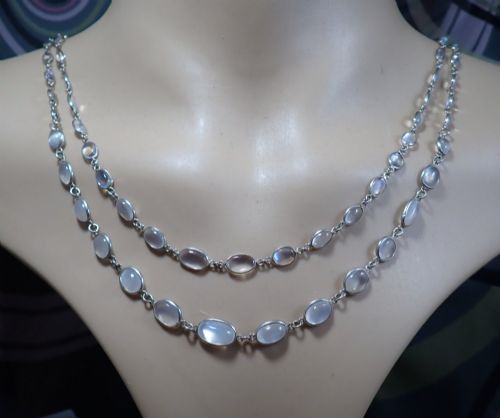
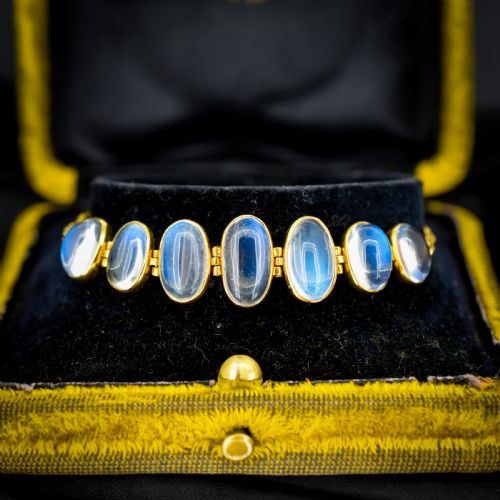
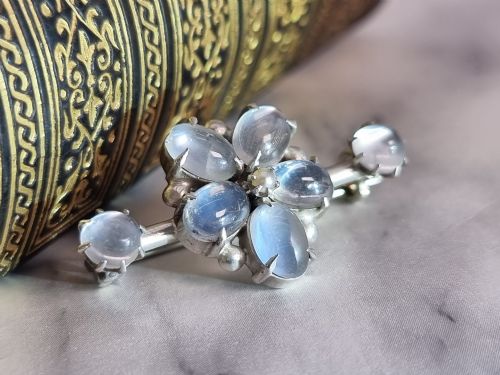
The versions most commonly met on this page combine cabochon-cut moonstones with sterling silver or gold settings, sometimes accented with seed pearls, sapphires, or enamel flowers. Forms range from simple flower brooches and screwback earrings to elaborate drop pendants and graduating stone bracelets.
Materials and construction
Goldsmiths and silversmiths shaped these jewels using sterling silver, 9ct gold, 15ct gold, and 18ct gold as the foundational mountings for the stones. Metalwork often displays handcrafted details characteristic of the Arts and Crafts aesthetic, including wirework and bezel settings.
Moonstones are shaped into smooth cabochons to maximise their characteristic optical phenomenon, frequently paired with seed pearls or coloured gems like garnets and amethysts. Artisans utilised these natural materials to create floral, insect, and geometric compositions typical of early twentieth-century design.
An antique scorpion brooch proves Edwardians loved creeping crawlies just as much as floral garlands.
Assessing quality
Quality rests upon the optical depth and adularescence of the moonstone itself, alongside the precision and character of the metal setting. Stronger blue or white floating light within the stone elevates a piece above standard examples.
The presence of attributed workshop designs or integration of secondary gems such as natural pearls and sapphires distinguishes finer examples. Structural integrity in delicate elements like screwback mechanisms or filigree wirework further indicates superior workmanship.
George Hunt·John Paul Cooper·Dorrie Nossiter·Amy Sandheim
The Edwardian Moonstone Jewellery Glossary
- Cabochon
- A gemstone shaped with a smooth, rounded, convex surface rather than faceted edges. This cut is utilised for moonstones to display their internal light play.
- Adularescence
- The optical phenomenon where a milky, bluish light shimmers across the surface of a moonstone. It creates the signature floating glow prized in these jewels.
- Arts and Crafts
- A design movement valuing handcrafted execution and natural motifs over mass production. Pieces from this style often feature hammered silver and organic forms.
- Lavaliere
- A pendant necklace featuring a central dangling drop, popular during the Edwardian period. These frequently suspend moonstones from delicate gold or silver chains.
- Seed pearl
- Very small, natural or saltwater pearls drilled and threaded into jewellery designs. They commonly accent moonstone brooches, bangles, and pendants.
Edwardian Moonstone Jewellery: Frequently Asked Questions
How do I care for antique moonstone jewellery?
Moonstones possess a moderate hardness and cleave along specific planes, meaning they require gentle handling to avoid scratching or impact damage. Clean them using warm soapy water and a soft cloth, avoiding harsh chemical dips or ultrasonic cleaners.
Store pieces individually in soft pouches away from harder gemstones that might abrade the polished cabochon surface. Regular checks on the claw or bezel settings ensure the stones remain secure in their original mountings.
What metals are typical in Edwardian moonstone pieces?
These pieces commonly utilise sterling silver, alongside 9ct, 15ct, and 18ct yellow or rose gold. Silver was frequently chosen by Arts and Crafts makers to complement the cool, lunar glow of the moonstone.
Gold mountings appear frequently in Edwardian pendants, rings, and bracelets, sometimes paired with seed pearls or diamonds. The choice of metal often reflects the stylistic movement, with silver dominating Arts and Crafts pieces and gold favouring traditional Edwardian designs.
How do I distinguish Edwardian from Victorian moonstone pieces?
Victorian pieces often feature heavier gold weights, darker metals, and sentiment-driven motifs like double hearts or serpents. Edwardian designs tend to favour lighter platinum or silver settings with lacy, openwork frames and floral or garland themes.
Overlap occurs because stylistic periods do not end abruptly, and makers carried techniques across decades. Examining the hallmarks, clasp types, and overall weight helps clarify the likely decade of manufacture.
Are moonstones treated or natural in antique jewellery?
Moonstones in antique jewellery are natural feldspar minerals without modern enhancement treatments. Their optical properties occur naturally through the structural intergrowth of orthoclase and albite.
Evaluating the internal light play reveals the untreated nature of these stones, which display subtle variations in clarity and sheen. Natural inclusions and slight colour shifts are standard characteristics of period gems.