




Edwardian Marquise Dress Ring
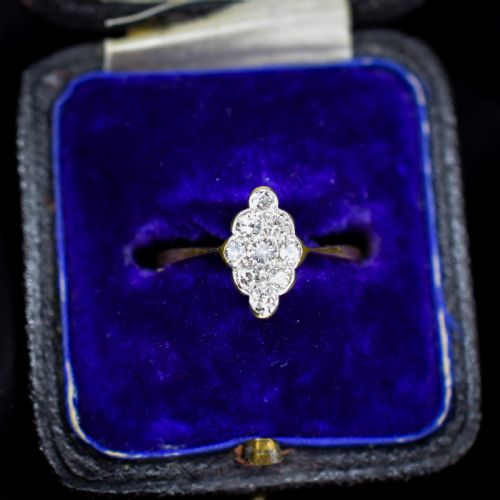
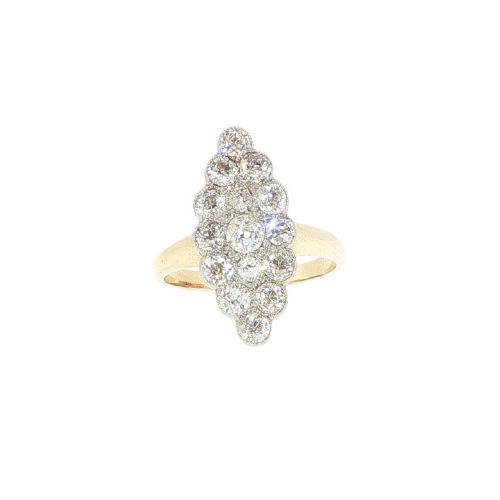
An edwardian marquise dress ring sits long and sharp upon the finger, drawing the eye with layered stones and delicate metalwork.
Edwardian Marquise Dress Ring
An edwardian marquise dress ring takes its name from the elongated, boat-shaped silhouette that stretches across the knuckle. These pieces span periods from Victorian through Edwardian and Art Deco, reaching into later decades.
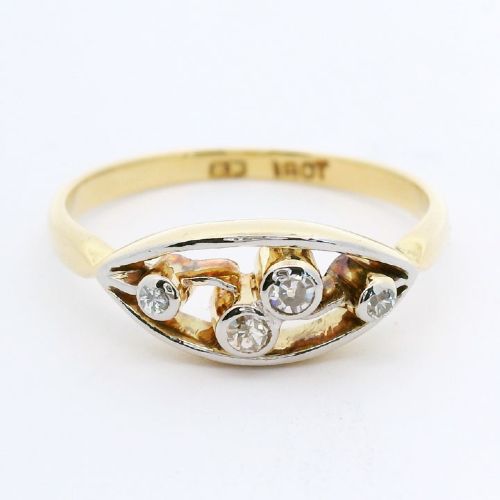
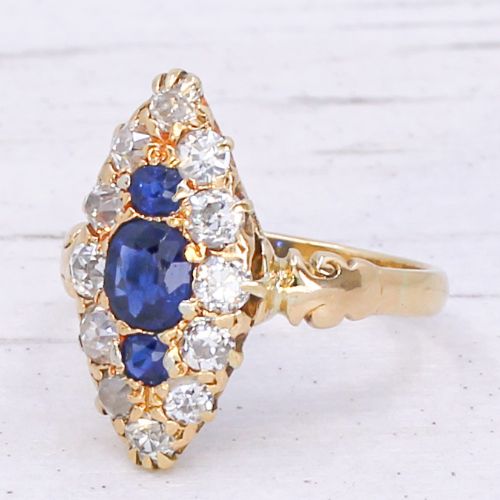
The format relies on clustered stones set into a pointed oval face, often pairing diamonds with sapphires, rubies, emeralds or pearls.
Yellow gold and platinum dominate the settings, frequently combining to give a warm shank alongside a bright, white metal face that enhances the stones.
Materials and construction
Goldsmiths combined 18ct yellow gold for structural strength with platinum on the face to hold delicate claw or rubover settings securely. Old cut, old mine and rose cut diamonds form the sparkling centrepieces alongside natural sapphires, rubies and emeralds.
Makers pierced and milled the platinum and gold to create openwork galleries and intricate millegrain borders that frame the gemstones.
Gemstones in these selections include diamonds, sapphires, rubies, emeralds, and pearls set into navette and cluster formations.
Assessing quality and craftsmanship
Superior examples show crisp, even millegrain edges and precise hand-piercing in the metalwork that holds the stones without crowding them. The integration of platinum with gold should be seamless, showing careful benchwork rather than clumsy joins.
The choice and match of central and accent stones dictate the distinction of the piece, where clean old cut diamonds or vivid coloured gems sit harmoniously within the narrow navette outline.
The Edwardian Marquise Dress Ring Glossary
- Marquise
- A pointed, elongated oval shape resembling a small boat, designed to stretch lengthways along the finger.
- Navette
- Another term for a boat-shaped ring or cluster, sharing the same pointed ends as a marquise.
- Millegrain
- A decorative technique creating a fine, beaded edge of metal along the borders of a setting.
- Old Cut
- A hand-faceted diamond cut typical of the Victorian and Edwardian eras, featuring smaller tables and broader facets.
- Rubover setting
- A mounting style where a thin collar of metal is pushed over the edge of the stone to hold it in place.
Edwardian Marquise Dress Ring: Frequently Asked Questions
How do I wear a marquise ring daily?
Because the pointed ends sit long upon the hand, pair the piece with plain bands so neighbouring rings do not rub against the delicate cluster.
Take the ring off during heavy manual tasks to protect the slender gold shank and the millegrain edges from knocks.
What is the difference between navette and marquise?
Navette and marquise both describe the same boat-shaped, pointed silhouette that characterises these dress rings.
Jewellers use both words interchangeably to indicate an elongated cluster design that stretches across the knuckle.
Are these rings made of platinum or gold?
Many examples combine 18ct yellow gold bands with platinum faces, a pairing popular during the Edwardian and Art Deco periods.
Platinum provided a bright, durable white surface to set diamonds, while gold formed a warm, strong foundation for the finger.
How can I tell the period of a ring?
Look at the combination of metals, the style of the stone cuts, and any hallmarks stamped inside the shank, such as town marks and specific dates.
Edwardian pieces often mix yellow gold with platinum and feature old cut diamonds, while later Art Deco versions lean into geometric precision.