
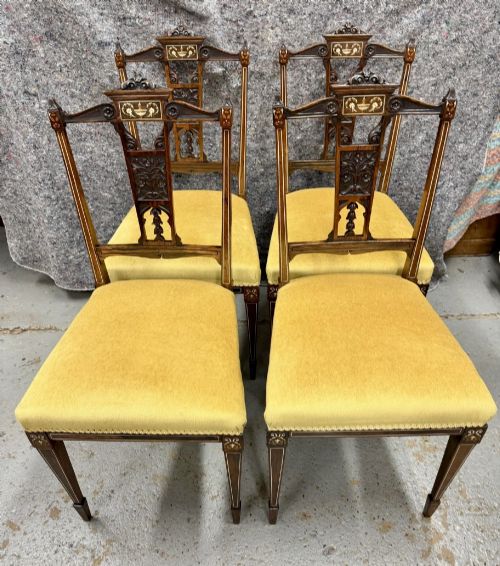
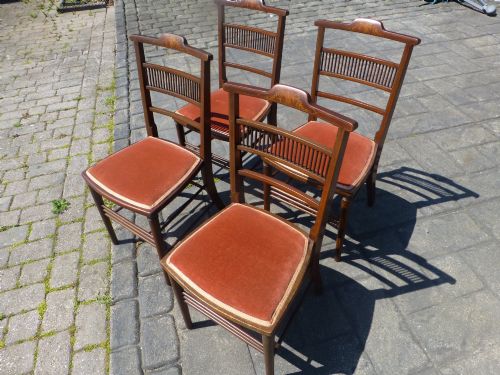


Edwardian Marquetry Side Chairs
Edwardian marquetry side chairs bring delicate floral and geometric wood inlay to formal seating, offering a refined focal point for any traditional interior.
Edwardian Marquetry Side Chairs
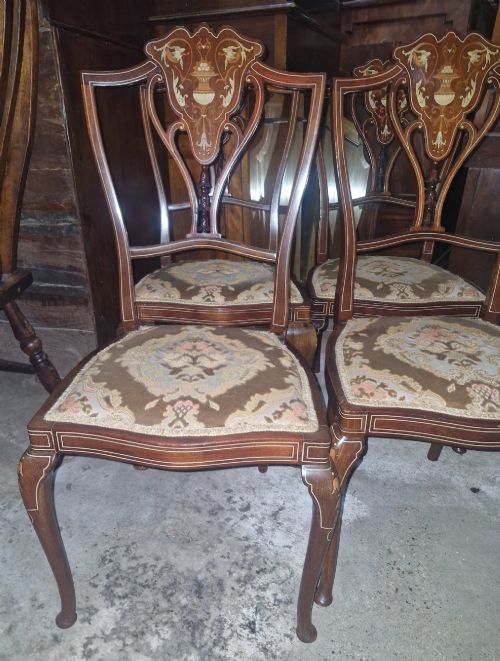
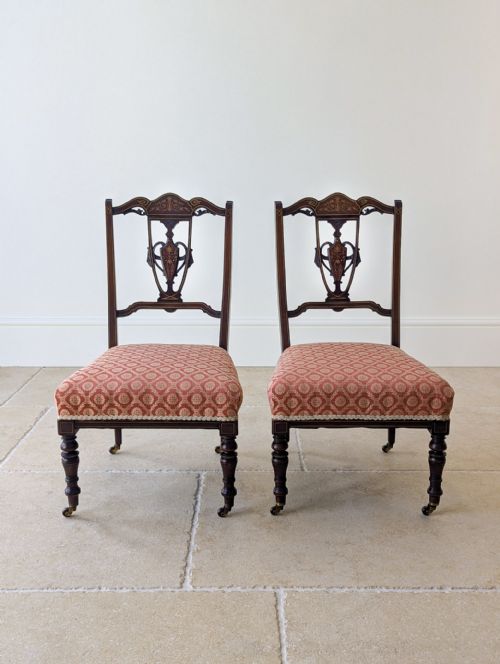
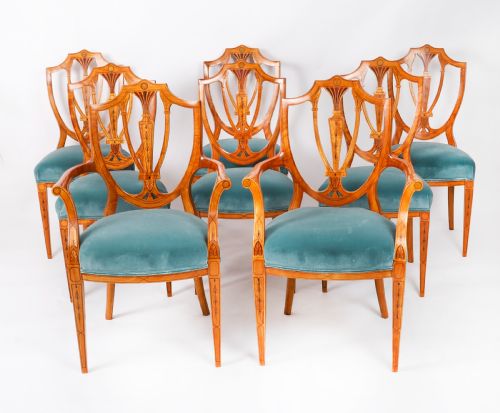
Edwardian marquetry side chairs combine lightweight wooden frames with contrasting wood inlay, originating predominantly from the Edwardian period and the late Victorian era. Buyers searching for these pieces will most frequently encounter mahogany or rosewood models, often styled after Sheraton Revival or Hepplewhite designs.
The selections span various room functions, including bedroom chairs, salon seating, and dining sets. Many items exhibit delicate marquetry patterns set into polished timbers, reflecting the decorative tastes of the early twentieth century.
Construction and Materials
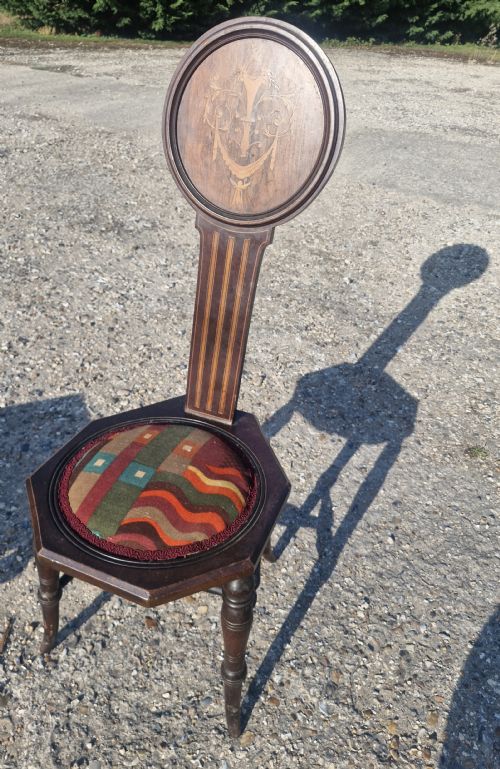
Cabinet makers constructed these frames primarily using solid hardwoods such as mahogany, walnut, and rosewood, occasionally incorporating beech. Surface decoration relied on wood inlay, satinwood inlay, and detailed marquetry to create contrasting pictorial or geometric motifs.
Upholstered elements utilised traditional materials like fabric, silk, and velvet, sometimes supported by brass details. Craftsmen combined these textiles with carved wooden structures to balance decorative ambition with everyday utility.
Listings feature periods spanning from the Victorian era through the Edwardian period, utilising mahogany, rosewood, walnut, fabric, and velvet.
Quality Variations
The standard of timber selection and the precision of the wood inlay establish the primary distinction between simpler utility pieces and high-end salon seating. Finer examples display intricate, multi-timber marquetry with tightly fitted joints and superior surface polishing.
Makers such as Cowtan & Sons and Shoolbred produced notable suites, where branded or attributed pieces demonstrate a superior level of cabinet making and design cohesion compared to unbranded workshop equivalents.
Cowtan & Sons·Shoolbred
The Edwardian Marquetry Side Chairs Glossary
- Marquetry
- Decorative veneer applied to a wood structure to form intricate pictures or patterns. It uses contrasting timbers to create detailed pictorial designs on chair backs and seats.
- Sheraton Revival
- A late nineteenth and early twentieth century design movement that reinterprets eighteenth century neoclassical furniture forms. These chairs often feature slender tapering legs and delicate inlay.
- Side Chair
- A chair without arms designed for dining or occasional use around a room. They occupy minimal space while providing formal seating.
- Satinwood
- A durable, lustrous timber with a yellow sheen utilised extensively for contrasting inlay work. It provides bright detail against darker woods like mahogany and rosewood.
Edwardian Marquetry Side Chairs: Frequently Asked Questions
What defines an Edwardian side chair?
These chairs are defined by their lightweight wooden construction, slender proportions, and decorative wood inlay characteristic of the early twentieth century.
They generally lack arms and were designed for placement around a dining table or alongside a salon wall.
How do I care for inlaid wood?
Protect inlaid surfaces from direct sunlight and sharp changes in temperature to prevent the delicate veneer from lifting.
Apply a microcrystalline wax periodically to nourish the polished timber without building up heavy residues.
Were these chairs used for dining?
Many examples functioned as dining chairs, particularly within matched sets produced during the Edwardian period.
Others served as salon, bedroom, or occasional seating depending on their upholstery and proportions.
How do I distinguish Edwardian from Victorian?
Edwardian pieces generally exhibit lighter proportions and brighter satinwood inlay, reflecting a shift away from heavier Victorian styles.
Victorian precursors often utilise darker timbers and heavier carving before the aesthetic turned toward neoclassical revivals.