

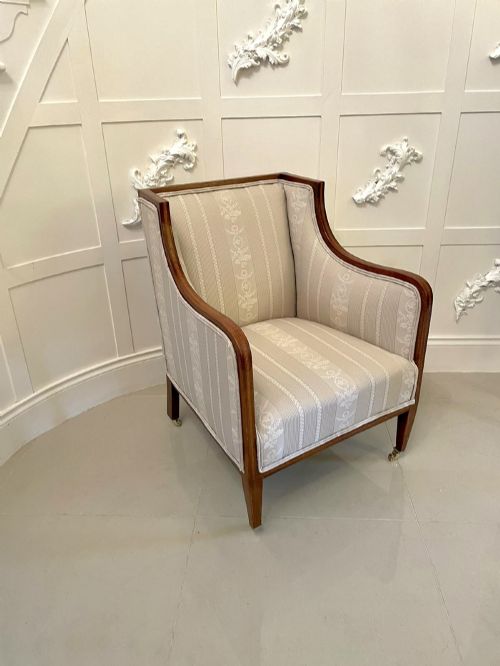
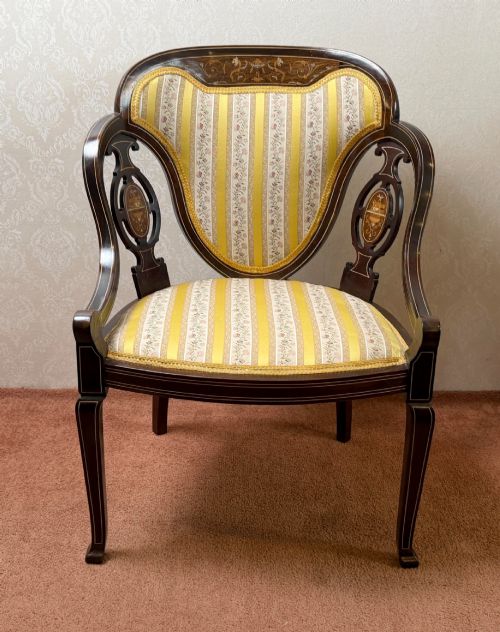
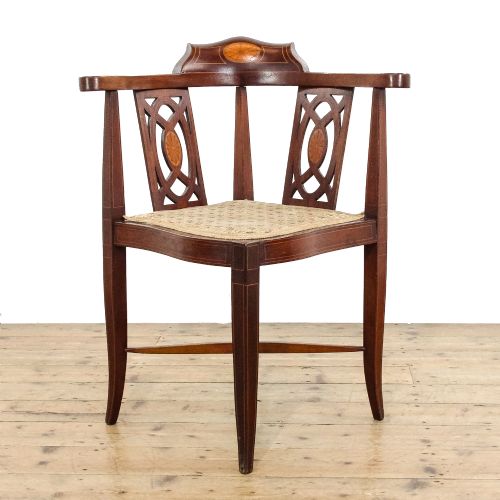
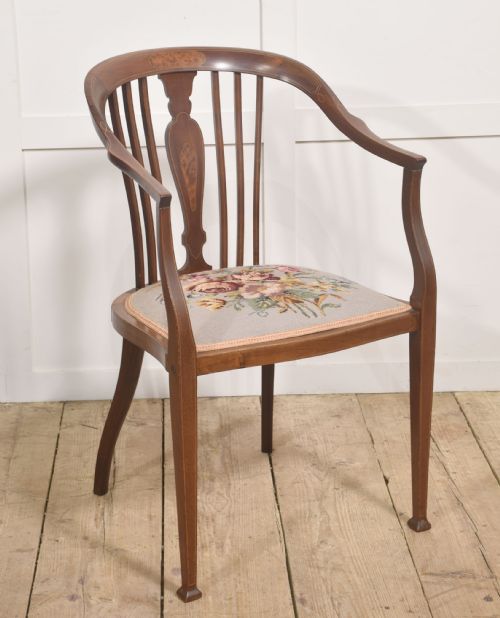


Edwardian Inlaid Tub Chair
An edwardian inlaid tub chair wraps the sitter in curved timber and delicate marquetry, bringing lightness to a room.
Edwardian Inlaid Tub Chair
An edwardian inlaid tub chair is a compact, enveloping seat defined by a curved, semicircular backrest that flows continuously into low arms. These chairs originate primarily from the Edwardian period and the surrounding decades, appearing as single occasional seats, matching pairs, or parts of larger salon suites. They serve well in bedrooms, dressing rooms, and corners where a deep, upright seat is required without heavy proportions.
The common form on this page pairs a solid mahogany frame with contrasting lighter wood inlays and fabric upholstery. Variations include corner chairs, desk chairs, and low salon armchairs that share the same characteristic curved profile. Makers of the period often adapted the shape for comfort and visual elegance in domestic interiors.
How They Were Made
Makers constructed the primary frames of these chairs using mahogany, sometimes bending the timber with heat to achieve the signature circular tub shape. Satinwood and boxwood provided the pale contrast needed for fine lines and stringing.
Wood inlay and marquetry created floral, ribbon, or neoclassical motifs set flush into the mahogany ground. Craftsmen finished the seating surfaces with fabric upholstery, padding the curved back and seat for domestic comfort.
Edwardian Inlaid Tub Chair Retail Price Guide 2026
Typical asking prices for edwardian inlaid tub chair among the pieces listed under this phrase on Sellingantiques today, from the lower quarter to the upper quarter. They describe what is for sale here now, not the wider market.
Listings demonstrate that mahogany remains the dominant structural timber, supplemented by satinwood inlay and fabric upholstery across Edwardian forms.
What Varies in Quality
The standard of an edwardian inlaid tub chair rests on the precision of the cabinetwork and the crispness of the marquetry. Superior examples display tightly fitted joinery that conceals stress points along the curved back rail, whereas lesser pieces show visible gaps where the arms meet the uprights.
The refinement of the inlay dictates the tier of the piece, with hand-cut satinwood and boxwood details outshining simpler printed or stamped motifs. Well-proportioned framing and original structural integrity separate workshop pieces meant for daily use from lighter decorative items.
Jenks & Wood
The Edwardian Inlaid Tub Chair Glossary
- Tub Chair
- An armchair with a continuous curved back and armrests forming a deep, protective enclosure. This seating form became particularly popular during the late nineteenth and early Edwardian periods.
- Marquetry Inlay
- Decorative patterns created by fitting thin pieces of various coloured woods into a prepared wooden surface. The technique allows for complex pictorial or symmetrical designs.
- Satinwood
- A durable, lustrous yellowish timber native to India and Sri Lanka, utilised extensively for contrasting inlay work on darker cabinet furniture. It catches the light differently depending on the grain direction.
- Sheraton Revival
- A late nineteenth and early twentieth century design movement that reinterpreted the lighter, neoclassical styles of eighteenth-century designer Thomas Sheraton. Pieces in this style rely heavily on satinwood banding and tapered legs.
- Stringing
- Narrow strips of contrasting wood inlaid into grooves on table edges, chair legs, or back rails. This linear detail defines panels and outlines structural forms.
Edwardian Inlaid Tub Chair: Frequently Asked Questions
How do I use an edwardian inlaid tub chair at a desk?
Select versions specifically noted as desk or office chairs, which offer slightly higher seats and more upright posture.
Ensure the curved arms fit comfortably beneath the writing surface before placing the chair in a working study.
Are these chairs suitable for daily seating?
Most pieces were built for light parlor use and feature delicate frames rather than heavy lounge construction.
Occasional sitting works well, but heavy daily wear requires checking the structural stability of the curved back joints.
How do I identify a true Edwardian period piece?
Look for the characteristic combination of mahogany timbers, satinwood stringing, and lighter proportions than Victorian furniture.
Construction methods such as hand-cut joinery and period upholstery webbing also help confirm the era.