

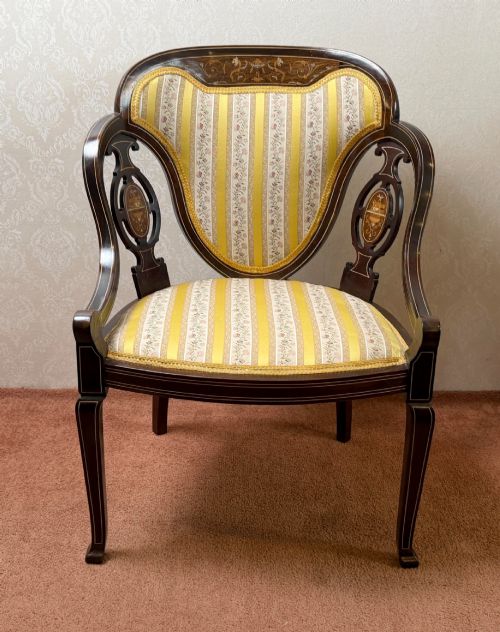
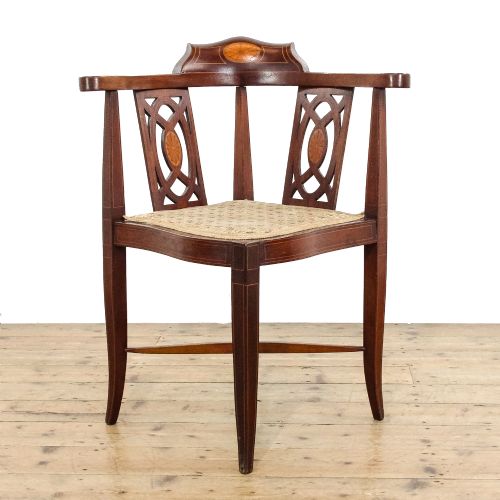
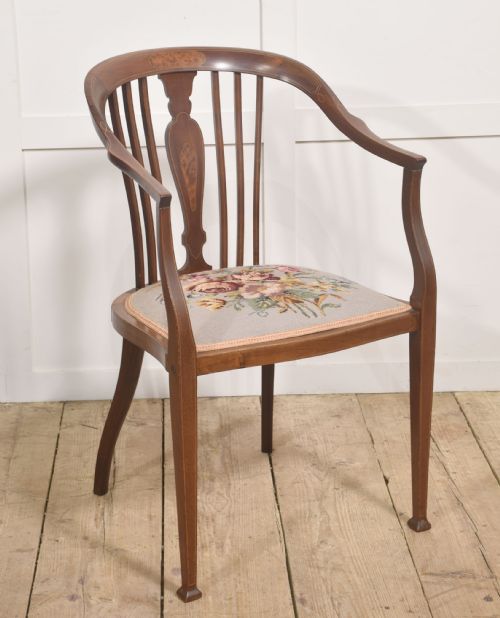


Marquetry Tub Chair
These marquetry tub chair examples combine curved backs with detailed wood inlay, offering a compact seating form for a study or drawing room.
Marquetry Tub Chair
The form appears in various guises across the inventory, including corner chairs, desk chairs, and salon armchairs. Mahogany forms the primary structural timber, often enriched with satinwood and marquetry inlay across the back and rails.
How they were made
Cabinet makers constructed these frames predominantly using solid mahogany or walnut, shaping the curved tub backs from steam-bent wood or segmented joinery. Wood inlay and marquetry techniques applied contrasting veneers of satinwood and exotic timbers into recessed channels on the crest rails and splats.
Upholstery completed the seating, with drop-in or sprung pads covered in fabric. Syrian Moorish examples utilised intricate geometric wood and bone or mother-of-pearl inlay techniques distinctive to Damascus workshops.
Marquetry Tub Chair Retail Price Guide 2026
Typical asking prices for marquetry tub chair among the pieces listed under this phrase on Sellingantiques today, from the lower quarter to the upper quarter. They describe what is for sale here now, not the wider market.
Listings feature Edwardian, Victorian, and nineteenth-century periods, constructed from mahogany, walnut, satinwood, and fabric.
What varies in quality
The refinement of the marquetry and wood inlay work distinguishes superior pieces from standard production. Crispness in the botanical or geometric veneer patterns and the absence of crude filler indicate higher workshop standards.
Structural integrity of the curved back joints and the selection of figured mahogany timbers also divide the ordinary chairs from exceptional items. Well-executed corner and desk chair forms demonstrate precise joinery where the curved arms meet the uprights.
Jenks & Wood
The Marquetry Tub Chair Glossary
- Marquetry
- Decorative veneer work arranged in pictorial or geometric patterns on a furniture surface. It differs from simple inlay by assembling an entire picture sheet before pressing it onto the wood.
- Tub chair
- An armchair with a continuous curved back and arms forming a rounded enclosure. This form provides wrap-around support for the sitter.
- Satinwood
- A pale, lustrous hardwood frequently utilised for contrasting stringing and inlay details on mahogany furniture. Its bright yellow-gold tone contrasts sharply with darker woods.
- Corner chair
- A seating form designed to fit into the corner of a room, featuring a diagonal seat and a continuous curved back rail supported by posts.
Marquetry Tub Chair: Frequently Asked Questions
What is a marquetry tub chair?
A marquetry tub chair is an upholstered seat featuring a continuous curved backrest decorated with detailed wood veneer patterns. These chairs combine supportive curved frames with decorative inlay work.
They serve as accent pieces, desk chairs, or occasional seating in period interiors.
How old are most marquetry tub chairs?
Most examples date from the Edwardian era around nineteen hundred, with other pieces originating in the Victorian period and the nineteenth century. Cabinet makers of these periods favoured mahogany and satinwood materials.
The recorded dates span from eighteen seventy through to nineteen twenty.
Where should I place a tub chair?
These chairs fit well in corners, studies, or bedrooms where a compact footprint is required. Their finished backs allow them to sit away from walls in open room layouts.
They function effectively as desk chairs or occasional seating in a salon.
What woods were used for inlay?
Mahogany and walnut form the primary frames, while satinwood provides a bright contrasting veneer for marquetry details. Makers also incorporated various exotic timbers to achieve multi-coloured pictorial designs.
Damascus Moorish examples introduced intricate geometric wood patterns.