

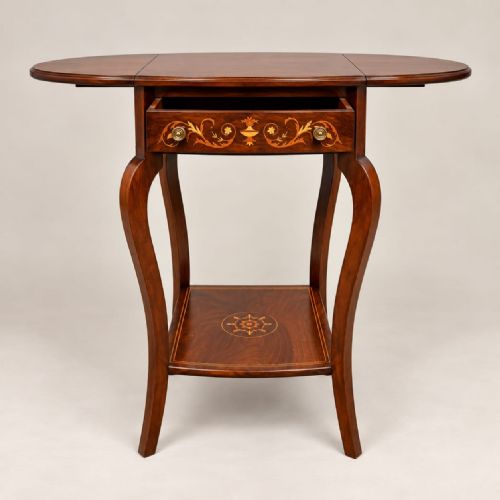


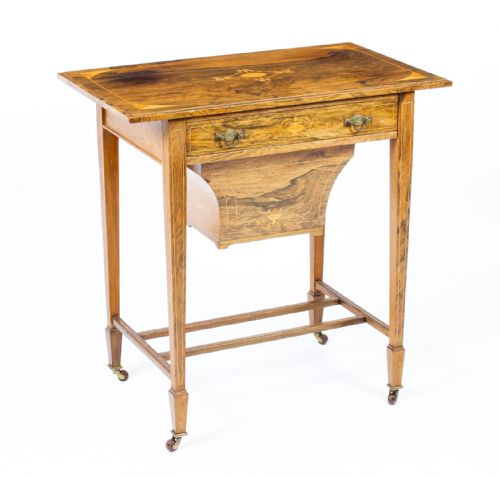


Edwardian Inlaid Sewing Table
An edwardian inlaid sewing table brings refined domestic utility into a room, combining crisp cabinetwork with delicate marquetry.
Edwardian Inlaid Sewing Table
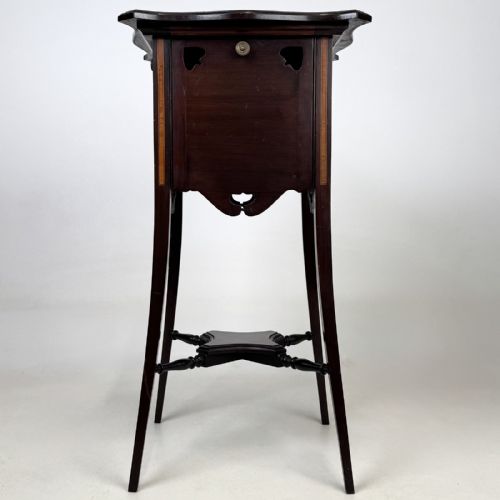
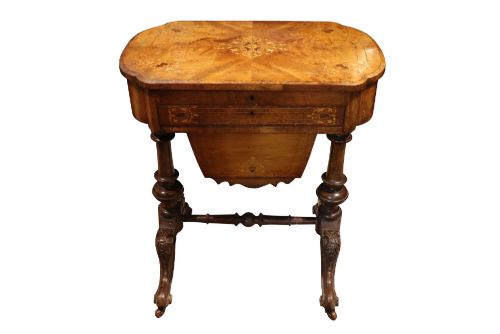
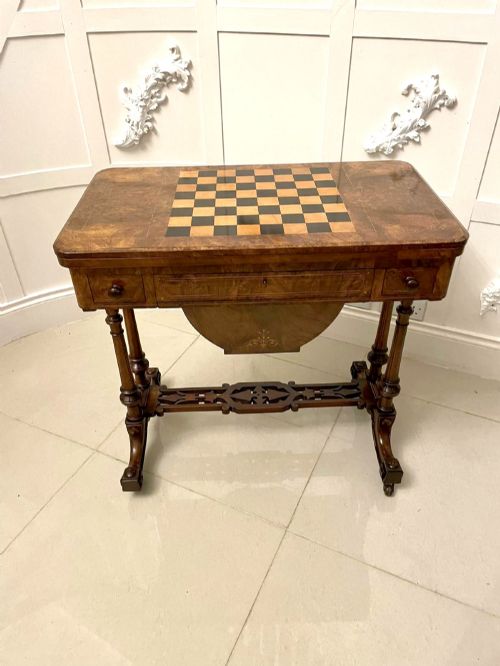
When you examine an edwardian inlaid sewing table, you are looking at a specialised piece of antique furniture designed for needlework, correspondence, and light domestic tasks. These pieces frequently feature fitted interior compartments and hanging silk baskets beneath a lift-up or drop-leaf top.
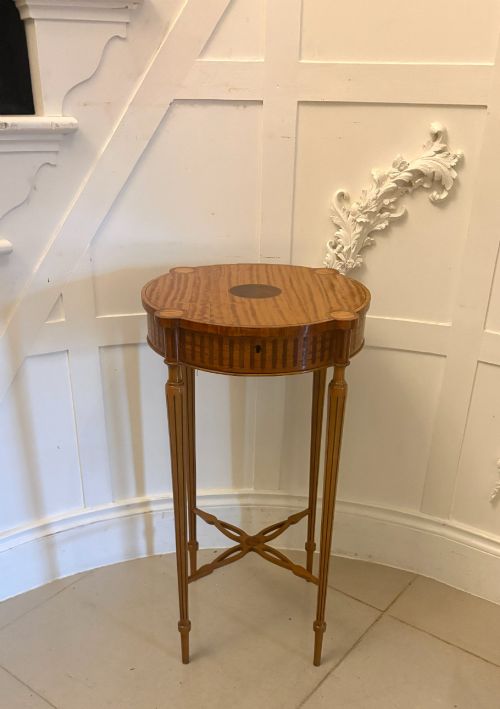
The pieces on this page span the Edwardian era and the late nineteenth century, with forms ranging from compact octagonal work tables to serpentine dropleaves and slender side tables. Many incorporate Sheraton Revival influences, utilising classical symmetry and delicate proportions suited to smaller reception spaces.
Originating predominantly from British workshops around the turn of the twentieth century, these tables reflect an era of sophisticated domestic craft. Alongside standard Edwardian examples, related nineteenth-century Victorian and Regency work tables appear, showing how the form evolved from earlier needlework stands.
Materials and Technique
Cabinetmakers constructed these tables using a solid timber frame faced with carefully selected veneers of mahogany, satinwood, rosewood, and burr walnut. Contrasting light timbers such as boxwood provided the linear stringing and geometric banding that define the inlaid surface decoration.
Marquetry techniques embellished the lids and friezes with floral swags, shells, and classical motifs, often incorporating hand-painted details or contrasting dark woods into the design. Brass hardware, including hinges, castors, and drop handles, secured the moving parts and enabled easy repositioning around the drawing room.
Edwardian Inlaid Sewing Table Retail Price Guide 2026
Typical asking prices for edwardian inlaid sewing table among the pieces listed under this phrase on Sellingantiques today, from the lower quarter to the upper quarter. They describe what is for sale here now, not the wider market.
Many of these tables hide miniature compartments intended for pins, wax, and bodkins, proving that polite Victorian and Edwardian needlework required an astonishing number of tiny tools.
Assessing Quality
The distinction between ordinary and superior examples rests upon the crispness of the cabinetwork and the precision of the timber matching. Finer tables display tightly fitted internal compartments for spools and pins, often retaining their original silk work bags and delicate brass locks.
Surface finish and the intricacy of the inlay separate standard production pieces from masterwork items. Sharp, well-defined marquetry and undamaged timber veneers indicate careful handling and superior original construction by skilled makers.
The Edwardian Inlaid Sewing Table Glossary
- Drop Leaf
- A table with hinged flaps on either side that can be raised to extend the surface area or lowered when space is limited. This design allowed sewing tables to occupy a minimal footprint against a wall.
- Marquetry
- Decorative veneer patterns applied to a furniture structure using thin pieces of wood, shell, or ivory to form pictorial or geometric designs. Craftsmen carefully cut and fitted these elements together before gluing them to the carcass.
- Sheraton Revival
- A late nineteenth-century design movement inspired by the neoclassical furniture of George III designer Thomas Sheraton. Pieces in this style typically feature light mahogany and satinwood construction with delicate floral inlay and tapered legs.
- Serpentine
- A furniture shape characterised by a gently curving front edge that undulates inward and outward in a continuous wave. This contour requires advanced woodworking skill to execute cleanly on drawer fronts and table tops.
- Poudreuse
- A multi-functional dressing and writing table featuring a mirror and lidded compartments beneath the top. These pieces share similar mechanical complexity with dedicated sewing and work tables.
Edwardian Inlaid Sewing Table: Frequently Asked Questions
What is an edwardian inlaid sewing table used for?
These tables served as functional furniture for ladies to store sewing materials, threads, and needlework projects while sitting in the drawing room. The fitted interiors kept small implements organised, while the top surface provided a stable area for writing or reading.
Today, they function well as versatile side or lamp tables in a modern living room. The hidden compartments and drawers remain practical for storing small household items out of sight.
How do I tell Edwardian pieces from Victorian ones?
Edwardian furniture dating from around 1901 to 1910 generally exhibits lighter timbers like satinwood and brighter mahogany, often with finer, more restrained inlay patterns. Victorian pieces from earlier in the nineteenth century tend to be heavier in proportion, frequently utilising dark rosewood or burr walnut with bolder marquetry.
Examining the internal construction and secondary woods underneath can also provide clues to the era of manufacture. Later pieces often show machine assistance in the cutting of joints, whereas mid-nineteenth-century examples rely more heavily on hand cutting.
Are the silk baskets usually original?
The hanging silk or fabric baskets beneath the work tables suffered from wear and deterioration over the decades of use. Consequently, many surviving tables have replacement fabric linings or reconstructed silk bags that match the historic style.
When a piece retains its original pleated silk basket, it adds considerable interest for a collector. However, modern textile replacements are common and do not detract from the utility of the table.
Can I use a work table as a desk?
Certain variations, particularly those catalogued as writing tables or bonheur du jour combinations, include pull-out surfaces or flat tops suitable for occasional correspondence. Standard sewing tables usually feature a smaller surface area designed primarily for needlework rather than heavy writing.
The interior depth and leg clearance underneath should be checked before using the piece for seating work. Many are proportioned for sitting alongside an armchair rather than pulling up an office chair.