
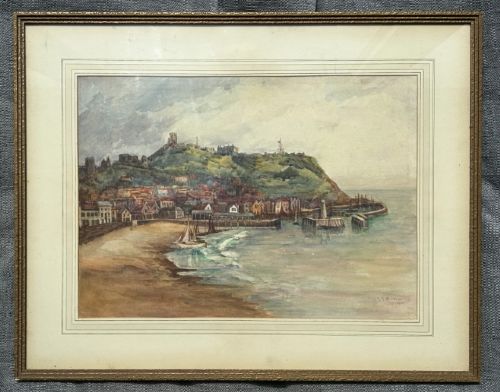


Edwardian Harbour Landscape
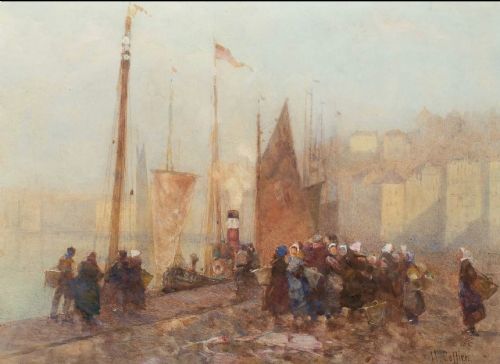
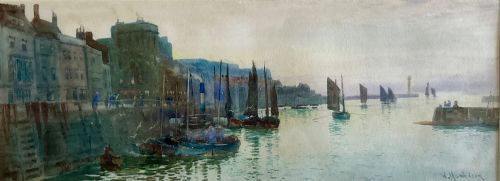
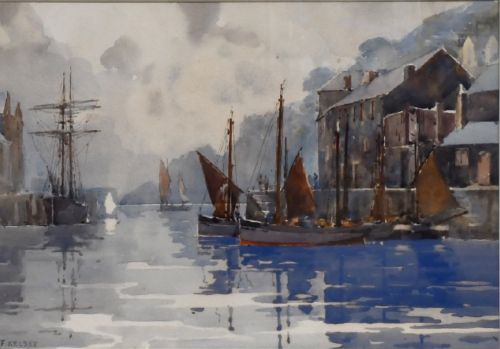
An edwardian harbour landscape captures bustling fishing docks and tidal shores through period watercolour and oil painting.
Edwardian Harbour Landscape
An edwardian harbour landscape depicts coastal basins, fishing fleets and historic Yorkshire or Cornish ports such as Whitby, St Ives and Polperro. Buyers will primarily find works on paper executed in watercolour pigment alongside oil paintings on canvas or board.
The selections span from the late nineteenth century through to the 1930s, embracing Edwardian realism and British impressionism. These depictions record historical working waterfronts, returning vessels and tidal river views across Britain and continental Europe.
Materials and Technique
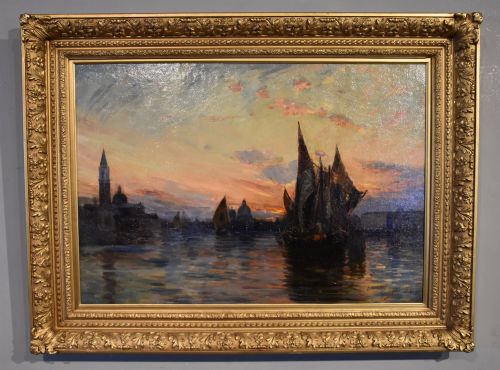
Artisans applied watercolour pigment onto paper to capture translucent coastal light and atmospheric dockyard haze. Other compositions utilise oil paint on canvas or board, laid into wooden frames often accented with gilt.
Brushwork varies from tight architectural rendering of abbey backgrounds and moorings to looser impressionistic washes depicting choppy seas and evening departures.
Several watercolours faithfully record boats waiting patiently outside busy Yorkshire harbours.
Determinants of Quality
Superior examples demonstrate confident brush handling that successfully conveys the movement of water and the dense atmosphere of smoke or mist over a busy pool. The finest sheets and canvases balance topographical detail with atmospheric depth.
The strength of the composition and the vibrancy of the pigment preservation distinguish exceptional works from routine topographical illustrations.
Hector Caffieri·William Matthison·Thomas Hodgson Liddell·Frank Kelsey·George F Pennington·Alfred George Morgan·Tom Clough·Stanley Leader·Fred Waugh·John Bell·James Webb·James Thomas Watts·Ernest F Hill·Frederick Stuart Richardson·Alfred Robert Quinton·Percy Brooke·William Lambert Bell·William Kay Blacklock·Frank W Scarborough·Harry Wanless·H Hadfield Cubley·Fred Mayor·Rowland Henry Hill·Owen Bowen·Walter Sweet
The Edwardian Harbour Landscape Glossary
- Watercolour pigment
- A finely ground colour substance suspended in a water-soluble binder, applied to paper to create translucent washes.
- Gilt wood
- Timber framing coated with a thin layer of gold leaf or metallic gilt, typical of framed paintings from this era.
- British Impressionism
- A painting style focusing on light and everyday subjects, prominent in British art around the turn of the twentieth century.
- Oil on canvas
- Pigment mixed with drying oils applied directly to stretched woven fabric, creating rich surface texture.
Edwardian Harbour Landscape: Frequently Asked Questions
What subjects appear in these coastal scenes?
These works frequently show fishing boats returning to port, bustling dock scenes, and historic abbeys overlooking coastal waters. Locations range from Yorkshire fishing ports and Cornish harbours to London river pools.
Artists also documented continental European waterways, capturing Venetian canals and French coastal towns during the early twentieth century.
How should I frame and display a watercolour?
Watercolours require mounting behind glass with a protective mat to keep the paper surface from touching the glazing. Position them away from direct sunlight to prevent fading of sensitive pigments.
Selecting a traditional wood frame preserves the historical character of works dating from the Edwardian period.
Are these works signed by the artists?
Many examples feature artist signatures or initials inscribed directly onto the lower corner of the painting or paper sheet. Signatures help attribute works to known painters active during the early twentieth century.
Unsigned paintings often rely on stylistic attribution and period framing to indicate their origin.
What differentiates watercolours from oil paintings?
Watercolours utilise translucent pigment on paper to create light, luminous effects well suited to atmospheric coastal weather. Oil paintings employ opaque pigments on canvas or board, offering heavier surface texture and richer colour depth.
Both mediums were widely used by British artists recording maritime life during the Edwardian era.