
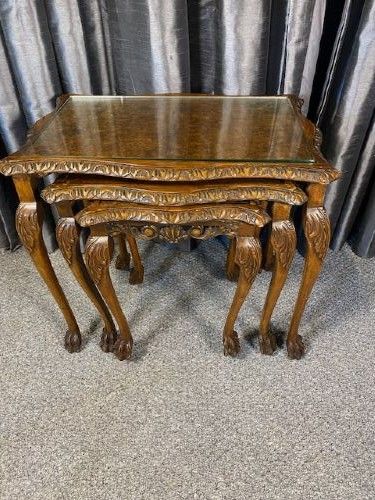


Edwardian Carved Nest Tables
Edwardian carved nest tables are versatile multi-tier occasional surfaces designed to save space, offering clever tiered utility for period drawing rooms.
Edwardian Carved Nest Tables
Edwardian carved nest tables comprise graduating sets of occasional surfaces that slide neatly beneath one another when not in use. You are most likely to meet mahogany examples from the Edwardian era and late Victorian period, often featuring inlaid satinwood or modest carved detailing.
The form spans sets of three or four tables, including quartetto formats and occasional pieces derived from Chinese designs. While the core of the evidence sits firmly in the Edwardian period, related pieces stretch from the nineteenth century into nineteen-twenty outputs in oak and teak.
How they were made
Cabinetmakers constructed these nests primarily from solid hardwoods such as mahogany, oak, and teak, frequently incorporating contrasting satinwood inlay and burr walnut veneers. Individual tables were dimensioned precisely so each smaller frame glides smoothly into the rebate or clearance space of the one above.
Carving and ebonising techniques varied by workshop, utilising hand-carved borders and turned supports alongside delicate stringing. These methods balanced structural stability in the larger primary table with lightness in the smallest sliding tiers.
Listings feature Edwardian, Victorian, and nineteen-twenty periods alongside nineteenth-century pieces in mahogany, oak, teak, and ebonised wood.
What varies in quality
Quality rests in the precision of the joinery and the selection of timber figures, where tight mahogany grains and crisp satinwood inlay elevate a set far above plain utility versions. Superior examples maintain structural rigidity across all four tiers without loose joints or sagging frames.
The finesse of the carving and the depth of the polish distinguish finer workshop output from simpler commercial sets. Balance and proportion remain paramount, ensuring the smallest table sits flush and secure.
The Edwardian Carved Nest Tables Glossary
- Quartetto
- A matched set of four graduating tables designed to nest together. This traditional term frequently appears in nineteenth-century and Edwardian cabinet maker records.
- Satinwood inlay
- A decorative technique using contrasting pale timber veneer inserted into recesses in the primary wood. It provides crisp geometric borders and floral motifs on table tops.
- Ebonised wood
- Timber treated with chemical stains or dark finishes to imitate costly ebony. This dark surface creates stark visual contrast against lighter woods and inlay.
- Nest of tables
- A group of multi-tier occasional surfaces sharing a unified design style. They stack sequentially to occupy the floor space of a single table.
Edwardian Carved Nest Tables: Frequently Asked Questions
What is a quartetto nest of tables?
A quartetto nest consists of four graduating tables designed to slide together into a single footprint. The term denotes a specific set of four rather than three.
Cabinetmakers built these for drawing rooms where space was at a premium during social gatherings. Each smaller table fits precisely beneath the next larger frame.
How do I date an Edwardian nest?
Dating relies on timber selection, construction methods, and characteristic inlay patterns associated with the early twentieth century. Edwardian pieces often combine mahogany with delicate satinwood stringing.
Earlier Victorian precursors tend to feature heavier frames and deeper polish tones. Later production stretching into nineteen-twenty often adopts simpler oak or teak constructions.
Were these tables used for tea?
These graduating surfaces served as versatile occasional tables for serving tea, holding books, or displaying ornaments. Multiple tiers allowed hosts to deploy extra surfaces instantly.
When tea was finished, the smaller tables returned to their stacked position beneath the main top. This made them essential furniture for compact Victorian and Edwardian reception rooms.
Why do some sets have four tables?
Sets of four tables, known as quartetto sets, offered maximum surface area expansion while maintaining a minimal storage footprint. Each table scaled down proportionately.
Sets of three were also common, often built with oval or rectangular tops. The choice of three or four tiers depended on the maker's design and intended domestic use.