

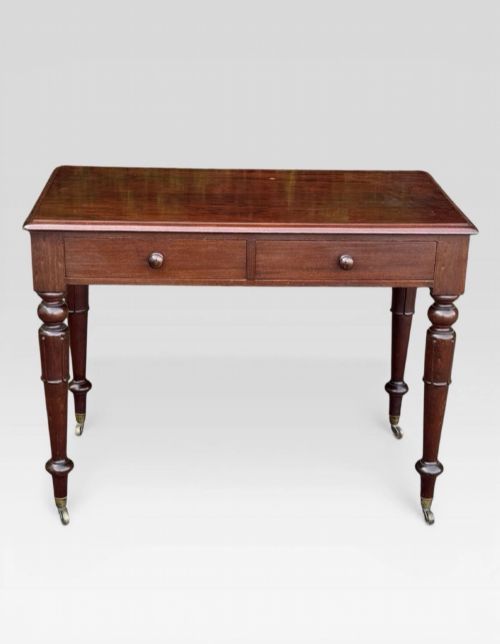


Edinburgh Mahogany Table
An edinburgh mahogany table brings Scottish cabinet-making tradition into a room through rich timber and disciplined proportions.
Edinburgh Mahogany Table
When searching for an edinburgh mahogany table, you encounter pieces spanning the Georgian, Regency, and Victorian periods, alongside later twentieth-century interpretations. The selection includes dining tables, card tables, tea tables, side tables, and sofa tables originating from Scottish workshops.
The most common formats on this page are dining tables, tea tables, and side tables, reflecting the domestic needs of nineteenth-century Edinburgh households. These forms range from simpler utilitarian designs to sophisticated inlaid pieces made for formal reception rooms.
Regional cabinet-makers often utilised local design vocabularies that distinguished their output from London equivalents, particularly through specific leg formations, timber selection, and structural joinery. Many items demonstrate the distinct influence of notable Edinburgh makers who shaped the Scottish furniture trade.
What varies in quality
The quality of an edinburgh mahogany table depends heavily on the selection of timber veneers and the precision of the underlying cabinet work. Superior examples exhibit carefully matched grain patterns across primary surfaces and well-executed structural joints that endure decades of use.
Proportion and decorative restraint separate standard production items from workshop pieces bearing attribution to prominent Edinburgh cabinet-makers. Finer pieces display crisp edge moulding, harmonious proportions, and integrated hardware that complement the overall design.
Edinburgh Mahogany Table Retail Price Guide 2026
Typical asking prices for edinburgh mahogany table among the pieces listed under this phrase on Sellingantiques today, from the lower quarter to the upper quarter. They describe what is for sale here now, not the wider market.
One remarkably honest desk arrived with an ink stain so perfectly circular it looks painted by hand.
Bruce & Burns of Edinburgh·J A Mein Edinburgh·John Taylor Edinburgh·Bryson Edinburgh·Whytock & Reid of Edinburgh·William Trotter of Edinburgh
The Edinburgh Mahogany Table Glossary
- Card table
- A folding table designed for gaming, typically featuring a baize-lined interior surface and a swivelling or gate-leg support structure.
- Sofa table
- A rectangular occasional table designed to sit in front of or beside a sofa, usually equipped with two small drop leaves and end-support trestles.
- Tea table
- A small domestic table intended for serving tea, often designed with a hinged top or raised gallery rim to secure porcelain vessels.
- Lacewood
- A timber known for its distinctive patterned grain, frequently used for decorative banding and contrasting borders on Regency furniture.
- Inlay
- A decorative technique where pieces of contrasting wood or metal are inserted into recesses cut into the primary timber surface.
Edinburgh Mahogany Table: Frequently Asked Questions
How do I identify a Scottish table?
Look for distinct regional proportions, characteristic timber choices, and structural joinery typical of Edinburgh cabinet-making workshops.
Attributions often rely on documentary evidence, branded signatures, or stylistic similarities to known pieces by makers like William Trotter or John Taylor.
What periods do these tables cover?
The inventory spans the eighteenth and nineteenth centuries, with Georgian, Regency, and Victorian periods represented alongside early twentieth-century works.
Earlier examples from the George III era tend to feature solid timber construction, while later Victorian pieces frequently employ sophisticated veneering techniques.
How were tea and card tables used?
Tea tables provided a stable surface for serving tea during domestic gatherings, often featuring folding tops that doubled their display area.
Card tables served a social function in evening entertainment, opening up to reveal a felt-lined playing surface for games like whist.
How do I care for mahogany timber?
Maintain stable indoor humidity levels and protect the surface from direct sunlight to prevent the mahogany timber from drying out or fading.
Apply traditional wax polish occasionally to nourish the grain and preserve the historic patina without sealing the wood.