
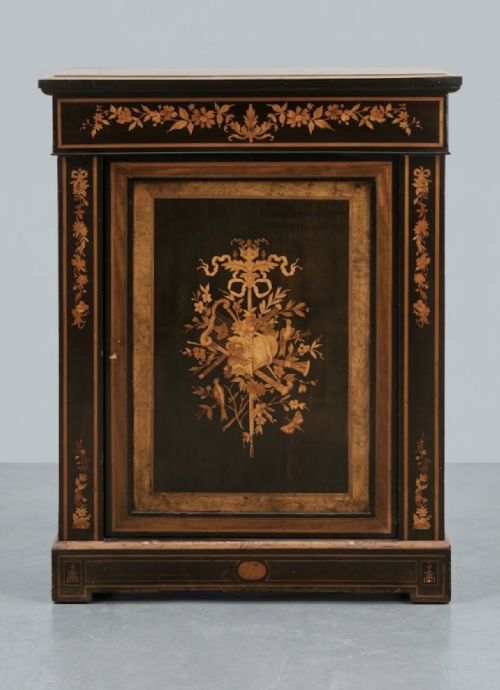
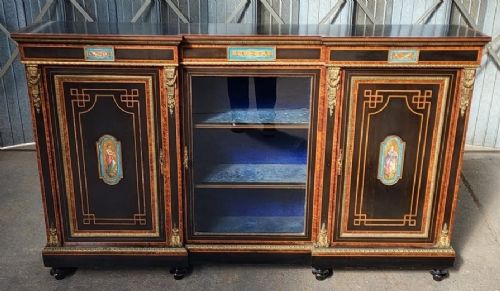
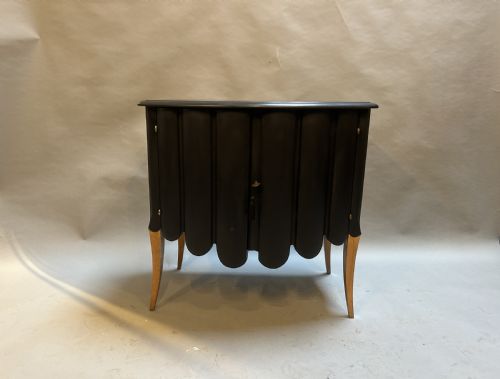


Ebonised Wooden Side Cabinet
An ebonised wooden side cabinet brings dark, polished contrast and subtle marquetry to a room.
Ebonised Wooden Side Cabinet
An ebonised wooden side cabinet is a substantial storage piece finished to resemble ebony, appearing frequently in Victorian designs and nineteenth century forms. These cabinets range from three door credenzas to smaller inlaid bookcases and sideboards.
The materials and styles span Victorian Aesthetic Movement, Napoleon III, and Art Deco periods, showing how cabinet makers adapted the dark finish across different decades. Buyers encounter variations with glass doors, brass mounts, and inlaid fruitwood details.
How they were made
The dark finish is achieved by staining or painting timber to imitate solid ebony, often applied to fruitwood, walnut, or mixed hardwoods. Craftsmen then polished the surfaces to a deep, reflective sheen.
Many examples incorporate contrasting decorative elements such as fruitwood inlay, brass mounts, or ormolu details. Certain pieces also feature glass panels, glazed doors, or inset marble tops.
Listings feature nineteenth century and Victorian pieces alongside Art Deco examples.
What varies in quality
Quality rests on the depth of the ebonised finish and the precision of the underlying woodwork. Finer pieces display crisp fruitwood inlay and well-fitted doors rather than flat, uniform paint.
The integration of metal mounts, such as brass or ormolu, distinguishes standard production from exhibition quality work. Better cabinets maintain integrity in their joinery and retain polished, substantial hardware.
The Ebonised Wooden Side Cabinet Glossary
- Ebonised
- Wood treated with stain or paint to imitate ebony. This dark finish was popular in nineteenth century cabinet making.
- Ormolu
- Gilt bronze mounted on furniture as decorative trim. It appears on Napoleon III and Victorian pieces.
- Credenza
- A low dining room cabinet or sideboard used for display and storage. Victorian versions often feature three doors and glass panels.
- Marquetry
- Decorative patterns formed by inserting pieces of wood veneer into a structure. Fruitwood inlay is a common form of this work.
- Breakfront
- A piece of furniture whose central section projects forward from the sides. This architectural form creates depth in larger credenzas.
Ebonised Wooden Side Cabinet: Frequently Asked Questions
What is an ebonised cabinet?
An ebonised cabinet is a wooden storage piece finished with a dark stain or paint to replicate solid ebony wood. This treatment gives the furniture a sleek, dark appearance that contrasts with lighter interiors.
Cabinet makers used this technique extensively during the nineteenth century on pieces like sideboards, credenzas, and bookcases.
How do I date an ebonised cabinet?
Dating relies on examining the construction methods, the wood types underneath the finish, and the stylistic details. Victorian and nineteenth century pieces often feature specific hardware, joinery, and decorative motifs like fruitwood inlay.
Art Deco examples from later decades show distinct geometric forms and simpler lines compared to ornate Victorian designs.
Where were these cabinets used?
These cabinets served primarily in reception rooms, dining rooms, and drawing rooms as practical storage and display surfaces. Their enclosed cupboards held china, glassware, or documents.
Open shelf versions and bookcases provided accessible space for displaying decorative objects and bound volumes.
How do I care for ebonised wood?
Ebonised wood requires gentle cleaning with a soft, dry cloth to remove dust without scratching the dark polished surface. Avoid harsh chemical cleaners and excessive moisture which can damage the finish.
Keeping the furniture away from direct sunlight preserves the depth of the dark stain over time.